search-icon
Whales, Whales, Whales

Traveling from dive spot to dive spot in Tonga it’s not difficult to find a misty cloud of water near the surface. We have arrived during Megaptera novaeangliae, humpback whale season. Why are there humpback whales near Tonga this time of year?
Dive-Vavau-8-300x200

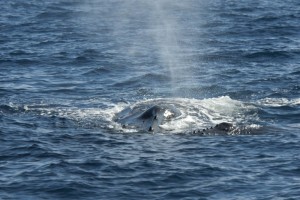
As humpback whales exhale, they can be observed at the surface of the water.

Humpback whales are found throughout all of the ocean basins. They seasonally migrate thousands of miles from high latitudes (poles) to lower latitudes in the subtropics and tropics. During the winter months, humpback whales migrate from the cold waters near the poles where they are feeding to the warm waters of the subtropics and tropics. They return again to these higher latitudes during the summer months when it’s warmer. Since seasons are opposite across in the northern and southern hemispheres, these two populations of whales are not thought to interbreed.
Humpback-Whale-Megaptera-novaeangliae-300x199

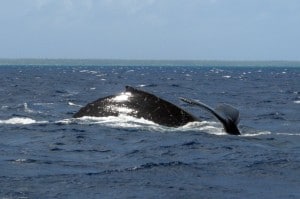
Two humpback whales diving.

Northern hemisphere humpbacks are typically present in the lower latitudes from late November to May. In the southern hemisphere, humpbacks are present in lower latitudes from about mid-July to mid-October.

Why make this immense journey? One of the reasons that these whales are traveling so far away is to go to their calving and breeding grounds. Pregnant females give birth to their calves in warmer waters because they would not survive the harsh winter months of the poles. Initially when calves are born, they do not have an insulating blubber layer making them vulnerable to colder temperatures.
Karen-Stone-300x201

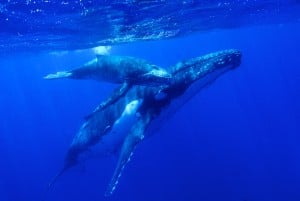
Mother and baby humpback whale photographed in Vava’u.

Also in their wintering grounds, humpback whales mate. Males display courtship rituals to attract females or to establish dominance over other males. Pregnant females have a gestation period around 11.5 months. Continuing the migration cycle, females will return to their breeding grounds almost one year later to give birth to their calves.
Baby-Humpback-Whale-breach-300x223

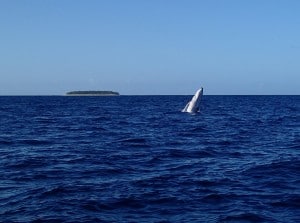
Baby humpback whale breaching.

Keep following our blogs to learn more about humpback whales.

Photos: 1,3 Karen Stone; 2 Ken Marks; 4 Rob Gardiner

Related Posts

From Sea to Soul – Rastafari Indigenous Village

As the sun dipped toward the horizon, we transitioned from the sea to the soul with a visit to the Rastafari Indigenous Village near Montego Bay. There, we were warmly welcomed into a community deeply rooted in spirituality, nature, and cultural resilience.
This meaningful relationship with Firstman, one of the Village’s original founders and a UN-recognized expert in cultural heritage and diversity, began over a decade ago through Emilie McGlone, Director of Peace Boat US. Her long-standing connection helped establish the foundation for this immersive experience, transforming the visit into a reconnection with trusted partners and friends…

Read More

Diving into Discovery Bay 

The Peace Boat US Youth for SDGs cohort embarked on an immersive learning journey in Jamaica. As a guest educator for the Peace Boat with local knowledge, I had the honor of introducing 13 passionate youth to the country and facilitating an unforgettable day exploring marine science and cultural heritage.

During our one-hour drive to the lab, I led an interactive discussion about the history of Jamaica, starting with the original inhabitants of the island, the Taino (a subgroup of the Arawak), and proceeding through the Spanish takeover, British colonization, and the transition from African slavery to East Indian laborers. This led us to a conversation about Jamaica’s national heroes, as well as other notable cultural influencers, such as Bob Marley. I also pointed out various places of interest as we passed them, helping to ground the students in both the geography and the cultural context of the island…

Read More
Privacy Overview

This website uses cookies so that we can provide you with the best user experience possible. Cookie information is stored in your browser and performs functions such as recognising you when you return to our website and helping our team to understand which sections of the website you find most interesting and useful.  You can view our complete Privacy Policy here.

Strictly Necessary Cookies

Most of our cookies are used to improve website security and reduce spam. These cookies should be enabled at all times. They also enable us to save your preferences for cookie settings.

3rd Party Cookies

This website uses Google Analytics to collect anonymous information such as the number of visitors to the site, and the most popular pages. Keeping this cookie enabled helps us to improve our website.