One of the most exciting aspects of this expedition is that every morning we get in the water having no idea what we’re about to find. There’s always something interesting to see, but sometimes the reefs we find are a little on the bland side. What we saw on today’s second dive, chosen almost at random from the several large dark spots we could see around the lagoon, was something to travel for.
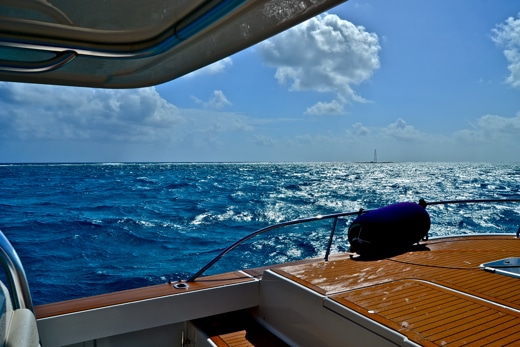
A view of Bajo Nuevo light and the lagoon from the Calcutta.
Often the only information we have, other than a very basic navigational chart, is some limited intel from the reef mapping team, who work mostly from the surface verifying and matching data in satellite photos with the reality in the water—this is known as groundtruthing. Several of the Colombians have also been here and they dove at numerous spots, but they were focused on sandy areas where they could study conch.
So usually, we head for a generally promising area, then chief scientist Andy Bruckner or coral reef ecologist Brian Beck jumps in with snorkel gear. If we get a thumbs up, then a boatload of divers start scrambling for gear and dropping over the sides.
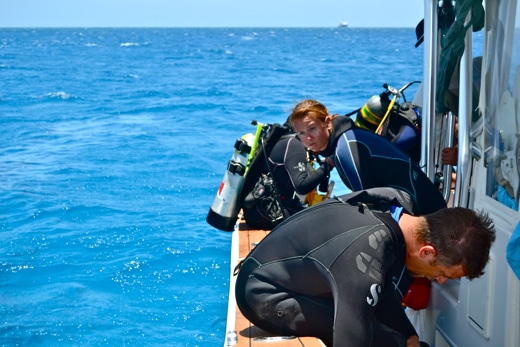
Alex Dempsey is getting ready to explore the lagoon, with the Golden Shadow in the background.
Today’s dive was a classic. We crossed a fine white sandy bottom to come to a large reef mound stretching up some 15 meters in front of us. There were star corals everywhere, along with brains, pillars, and the occasional stands of elkhorn and staghorn corals. Normally, I try to take a peak under every coral ledge to see if a big fish or lobster might be hiding there, but here at this unnamed, unknown reef, there were far too many crannies and passageways to check them all.
The coral folks have plenty to study, but, for them, the sites are a shade depressing because they are finding much more coral disease here. I’ll be getting into that in a later post.
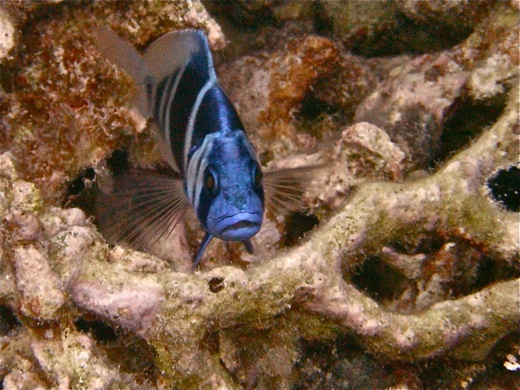
An indigo hamlet.
The fish folk, however, are positively giddy. Since arriving at Bajo Nuevo, Joyce Schulke and Dave Grenda have already spotted some 30 species they hadn’t yet seen on this trip. One, a sort of raccoon-faced fish known as a masked hamlet, Joyce had never seen before. They are found only in a few parts of the Caribbean. There have been 7 other hamlet species, along with gobies, blennies, and drums. Plus we’ve been seeing a nurse shark or two on most dives. Some in the group were treated to the sight of a hawksbill sea turtle making its way about. Wandering a bit afield of the others, I came around a coral corner to find a large midnight parrotfish that swam off into a school of chubs.
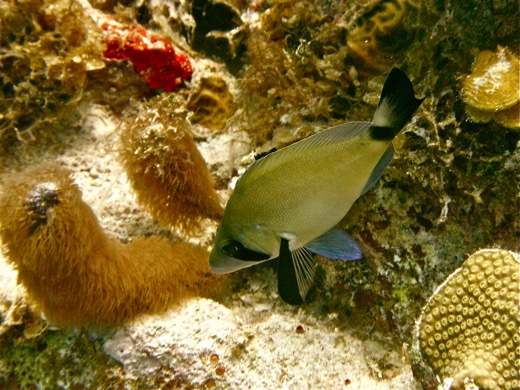
The masked hamlet.
We’ll have one more day at Bajo Nuevo. Then, late tomorrow night we’ll be running for the Serranilla Bank. The weather is still a little rough and promises to stay that way for a few more days. At Serranilla there are more islands for us to hide behind, so that should simplify operations. If all goes well, the conditions will be calming toward the end of the week and we’ll return to Bajo Nuevo to finish survey work here. But when you’re at sea it’s best to think of plans as written in pencil.
Photos/Images by: 1&2 Mark Schrope, 3&4 Alfredo Abril-Howard