Posts Tagged ‘The Nature Conservancy’

Surface Interval

Monday, March 26th, 2012

March 25, 2012

The crew of the M/Y Golden Shadow is busy getting the ship ready to depart for the Global Reef Expedition’s next mission to Navassa Island, an uninhabited island between Jamaica and Haiti currently managed by the US Fish and Wildlife Service.
During the extended surface interval in Port Antonio, Jamaica, staff cataloged samples, reorganized the lab, and indexed the data for processing by various partners. The hiss from the dive locker means Dive Safety Officer Nick Cautin was busy filling tanks for tomorrow’s dives. The activity on-board never stops.

In addition to scientific research, education and outreach are important components of the Global Reef Expedition. The Living Oceans Foundation staff conducted two community-based workshops while in port. In the first workshop, the Foundation hosted 5 high school students from Port Antonio High School and 25 college students from the nearby College of Agriculture, Science, and Education (CASE). Eddie Gonzalez, LOF Director of Education, presented on the work of the Foundation and the importance of investigating the natural world. The students also observed a research vessel up close as they toured the Golden Shadow.

Students from Port Antonio High School and CASE discuss priority conservation areas in Jamaica.

Students from Port Antonio High School and CASE discuss priority conservation areas in Jamaica.

Read the rest of Surface Interval »

Mapping the Proposed Fish Sanctuary with the Starfish

Sunday, March 18th, 2012

March 16, 2012

Another long, three-dive day in the Calcutta, with more lionfish spearing and a sea turtle sighting. While almost everyone else was underwater, Steve Schill and his group—Sean Green, Junior Squire, and Azra Blythe-Mallet—were staying dry, although they were looking at the bottom in just as much detail. Based on the Twin Vee, Steve’s crew operates the brand-new Tritech Starfish 990f  sidescan sonar.

Sidescan sonar image, showing scanned areas to either side (brown) and unscanned area under the boat (black)

It looks like a little red plastic rocket, under 38 cm (15 in) long, but costs as much as a decent used car. This kind of sensor is often used by search and rescue teams for body recoveries, and also for surveys of wrecks, canals, lakes, ports and harbors—anywhere people want to know in detail what’s under water up to 35m (114 ft) deep.

Read the rest of Mapping the Proposed Fish Sanctuary with the Starfish »

Science Without Borders®

Friday, August 5th, 2011

August 4, 2011

Science Without Borders® is a critical component of the Khaled bin Sultan Living Oceans Foundation’s Global Reef Expedition.  The founder, His Royal Highness Prince Khaled bin Sultan of the Kingdom of Saudi Arabia, was inspired by the well-known organization, Doctors Without Borders, to develop an initiative that could provide support for international marine conservation, public outreach and scientific research programs.  By complementing the objectives of our Global Reef Expedition, Science Without Borders® increases the potential to advance ocean preservation, protection and restoration around the globe.

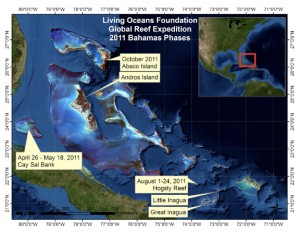
This year, three missions of the Global Reef Expedition are being carried out in the Bahamas.  The locations of these coral reef research projects include the Cay Sal Bank (held 26 April to 18 May, 2011), Great Inagua, Little Inagua and Hogsty Reef (in progress from 1 August to 24 August, 2011) and Abaco and Andros Islands (to be held in late September through mid-October, 2011).  The Science Without Borders® initiative is achieved for the Bahamas missions by means of collaboration with several Bahamian marine conservation organizations.  On the ship presently are four Bahamian scientific research divers, with two more joining the ship on the second half of the expedition.  These scientists represent various local organizations interested in contributing to the goals of the Global Reef Expedition while simultaneously achieving their own organization’s objectives.


2011 Bahamas Global Reef Expeditions with the Khaled bin Sultan Living Oceans Foundation

2011 Bahamas Global Reef Expeditions with the Khaled bin Sultan Living Oceans Foundation


Indira Brown is onboard to contribute her fish identification skills to the REEF (Reef Environmental Education Foundation) fish surveys that will be used on this expedition to assess fish diversity and abundance.  Indira comes to the expedition from the Bahamas Department of Marine Resources.  She will perform roving dive surveys to gain a comprehensive assessment of fish biodiversity around the Inaguas and Hogsty Reef.

Lindy Knowles will also be surveying fish at our study sites to contribute to the expedition’s evaluation of reef fish populations.  Lindy is an Assistant Parks Planner with the Bahamas National Trust in the Parks & Science Division.

On the team to contribute to the benthic (sea floor) and coral coverage studies is Agnessa Lundy, a scientific diver from The Nature Conservancy’s Bahamas Office.  Agnessa will help to identify and record the different species of algae, coral and other marine invertebrates we encounter.

Rounding out the Bahamian team on the present Global Reef Expedition is Krista Sherman.  Krista has a master’s degree in Marine Science and currently works for the Bahamas National Trust.  Krista’s marine invertebrate identification skills will be utilized in the expedition’s benthic and coral coverage research.


From Left to Right: Inidira Brown, Bahamas Dept. of Marine Resources; Krista Sherman, Bahamas National Trust; Angnessa Lundy, The Nature Conservancy Bahamas Office; Lindy Knowles, Bahamas National Trust

From Left to Right: Inidira Brown, Bahamas Dept. of Marine Resources; Krista Sherman, Bahamas National Trust; Agnessa Lundy, The Nature Conservancy Bahamas Office; Lindy Knowles, Bahamas National Trust


Tavares Thompson (a park warden on Andros Island for the Bahamas National Trust) and Alannah Vellacott (a biology major at the College of Bahamas) will join the second half of the expedition to conduct REEF and AGRRA fish surveys.

Thanks to Science Without Borders®, the research conducted in the Bahamas during the Global Reef Expedition will assist and support the Bahamian government’s decision-making process in determining the best courses of action to sustainably manage their valuable coral reef resources.


Written by Kit van Wagner

(Photo and Map by: Amanda Williams)

To follow along and see more photos, please visit us on Facebook! You can also follow the expedition on our Global Reef Expedition page, where there is more information about our research and our team members.


Our First Find of Staghorn Coral!

Tuesday, June 7th, 2011
June 6, 2011

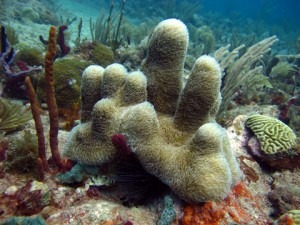
Our research team headed south for today’s dives, surveying two reefs off the southwestern end of Nevis and one off the northwestern end.  The first site, Caverns, was a raised terrace with large volcanic boulders at its margin and a prominent undercut ledge that dropped into a gently sloping sand patch.    Most corals were small, but unusually diverse and in excellent health.  There were many pillar corals (Dendrogyra cylindrus), including flattened juvenile colonies that lacked upward spires.  This coral is unusual, in that it has long tentacles that are extended in the day.

Pillar coral (Dendrogyra cylindrus)

Pillar coral (Dendrogyra cylindrus)


Another unusual species, the spiny flower coral (Mussa angulosa) has large fleshy polyps, spiky skeletal structures (septa) and is brightly colored shades of green and fluorescent red.

Large colony of spiny flower coral (Mussa angulosa)

Large colony of spiny flower coral (Mussa angulosa)

Read the rest of Our First Find of Staghorn Coral! »

Think Globally, Act Locally

Friday, June 3rd, 2011

June 2, 2011

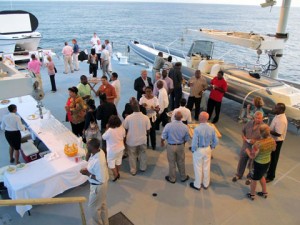
As part of the Living Oceans Foundation’s efforts to inform local stakeholders on the importance of their coral reefs and the benefits of the proposed marine zoning strategy in conserving these resources, our St. Kitts & Nevis program includes a strong education and outreach component. Today, we hosted a press conference aboard the M/Y Golden Shadow, alongside Ruth Blyther and Nancy Graff from The Nature Conservancy (TNC) U.S. Virgin Islands Office, and the Director of the St. Kitts & Nevis Department of Maritime Affairs, Mr. McClean Hobson. Representatives from The Leeward Times and Independent Link newspapers and CHOICE FM Radio and WINN FM 98.9 participated in the round-table interviews.

Press conference held aboard the M/Y Golden Shadow

Press conference held aboard the M/Y Golden Shadow

Read the rest of Think Globally, Act Locally »

Welcome to St. Kitts and Nevis

Tuesday, May 31st, 2011

June 1, 2011

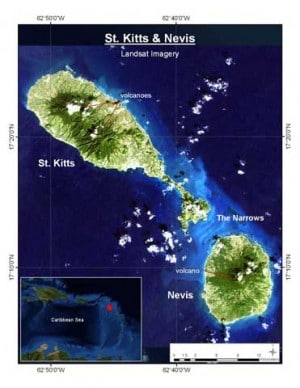
Today we are embarking on the second leg of the Global Reef Expedition. Destination: the Federation of St. Kitts (AKA Saint Christopher) and Nevis.   The twin islands are part of the West Indies, in the eastern Caribbean, roughly east of Antigua and Barbuda, north of Montserrat and south Saba. Together, having  a total landmass of just 262 km2, St. Kitts is slightly larger (168 km2) than Nevis (94 km2).  St. Kitts and Nevis are located about 2 miles apart, separated by a shallow channel called the Narrows.  They are both volcanic islands; in essence, they are summits of a submerged mountain range which forms the eastern boundary of the Caribbean tectonic plate. These lush islands are known for their dense tropical rainforest, mountain streams and an inland lake, lava formations, white, sandy beaches, and a strong British influence. These islands were home to the first British and French colonies in the Caribbean, achieving full independence in 1983. The total population is about 50,000, with most people residing in St. Kitts (38,000).

Map of St. Kitts and Nevis

Map of St. Kitts and Nevis

Read the rest of Welcome to St. Kitts and Nevis »

GRE Website YouTUBE Channel Follow on Facebook Follow on Twitter RSS Feed Updates LOF Website

Search

Calendar

May 2013
M T W T F S S
« Apr    
 12345
6789101112
13141516171819
20212223242526
2728293031  

Archives