Posts Tagged ‘star coral’

Wandering Bajo Nuevo’s corals

Thursday, April 19th, 2012

April 17, 2012

Our afternoon dive today was more surreal than most. We were on the far side of Bajo Nuevo’s lagoon and instead of a large, defined reef mound, we were wandering through what looked like a field of monuments. They were coral pillars, some two or three meters high.
Coral pillar

Coral pillar at Bajo Nuevo

  Read the rest of Wandering Bajo Nuevo’s corals »

Lagoon Life

Tuesday, April 17th, 2012

April 16, 2012

One of the most exciting aspects of this expedition is that every morning we get in the water having no idea what we’re about to find. There’s always something interesting to see, but sometimes the reefs we find are a little on the bland side. But what we saw on today’s second dive, chosen almost at random from the several large dark spots we could see around the lagoon, was something to travel for.

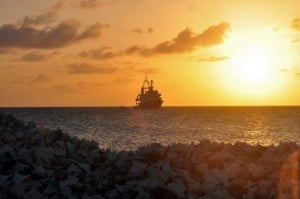
A view of Bajo Nuevo light and the lagoon from the Calcutta

A view of Bajo Nuevo light and the lagoon from the Calcutta

  Read the rest of Lagoon Life »

Mission’s End

Thursday, March 22nd, 2012

March 19-20, 2012

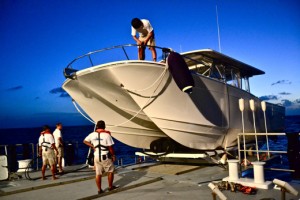
The first day of spring was the last day of diving for the Pedro Bank mission. Winston “Shucksman” Kerr, a local fisherman, guided us to two sites within sight of the Golden Shadow. No nurse sharks today, but lots of coral, and two reef sharks appeared on the second dive. Nathalie Zenny speared a lionfish, which Winston neatly trimmed of its spines on board the Calcutta.

Winston “Shucksman” Kerr carefully trims off lionfish spines

The afternoon was a flurry of activity. Nathalie, Llewellyn, Andy Bruckner and a few others went to Middle Cay for a community meeting to explain the mission of the Global Reef Expedition and the Living Oceans Foundation and discuss all things reef-related.

Read the rest of Mission’s End »

Shark Day

Monday, March 19th, 2012

March 17, 2012

St. Patrick’s Day saw the Calcutta leaving early for the far eastern end of Pedro Bank. The route took us across an area of deeper water and larger swells, so it took close to three hours of hard bouncing to cover the 41 km (25.5. mi) to Portland Rock, without a doubt one of the least inviting islets in the Caribbean. A nub of steep, sharp rock lashed by waves and covered with guano, it still had a few fisherman’s tents on top and a handful of fishing boats pulled up nearby.

Welcome to Portland Rock

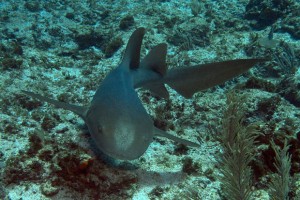
Unfortunately, even after asking these knowledgeable locals for advice, we weren’t able to find any spots with more than minimal coral cover, and the underwater visibility was low. Andy and Phil decided it would make better sense to backtrack another 30 minutes to tiny Blower Rock. The first dive was marked by huge colonies of star coral (Montastraea faveolata and M. annularis) up to 2.6 m (8.5 ft) across. We spotted our first nurse shark as soon as we entered the water, but Rachel soon got a closer look.

Read the rest of Shark Day »

Hogsty’s New Reef Recruits

Friday, August 12th, 2011

August 11, 2011

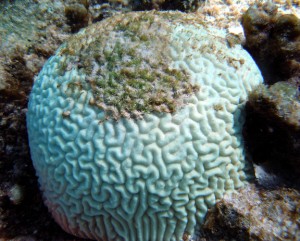
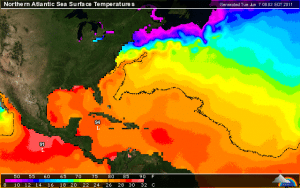
In 1997-1998, the marine equivalent of a massive and destructive forest fire overwhelmed numerous coral reefs around the world.  Caribbean coral biologists still speak of the bleaching event of 1998 in reverential tones.  A powerful El Niño season was a factor in generating extreme tropical sea surface temperatures.  As a consequence, over-stressed corals everywhere released their symbiotic algae known as zooxanthellae [zoh-zan-thel-ee].  This phenomenon is known as coral bleaching.

Millions of microscopic zooxanthellae play a critical role in a coral colony’s ability to both metabolize, and process waste.  The tiny algae also give corals their color.  When zooxanthellae are released into the water column, the remaining coral head appears as white as its underlying calcium carbonate skeleton.   A coral colony can survive for a limited time without zooxanthellae, as long as environmental conditions return to normal.  Slowly, new zooxanthellae will reappear in the coral tissues, and the corals, although susceptible to disease and algal overgrowth, having a fighting chance of recovery.  However, in 1998, conditions did not level out and an estimated 16% of the world’s corals died (Wilkinson 2000).  In some regions, the rate of mortality was probably much higher, and the relatively shallow western Caribbean  and Bahamas were likely hit especially hard.


A bleached brain coral becoming overgrown with algae.  Photo: NOAA

A bleached brain coral becoming overgrown with algae. Photo: NOAA


To understand our initial observations taken at eight study sites on Hogsty Reef, thirteen years after the 1998 massive bleaching event, let’s return now to the forest fire analogy.  Imagine large, healthy coral heads on a reef as the old growth trees of a forest.  When a raging fire burns through a forest, it destroys almost all of the young seedlings and saplings, leaving behind only a few of the strongest old-growth trees.  However, any remaining live trees are weakened and damaged by the fire and are susceptible to diseases and parasites.  The surviving trees are also responsible for reseeding the forest with the next generation of seedlings.


Read the rest of Hogsty’s New Reef Recruits »

Understanding Reef Resilience

Wednesday, June 8th, 2011
June 6, 2011

Afternoon Dive

A major component of our work during the Global Reef Expedition focuses on understanding factors and processes that enhance the resilience of coral reefs.  We evaluate a number of ecological, physical and chemical parameters at each reef we visit, which allows us to compare and rank reefs within a single location and across large spatial scales to come up with a coral reef health index.  We combine data on coral population structure, recruitment, health and disease, algal community assemblages, degree of herbivory, fish community structure and biomass, and other parameters we collect during our rapid assessments to determine how resilient a reef is.  We will then develop recommendations on actions that can be taken to either protect that resilience or enhance it in stressed locations.  

This approach is being taken by other researchers as well, but the parameters that are measured vary and the strategy to compare the resilience of reefs also varies.  What is your baseline for a healthy or resilient reef?  Is the best location in a particular country or region the highest ranked site and all others are ranked against this standard?  Is a reef that is considered in near-pristine state (which is difficult to find nowadays) the standard and all others are compared against this standard?  Is a reef that has changed significantly due to a widespread decline of one of the most important reef building corals (star corals), from which recovery to their former glory would require 100s of years (like many Caribbean reefs) still considered resilient if much of the structure is still present, assemblages of other species are intact, and there are high levels of recruitment, herbivory and other processes we consider essential for a properly functioning reef?  What is the reef resilient to? 

Most resilience assessments today are targeting one parameter in particular: coral reef bleaching.  Reef-building corals and other organisms have symbiotic relationships with single-celled photosynthetic algae (dinoflagellates), known as zooxanthellae (other similar symbionts occur in sponges and other organisms).  These organisms are vital to the health and proper functioning of a coral, providing food, removing metabolic waste products, aiding in calcification and a host of other functions. Bleaching is a phenomenon where the coral animal (polyp) becomes stressed and the zooxanthellae are expelled, or the zooxanthellae lose their photosynthetic pigments, and the coral becomes pale, or in extreme cases stark white, as if someone poured chlorine bleach on the coral. 

Various stages of bleaching in a mountainous star coral (Montastraea faveolata)

Various stages of bleaching in a mountainous star coral (Montastraea faveolata)

Read the rest of Understanding Reef Resilience »

GRE Website YouTUBE Channel Follow on Facebook Follow on Twitter RSS Feed Updates LOF Website

Search

Calendar

May 2013
M T W T F S S
« Apr    
 12345
6789101112
13141516171819
20212223242526
2728293031  

Archives