Posts Tagged ‘staghorn coral’

Hao Atoll at Eye Level

Sunday, January 20th, 2013

January 19, 2013

By Megan Berkle and Eddie Gonzalez

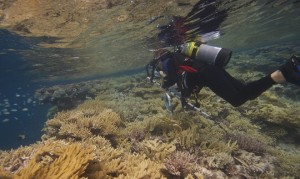
Research dives can be distilled down to lists of what is seen and what is not seen. Surveying the reef means figuring out what is there and what is missing. For the last few days, the science team has been jumping into a variety of sites inside the lagoon and outside the perimeter of Hao Atoll. As dive buddy teams enter the water, they scatter across the reef to deploy their instruments, gauges, transect lines, and quadrats with efficiency and purpose. It’s an amazing sight.

Divers descend to the reef to begin their surveys.

Divers descend to the reef to begin their surveys.

Clip boards and cameras record the species, size, distribution, abundance, and health of corals, sponges, fish, and invertebrates. By aggregating the observations, some early assessments are possible. For example, as in the other French Polynesia research sites, branching corals such as cauliflower coral (Pocillopora), table and staghorn corals (Acropora), thin crusts of corrugated leaf coral (Pavona), and fire coral (Millepora) are the more the common corals seen so far in Hao.

Dr. Andrew Bruckner, LOF Chief Scientist, scans the variety of coral.

LOF Chief Scientist, Dr. Andrew Bruckner, scans the variety of coral.

After each dive, the conversation on the dive boat quickly turns to the highlights. Fish ecologist, Badi Samaniego, caught a glimpse of the uncommon Chabanaud’s soapfish. On another dive, a giant manta ray (Manta alfredi) glided past the science team in the outer lagoon. Each dive reveals more about the underwater ecosystems at Hao Atoll.

A parrotfish, Chlorurus microrhinos, swims along the reef.

A parrotfish, Chlorurus microrhinos, swims along the reef.

(Photos by: 1 Brian Beck, 2 Joao Monteiro, and 3 Phil Renaud)

Mission’s End

Thursday, March 22nd, 2012

March 19-20, 2012

The first day of spring was the last day of diving for the Pedro Bank mission. Winston “Shucksman” Kerr, a local fisherman, guided us to two sites within sight of the Golden Shadow. No nurse sharks today, but lots of coral, and two reef sharks appeared on the second dive. Nathalie Zenny speared a lionfish, which Winston neatly trimmed of its spines on board the Calcutta.

Winston “Shucksman” Kerr carefully trims off lionfish spines

The afternoon was a flurry of activity. Nathalie, Llewellyn, Andy Bruckner and a few others went to Middle Cay for a community meeting to explain the mission of the Global Reef Expedition and the Living Oceans Foundation and discuss all things reef-related.

Read the rest of Mission’s End »

Regionally Rare, Locally Abundant

Friday, August 19th, 2011

August 18, 2011 

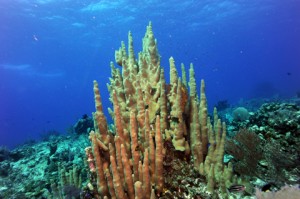
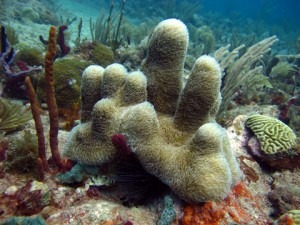
Throughout most of the Caribbean, there are species of coral that are common and easily spotted on a dive, and those that are rare and difficult to locate.   Experienced divers can usually characterize a reef fairly quickly based on the types of corals growing there.  Some common corals that are generally easy to find include star corals (Montastrea sp.), starlet corals (Siderastrea sp.) and brain corals (Diploria sp.).  On the other hand, pillar corals (Dendrogyra cylindrus) and staghorn corals (Acropora cervicornis) are generally quite rare.  The corals of Hogsty Reef and Great Inagua have so far not followed this formula.  Living Oceans Foundation researchers have seen an unusually high number of rare corals.  Specifically, pillar corals appear to be thriving on the reefs here and staghorn corals are demonstrating remarkable resilience.  

Pillar coral (Dendrogyra cylindrus) is not a rare find around the Inaguas

Pillar coral (Dendrogyra cylindrus) is not a rare find around the Inaguas

Read the rest of Regionally Rare, Locally Abundant »

Establishing Legacy Sites

Saturday, June 11th, 2011
June 9, 2011

As the Living Oceans Foundation circumnavigates the globe, one of our core activities is rapid assessments of the health and resilience of coral reefs.  Our assessments tell us about the diversity and population structure of corals and fishes, the types and amount of algae, and interactions among these species.  We can determine if a reef is stressed and why and, if it has been impacted by a past event, how likely it is to rebound.  One measure in particular we use is the age (size) distribution of the corals and how many small corals (recruits) that settled within the last 1-2 years.  The basic assumption, if there is good settlement and recruitment of new corals, is that there is a source population providing these corals to the reef, the habitat quality is good enough to promote settlement, and conditions allow for growth and survival of these corals.  As we explore reefs of St. Kitts and Nevis, it’s been a mixed bag. We found some sites with a lot of recruits and others with few. 

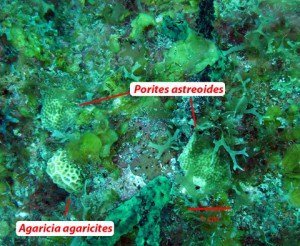
We look more closely at the species of recruits, the amount of algae and herbivory, and other measures to understand why there are differences between sites.  We know certain corals, known as brooders, tend to have very high levels of settlement.  Brooders are species that may reproduce multiple times in a year.  Fertilization is internal and the parents raise the young (brood) until they are much larger and competent (ready to settle), so that they will attach to the bottom, differentiate from a planula larvae into a coral polyp very quickly, and exhibit higher rates of early survival.  Brooders tend to be the dominant small corals you see on a reef, especially after a disturbance.  The two most common brooders are mustard hill coral (Porites astreoides) and lettuce coral (Agaricia agaricites).  In St. Kitts, Porites is by far the dominant coral in terms of numbers of colonies.  It has carpeted the bottom and colonized the skeletons of other corals that have died. Agaricia is less common, although some reefs have a lot of these corals. 

Porites and Agaricia coral recruits

Porites and Agaricia coral recruits

Read the rest of Establishing Legacy Sites »

Our First Find of Staghorn Coral!

Tuesday, June 7th, 2011
June 6, 2011

Our research team headed south for today’s dives, surveying two reefs off the southwestern end of Nevis and one off the northwestern end.  The first site, Caverns, was a raised terrace with large volcanic boulders at its margin and a prominent undercut ledge that dropped into a gently sloping sand patch.    Most corals were small, but unusually diverse and in excellent health.  There were many pillar corals (Dendrogyra cylindrus), including flattened juvenile colonies that lacked upward spires.  This coral is unusual, in that it has long tentacles that are extended in the day.

Pillar coral (Dendrogyra cylindrus)

Pillar coral (Dendrogyra cylindrus)


Another unusual species, the spiny flower coral (Mussa angulosa) has large fleshy polyps, spiky skeletal structures (septa) and is brightly colored shades of green and fluorescent red.

Large colony of spiny flower coral (Mussa angulosa)

Large colony of spiny flower coral (Mussa angulosa)

Read the rest of Our First Find of Staghorn Coral! »

GRE Website YouTUBE Channel Follow on Facebook Follow on Twitter RSS Feed Updates LOF Website

Search

Calendar

May 2013
M T W T F S S
« Apr    
 12345
6789101112
13141516171819
20212223242526
2728293031  

Archives