Posts Tagged ‘St. Kitts’

Thank You for Having Us, St. Kitts and Nevis!

Monday, June 13th, 2011

June 13, 2011

Today, most of the research scientists disembarked the M/Y Golden Shadow at the conclusion of a very successful research project in St. Kitts and Nevis.  As they walked down the pier, we welcomed 23 students and 4 chaperones from St. Kitts and Nevis who boarded the ship for an outreach day cruise.  The 14 students from St. Kitts attend the Clarence Fitzroy Bryant College and are studying various aspects of science in order to earn an Associate’s degree.  Some are studying medicine, some environmental science, and others are directly involved in marine science and are familiar with coral reef ecology.  The 9 youths from Nevis were representatives of the Nevis Tourism Youth Council (NTYC). The cruise began promptly at 10:30AM with departure from port. The students were able to view the action from the Bridge Deck. 

CAPT Steve Breen steers the ship away from port

CAPT Steve Breen steers the ship away from port

Read the rest of Thank You for Having Us, St. Kitts and Nevis! »

Best Wishes for Reef Fishes

Sunday, June 12th, 2011

June 12, 2011

Over the last ten days we were fortunate to have excellent weather and a hard working research team.  We completed surveys of representative reefs around both islands, hitting nearly every location we had planned.  Throughout this series of blogs, I mentioned a lot about the reef-builders, but have said little about reef fish and other megafauna.  We had a very talented team conducting quantitative belt transects to assess species abundance and size and local divers assessing species diversity.  We now have a detailed picture of the species diversity and population dynamics of reef-associated fishes. 

Like other locations in the Caribbean, we saw a lot of small reef fish, including large schools of chromis, bluehead wrasse, creole wrasses, hamlets, damselfishes, highhats and drums, soldierfish, and juveniles of many species.  However, there were few large fishes and certain species were completely absent.  Throughout the entire mission we did not see a single grouper and their close relatives, the hind and coney, were much smaller and less abundant than in most other locations. Snapper were notably absent. There was the occasional schoolmaster snapper, and a few other isolated individuals, but characteristic schools of schoolmaster snapper, large gray snapper, lane snapper, yellowtail snapper, mutton snapper and other species were rare or absent. Few pelagic predators were seen, other than a few small schools of horse eye jack and bar jack, and the isolated cero.

Butterflyfishes and angelfishes were present, but in very low numbers.  Only a few locations supported schools of grunts, and individual margates, hogfish and porkfish were seen only once or twice.  Queen triggerfish were also rare, but some exposed sites had large numbers of black durgon.

Few Queen triggerfish were found on the reef

Few Queen triggerfish were found on the reef

Read the rest of Best Wishes for Reef Fishes »

Establishing Legacy Sites

Saturday, June 11th, 2011
June 9, 2011

As the Living Oceans Foundation circumnavigates the globe, one of our core activities is rapid assessments of the health and resilience of coral reefs.  Our assessments tell us about the diversity and population structure of corals and fishes, the types and amount of algae, and interactions among these species.  We can determine if a reef is stressed and why and, if it has been impacted by a past event, how likely it is to rebound.  One measure in particular we use is the age (size) distribution of the corals and how many small corals (recruits) that settled within the last 1-2 years.  The basic assumption, if there is good settlement and recruitment of new corals, is that there is a source population providing these corals to the reef, the habitat quality is good enough to promote settlement, and conditions allow for growth and survival of these corals.  As we explore reefs of St. Kitts and Nevis, it’s been a mixed bag. We found some sites with a lot of recruits and others with few. 

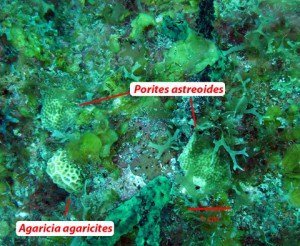
We look more closely at the species of recruits, the amount of algae and herbivory, and other measures to understand why there are differences between sites.  We know certain corals, known as brooders, tend to have very high levels of settlement.  Brooders are species that may reproduce multiple times in a year.  Fertilization is internal and the parents raise the young (brood) until they are much larger and competent (ready to settle), so that they will attach to the bottom, differentiate from a planula larvae into a coral polyp very quickly, and exhibit higher rates of early survival.  Brooders tend to be the dominant small corals you see on a reef, especially after a disturbance.  The two most common brooders are mustard hill coral (Porites astreoides) and lettuce coral (Agaricia agaricites).  In St. Kitts, Porites is by far the dominant coral in terms of numbers of colonies.  It has carpeted the bottom and colonized the skeletons of other corals that have died. Agaricia is less common, although some reefs have a lot of these corals. 

Porites and Agaricia coral recruits

Porites and Agaricia coral recruits

Read the rest of Establishing Legacy Sites »

Safety is Our Number One Priority

Friday, June 10th, 2011
June 8, 2011

While our daily dives may sound calm and cheery all of the time, foul weather and strong currents can make it a true challenge to even get off the Golden Shadow onto the dive boat and then into the water.  The morning of June 5th, we had to take extra precautions at the surface and use the anchor line to descend.  The current was so strong that, when taking a giant-stride off the front of the dive boat, a few of the divers were nearly swept underneath the boat.  A few divers even lost their data sheets and transect lines.  If the diver has not panicked by this situation at the surface and has control of their equipment and has maintained buddy contact, the best action is to descend immediately in order to avoid surface currents.  This dive, however, had currents all the way to the bottom.  Upon descent, a few divers were unable to catch their breath and, at times, it can feel like your heart is pounding out of your chest when you’re at depth and out of breath.  In these cases, we always reinforce with divers to use their best judgment and abort the dive, if necessary.  One third of the survey team was unable to conduct the research dive due to the strength of the currents at this site.  We also experienced strong currents on June 6th, and divers took better precautions when entering the water, giving each other plenty of space on the descent line.  There was no chop at the surface, but the current was ripping throughout the entire dive.  The survey team had a difficult time spreading out through the dive to complete their surveys, but many were able to find sheltered spots to survey in order to catch their breath.  On these kinds of dives, there are usually less data collected due to a decreased bottom time from heavy breathing and excess exertion during the dive.

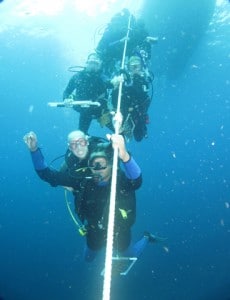
Divers conducting a ~5m/15ft safety stop on the anchor line

Divers conducting a ~5m/15ft safety stop on the anchor line


Read the rest of Safety is Our Number One Priority »

The Changing Face of Caribbean Reefs

Thursday, June 9th, 2011
June 7, 2011

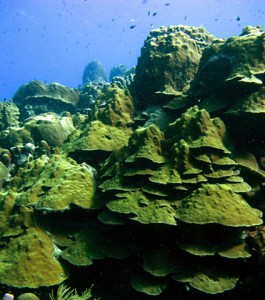
Our morning dive at Sandy Point was like travelling through time, with glimpses of the past and a foreshadowing of future directions of reef growth visible simultaneously.  Built on a foundation of 200-500 year old corals, many over 5 m in diameter and 7-8 meters tall, the reef consisted predominantly of star coral colonies (Montastraea faveolata) that were completely live back in 1990.  These corals grew together like a chain of mountains, extending from depths of 25m to 10-12 m below the water’s surface. 

Mountainous star coral (Montastraea faveolata) once looked like this. (Photo taken in Bonaire, July 2010)

Mountainous star coral (Montastraea faveolata) once looked like this. (Photo taken in Bonaire, July 2010)


The shape of many of these corals was similar to a child’s drawing of a Christmas tree – each colony having a sharply pointed peak, with a series of overlapping shingles layered down the sides.  Other corals were reminiscent of the moguls on an expert ski slope in Colorado, although they were colored golden brown, green and dark brown instead of white. 

Live mountainous star coral (Montastraea faveolata) shingles (bar = 1 m)

Live mountainous star coral (Montastraea faveolata) shingles (bar = 1 m)

Read the rest of The Changing Face of Caribbean Reefs »

Understanding Reef Resilience

Wednesday, June 8th, 2011
June 6, 2011

Afternoon Dive

A major component of our work during the Global Reef Expedition focuses on understanding factors and processes that enhance the resilience of coral reefs.  We evaluate a number of ecological, physical and chemical parameters at each reef we visit, which allows us to compare and rank reefs within a single location and across large spatial scales to come up with a coral reef health index.  We combine data on coral population structure, recruitment, health and disease, algal community assemblages, degree of herbivory, fish community structure and biomass, and other parameters we collect during our rapid assessments to determine how resilient a reef is.  We will then develop recommendations on actions that can be taken to either protect that resilience or enhance it in stressed locations.  

This approach is being taken by other researchers as well, but the parameters that are measured vary and the strategy to compare the resilience of reefs also varies.  What is your baseline for a healthy or resilient reef?  Is the best location in a particular country or region the highest ranked site and all others are ranked against this standard?  Is a reef that is considered in near-pristine state (which is difficult to find nowadays) the standard and all others are compared against this standard?  Is a reef that has changed significantly due to a widespread decline of one of the most important reef building corals (star corals), from which recovery to their former glory would require 100s of years (like many Caribbean reefs) still considered resilient if much of the structure is still present, assemblages of other species are intact, and there are high levels of recruitment, herbivory and other processes we consider essential for a properly functioning reef?  What is the reef resilient to? 

Most resilience assessments today are targeting one parameter in particular: coral reef bleaching.  Reef-building corals and other organisms have symbiotic relationships with single-celled photosynthetic algae (dinoflagellates), known as zooxanthellae (other similar symbionts occur in sponges and other organisms).  These organisms are vital to the health and proper functioning of a coral, providing food, removing metabolic waste products, aiding in calcification and a host of other functions. Bleaching is a phenomenon where the coral animal (polyp) becomes stressed and the zooxanthellae are expelled, or the zooxanthellae lose their photosynthetic pigments, and the coral becomes pale, or in extreme cases stark white, as if someone poured chlorine bleach on the coral. 

Various stages of bleaching in a mountainous star coral (Montastraea faveolata)

Various stages of bleaching in a mountainous star coral (Montastraea faveolata)

Read the rest of Understanding Reef Resilience »

Our First Find of Staghorn Coral!

Tuesday, June 7th, 2011
June 6, 2011

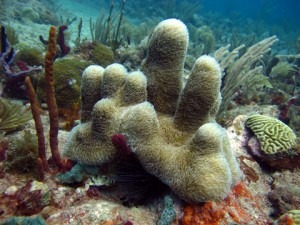
Our research team headed south for today’s dives, surveying two reefs off the southwestern end of Nevis and one off the northwestern end.  The first site, Caverns, was a raised terrace with large volcanic boulders at its margin and a prominent undercut ledge that dropped into a gently sloping sand patch.    Most corals were small, but unusually diverse and in excellent health.  There were many pillar corals (Dendrogyra cylindrus), including flattened juvenile colonies that lacked upward spires.  This coral is unusual, in that it has long tentacles that are extended in the day.

Pillar coral (Dendrogyra cylindrus)

Pillar coral (Dendrogyra cylindrus)


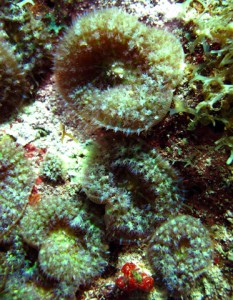
Another unusual species, the spiny flower coral (Mussa angulosa) has large fleshy polyps, spiky skeletal structures (septa) and is brightly colored shades of green and fluorescent red.

Large colony of spiny flower coral (Mussa angulosa)

Large colony of spiny flower coral (Mussa angulosa)

Read the rest of Our First Find of Staghorn Coral! »

Exploring Monkey Shoals

Monday, June 6th, 2011
June 5, 2011

Our morning dives were located at Monkey Shoals, a submerged bank that lies about 3 miles offshore between St. Kitts and Nevis and west of the Narrows.  The reef structure is reminiscent of a Pacific atoll, without the typical emergent land encircling its perimeter.  The top of the shoal extends about 1 mile across, consisting of a relatively flat hardground habitat between 10-15 m in depth. A well-developed reef system encircles the perimeter, sloping gradually from about 15 m depth to a sand terrace at 30-40 m depth, before plummeting into deeper water.  This reef had a high amount of topographic relief, with many crevices, ledges and channels, mostly due to an extensive build-up of lobate and mountainous star coral.  These corals were often several meters in diameter, although most had died and were covered in fleshy algae, sponges and other encrustations.  Nevertheless, smaller colonies of these species abound and living patches of tissue survive at the bases of the larger corals and are beginning to regrow.  The reef substrate and dead skeletal surfaces of the star corals were also colonized by smaller brain corals, flower coral, cactus corals, finger corals, lettuce coral, mustard hill coral, and several other species, most of which were in excellent health. 

Sea fans were also common at this site, but other species of soft corals showed signs of a recent die-off.  All that remains of these is the hardened brownish central axis, which was often covered with fire coral.  We were told that the mortality event was due to an outbreak of flamingo tongues (Cyphoma gibbosum), an unusual gastropod mollusk with a creamy white mantle covered with irregular-shaped orange spots with black outlines.  This snail prefers to feed on soft corals, but usually leaves small feeding scars that rapidly heal.

Flamingo tongue (Cyphoma gibbosum)

Flamingo tongue (Cyphoma gibbosum)

We anchored on the top of the shoal in a large circular sand patch for our second dive, in an area called “the donut”.  In the center of the sandy area was a small patch reef with a vibrant fish community dominated by schools of grunts, small snappers, squirrelfish, parrotfish, wrasses and many other species.  At the edge of the sand, in about 10 m depth, was an undercut ledge about 50 cm in height that provided habitat and shelter for resting schools of snapper, grunts, glasseye snapper, soldierfish, highhats, nurse shark, and other reef fishes, as well as lobsters, crabs and other motile invertebrates.  Check out the video of these fish hanging out on YouTUBE.

Read the rest of Exploring Monkey Shoals »

First Day of Research

Sunday, June 5th, 2011
June 4, 2011

We began our research dives with two spots on the Atlantic side of the St. Kitts and Nevis, seaward of the narrows in a reef system known as Grid Iron.  This shallow reef stretches over 10 km from the northeastern end of Nevis to the coastline off St. Kitts.  Formerly a flourishing elkhorn coral reef at depths of 5-10 m, most of this coral died 30 years ago and dense interdigitated skeletons remain in growth position.  We did find a few survivors, some growing atop old skeletons and others sending branches up from the bottom. 

A surviving colony of elkhorn coral

A surviving colony of elkhorn coral

At the perimeter of the elkhorn coral thicket were unusually large (3-5 m diameter) colonies of lobate star coral (Montastraea annularis) and mountainous star coral (Montastraea faveolata).  Many of these had also had died, although a large number of the colonies still had small patches of live tissue on the topside of the lobe.  In some cases, these tissue remnants were actively resheeting over the skeletons and continuing their upward growth, resembling a juvenile coral. Large brain corals had suffered similar fate; many standing dead in place, others with small living tissue remnants dispersed over the colony surface.  However, a closer inspection of the reef revealed many signs of recovery.  A dozen species of coral had settled on the dead skeletons and were expanding outward.  While most of these were species that tend to be early colonizers and short-lived, such as mustard hill coral (Porites astreoides), we also saw a number of more long-lived massive corals like starlet coral (Siderastrea siderea) and brain corals (Diploria spp. and Colpophyllia natans).  A lot of the bottom was covered with fleshy seaweeds or macroalgae, especially a bushy brown macroalgae known as Dictyota. Underneath this alga, and also commonly seen covering dead coral heads was bright pink crustose coralline algae, which is a good sign as this is known to be preferred settlement surface for larval corals. 


Read the rest of First Day of Research »

Building Local Research Capacity

Saturday, June 4th, 2011
June 3, 2011

In continuation of the Foundation’s efforts in outreach and education, the Foundation’s Chief Scientist, Dr. Andy Bruckner, led a coral reef monitoring workshop for St. Kitt’s divers and conservation officers on board the M/Y Golden Shadow.  The day opened with a discussion about the global coral reef crisis, changes to Caribbean coral reefs over the last three decades, and factors triggering reef degradation. This was followed by an overview of the objectives of the GRE, how the research we conduct will fill critical knowledge gaps and aid in the development of actions that can mitigate local impacts, enhance the resilience of coral reefs and ensure the persistence of these threatened ecosystems locally and globally.  Participants gained an understanding of the linkages between reef fishes, algae and corals, how a balanced ecosystem can help promote rapid recovery following large-scale disturbances, and local actions that are necessary to protect and restore vulnerable coral reef ecosystems.  They explored some of the tools available for marine spatial planning, how we develop these tools, and how they can be applied to meet conservation needs and ensure sustainable use of coral reef resources.  This led into a discussion on the importance of rapid assessments in defining the current baseline, threats, and health of coral reefs, and the need for continued monitoring to evaluate changes in response to management.  The classroom sessions ended with an introduction to the methods we are using in St. Kitts and Nevis and in other locations we examine during the GRE.  Participants received three sets of underwater identification cards depicting reef building corals, coral diseases, and ecological resilience indicators.

In the afternoon, 12 divers and 2 snorkelers headed out on the Golden Shadow’s two small catamaran dive boats to a shallow reef in order to practice the survey methods.  The Living oceans Foundation is using a standardized survey approach that Bruckner developed and tested in the Red Sea, and further refined during our 2010 Caribbean field surveys. This combines attributes of the AGRRA survey approach, the IUCN resilience assessment approach and additional components on substrate quality, coral structure, algal communities and nuisance species.  By employing a standardized method at all locations we visit, we will be able to assess the health and resilience of these sites and make valuable comparisons among different locations.  Divers were split into three 2-3 person buddy teams, each with an instructor (Andy, Amanda and James). 

Graeme Browne conducts a benthic survey

Graeme Browne conducts a benthic survey

Read the rest of Building Local Research Capacity »

GRE Website YouTUBE Channel Follow on Facebook Follow on Twitter RSS Feed Updates LOF Website

Search

Calendar

May 2013
M T W T F S S
« Apr    
 12345
6789101112
13141516171819
20212223242526
2728293031  

Archives