Posts Tagged ‘resilience’

Lessons Learned

Thursday, March 28th, 2013

28th March 2013

Written by CREW member Jim Evans

Probably the most significant thing I learned on this trip is that it is possible for coral to be resilient to environmental stresses. It was exciting to see the reaction of researchers who studied the coral reefs in the lagoon of Rangiroa over ten years ago. They said that in 1998 the reefs were devastated, but now life has returned to the reefs.

Jim Evans having a skype call with two classes on the east coast of the US while off the coast of Moorea

Jim Evans having a webchat with two classes on the east coast of the US while off the coast of Moorea


We visited coral reefs of the coast of Moorea, which were devoid of life to a greater degree than Rangiroa. Although the reefs still appear somewhat lifeless, the researchers commented on how coral recruits are present, which is the first step in the revival of a reef. And the main lesson I have learned here that I will bring back to my students is that there is still hope.

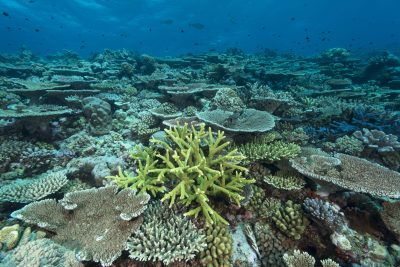
Healthy reef with high coral cover off the coast of Rangiroa

Healthy reef with high coral cover off the coast of Rangiroa


However, if we continue to treat our planet the way we do, that hope can dwindle. If we continue to let environmental stresses such as climate change affect our coral reefs, they may in time lose that resilience and we may lose them forever.

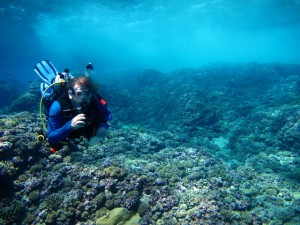
Jim Evans enjoying the coral cover on the shallow reef

Jim Evans enjoying the coral cover on the shallow reef

(Photos by 1-3 Brian Beck)

To follow along and see more photos, please visit us on Facebook!  You can also follow the expedition on our Global Reef Expedition page, where there is more information about our research and team members.

Bringing the Message to Many

Thursday, October 18th, 2012

October 17, 2012

Written by Candice Jwazko

My two weeks aboard the Golden Shadow have come to a close. During that time, I spent the days diving with the science team.  At night, as the ship swayed with the swells of the ocean, I reflected on their research. I’ve always been interested in coral reefs and now I have an insider’s view that few have seen. I have discussed coral reef sustainability with scientists who’ve worked in this field long enough to see firsthand the changes that are occurring. Instead of an Internet search, I’ve been here, in the Pacific Ocean, watching the data being collected, discussing how it will be analyzed, and understanding the larger picture of coral reef health.

Expedition researchers at work on the reef

Expedition researchers at work on the reef

Read the rest of Bringing the Message to Many »

Corals and Carbon Dioxide

Thursday, June 14th, 2012

June 13, 2012

The Golden Shadow arrived at Puerto Villamil, on the southern end of Isabela Island, last night. It the third-largest settlement, and the largest island, in the archipelago. Today we explored shallow lagoons near the town’s docks, in particular one called Concha y Perla (Conch and Pearl), popular with tourists for its fish, curious sea lions and—good guess—its’ corals.

Brian Beck checks for surfacing divers

Brian Beck checks for surfacing divers

Today, like most days, Derek Manzello of NOAA hauled a pneumatic drill and an extra tank to power it on his dive, and he brings back bottles full of seawater back to the Golden Shadow. The drill is for taking cores to measure how fast corals are growing, like a tree core tells a tree’s growth rate. The seawater is for measuring carbon dioxide (CO2) levels. This greenhouse gas that we all exhale can also affect the health of coral reefs, and Derek is looking at how the Galapagos can help us predict the fate of corals around the world.

Read the rest of Corals and Carbon Dioxide »

Currents, Corals and a “Sleeping” Nurse Shark

Tuesday, March 13th, 2012

March 12, 2012

Whitecaps are never good news when you’re diving. Sure enough, the swell and breeze both grew overnight, though luckily not too big to take the Calcutta out. After a late start for some repairs, the dive boat brought the group to the first site of the day.  Under a merciless sun, everyone was happy to get in the water and set about their various tasks.

Brian Beck and CAPT Phil Renaud paired off to do transects: coral and photographic, respectively. Brian laid out a weighted 10-meter line on the bottom and proceeded to record every coral species for half a meter on either side, a slow, meticulous task that took the entire dive. Phil followed his own 10-meter line, taking high-resolution, digital photos of every square meter.

Back on the ship, these photos will be analyzed using an open-source program called Coral Point Count with Excel extension or CPCe. This gives you statistics on how much of the bottom each coral species (or whatever else you want to record) covers. It scatters any number of points on each photo, which you then have to tag as being a particular species of coral, healthy or not, or any other variable you want to record. It can take a long time — graduate school and internships involve a lot of this sort of work.

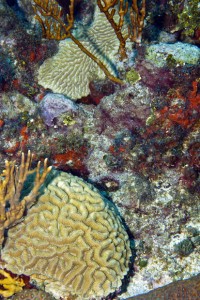
On his dive, Ken Marks spotted a species of coral that had just been described as new last November. Meandrina jacksoni is a hermatypic (stony) coral, meaning it helps build reefs with its calcium skeleton, as opposed to soft-bodies corals, which don’t. It looks a lot like Meandrina meandrites, the species it was originally lumped under, but its “brain” pattern has smaller ridges and whitish valleys. There are less than 100 hermatypic species in the Caribbean, so it’s a reef scientist’s dream to identify a new one.

Meandrina jacksoni (top) compared to Meandrina meandrites (bottom). See the difference?

Read the rest of Currents, Corals and a “Sleeping” Nurse Shark »

Golden Shadow Heads to Jamaica’s Pedro Bank

Monday, March 12th, 2012

March 11, 2012

After a night boarding at Errol Flynn Marina at Port Antonio, Jamaica and a rolling crossing that left more than a few green faces and empty chairs at dinner, the Golden Shadow motored overnight to Pedro Bank, about 100 miles southwest of Kingston.

Loading up the Golden Shadow in Errol Flynn Marina, Port Antonio

Now we’re anchored off Southwest Cay, a.k.a. Bird Cay, one of four small, mostly empty islets that together cover a tenth of a square mile. It’s a strip of sand with a few bushes and palm trees and a long, low pile of what looks like bleached coral but is actually empty conch shells discarded by fishermen over the decades. Just beyond it is Middle Cay, one of two inhabited islets, with a Jamaican Coast Guard station, a research station built by The Nature Conservancy, and a scattering of fishing huts. Read the rest of Golden Shadow Heads to Jamaica’s Pedro Bank »

Regionally Rare, Locally Abundant

Friday, August 19th, 2011

August 18, 2011 

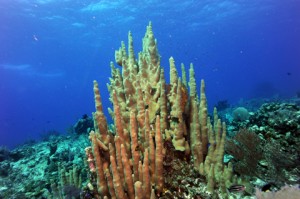
Throughout most of the Caribbean, there are species of coral that are common and easily spotted on a dive, and those that are rare and difficult to locate.   Experienced divers can usually characterize a reef fairly quickly based on the types of corals growing there.  Some common corals that are generally easy to find include star corals (Montastrea sp.), starlet corals (Siderastrea sp.) and brain corals (Diploria sp.).  On the other hand, pillar corals (Dendrogyra cylindrus) and staghorn corals (Acropora cervicornis) are generally quite rare.  The corals of Hogsty Reef and Great Inagua have so far not followed this formula.  Living Oceans Foundation researchers have seen an unusually high number of rare corals.  Specifically, pillar corals appear to be thriving on the reefs here and staghorn corals are demonstrating remarkable resilience.  

Pillar coral (Dendrogyra cylindrus) is not a rare find around the Inaguas

Pillar coral (Dendrogyra cylindrus) is not a rare find around the Inaguas

Read the rest of Regionally Rare, Locally Abundant »

GRE Website YouTUBE Channel Follow on Facebook Follow on Twitter RSS Feed Updates LOF Website

Search

Calendar

May 2013
M T W T F S S
« Apr    
 12345
6789101112
13141516171819
20212223242526
2728293031  

Archives