Posts Tagged ‘research’

A Fond Farewell

Wednesday, April 17th, 2013

Written by Brian Beck

The Golden Shadow arrived in Papeete, French Polynesia back in July 2012 and for the past eight months Papeete has been our home, but we said goodbye last week as we started our final research expedition in the Austral islands. We will spend the next 2 weeks surveying in the Austral Islands and from there we will not return to Papeete, but instead sail out of French Polynesia and into the Cook islands.


M/Y Golden Shadow says farewell to Papeete

M/Y Golden Shadow


Before leaving Papeete we took an evening to share some of our initial research findings with local scientists, representatives of our partner organizations, and government officials. A full analysis of all the data we gathered will take months but we have seen some observable trends during our field work.


Dr Andy Bruckner gives a scientific update with French translation by Clare Pasdelou

Dr Andy Bruckner gives a scientific update with French translation by Clare Pasdelou


We displayed images from some of the remote sites we have surveyed during our field research and were delighted that the French Polynesian Minister for Education, Tauhiti Nena, came to encourage us on our continued scientific journey. It was a great way to say good bye to Papeete.

KSLOF Executive Director Philip Renaud and Minister for Education Tauhiti Nena

KSLOF Executive Director Philip Renaud and Minister for Education Tauhiti Nena

Photos by 1 Michele Westmorland, 2 and 3 KSLOF

Something’s Fishy Around Here

Wednesday, February 13th, 2013

February 12, 2013

Written by Dr. Andy Bruckner

A fish sandwich? Think again. You may want to leave the fish on the reef, if you live in Mangareva.  There’s a good chance it may be ciguateric.  Ciguatera fish poisoning (CFP) is seafood intoxication caused by the consumption of tropical reef fishes contaminated with a type of microalgae called a dinoflagellate.  The dinoflagellate belongs to the genus Gambierdiscus, which was first identified in the Gambier Islands (hence the scientific name) after a severe outbreak in the late 1960s.  Gambierdiscus usually occur on benthic algae, increasing in abundance after some type of disturbance degrades a coral reef, such as a cyclone, bleaching event, or, in the case of French Polynesia in the 1960s, nuclear testing.

Gambierdiscus under a microscope

Gambierdiscus under a microscope


The dinoflagellates produce a potent neurotoxin (ciguatoxin) that is bioaccumulated (built-up in the tissue) and biotransformed along the trophic chain first to the herbivorous fishes, then to carnivorous fish. The population of these microalgae usually blooms 10 months after a coral die-off and then it takes about 4 months for it to pass up the food chain and cause outbreaks in humans. There are now 11 known species of Gambierdiscus.  They affect tropical areas in the Caribbean Sea, and the Pacific and Indian Oceans. Some 50-100,000 cases of CFP are reported every year.  If you eat a ciguatoxic fish, you’ll know within about 2 hours via digestive disorders, followed by neurological symptoms ranging from temperature reversal, tingling, itching, muscular pains, chronic fatigue, and numbness.  These symptoms may last a few weeks or even a lifetime.  Symptoms following consumption of a second ciguatoxic fish at a later date are even worse, as the toxin accumulates in your body.

Andre Ung holds up the string of fish

Andre Ung holds up a string of toxic fish


Ciguatera poisoning has occurred since at least the 7th century, in China and it was commonly reported among explorers in the 16th century.  In French Polynesia, mass intoxications were reported in Bora Bora in the 1960s, followed by the Gambiers, but little research was done until about a decade ago.  Monitoring sites were first established here last year, and five scientists from Institute Louis Malardé and IRD are with us during this expedition to follow-up on this work.  It takes one to two very long days for the researchers to work one site. The day starts with a quantitative survey of the bottom (100 m X 100 m area) to determine how much and what type of fleshy algae are present, the amount of dead coral, and how much turf algae is present. One species of turf is a preferred habitat for the dinoflagellate (Amphiroa rigida).  This alga is collected and then washed through a fine mesh filter to remove and collect the microalgae.

Red algae Amphiroa that the dinoflagellates settle on

Red algae Amphiroa that the dinoflagellates settle on


If there is a bloom (this year, a bloom was identified in one site off Rikitea), then enough of the Gambierdiscus can be collected to allow determination of the species using molecular tools (PCR).  Finally, a subsample of the known toxic fish is collected.

The day's catch includes two species of parrotfish (Chlorurus micorhinos, Hipposcarus longiceps) , unicornfish/surgeonfish (Naso lituratus and N. unicornis), two groupers (Epinephelus merva and E. tauvina), Parapeneus barberinus and a jack (Carangoides orthogrammus), all species known to be ciguatoxic here.

The day’s catch includes two species of parrotfish (Chlorurus micorhinos, Hipposcarus longiceps) , unicornfish/surgeonfish (Naso lituratus and N. unicornis), two groupers (Epinephelus merva and E. tauvina), Parapeneus barberinus and a jack (Carangoides orthogrammus), all species known to be ciguatoxic here.


On the ship, the fish are cleaned and filets are carefully weighed and frozen for analysis, but strictly kept for research purposes and are not to be consumed!

Dr. Melaine Roue weighs and bags fish for freezing

Dr. Melaine Roue weighs and bags fish for freezing


The research team has conducted a very thorough study, completing the three sites they established last year and establishing three new sites. Remarkably, 2012 and 2013 represent the first comprehensive Gambierdiscus assessments ever done in the Gambiers!

(Photos by: Dr. Andy Bruckner)

Coral Bommies and Patch Reefs

Sunday, January 27th, 2013

January 27, 2013

By Dr. Andrew Bruckner

Navigation hazards are many in Hao Atoll, due to a myriad of submerged patch reefs that rise to the surface from the 60 m deep lagoon floor. These reefs are distributed in a seemingly random pattern. Some are circular and few centimeters below the surface, some are narrow and elongate, and others are little more than a pinnacle, a meter or so wide and a few meters in height. Unlike those in Fakarava, none of the patch reefs have an associated island or an emergent reef framework. They contain some of the same corals, but the corals vary in distribution and abundance from one patch reef to another, and a dominant species on one may be completely absent from another.

Hoa patch reefs

Hoa patch reefs


How do these form? One theory is that they are built on a framework of the massive pore coral, Porites. Porites forms large mountainous colonies around the rim of many of these reefs. These corals grow up to the water’s surface and then their upper surfaces die, due to aerial exposure during low tides. This provides substrate for the settlement and growth of branching corals, mostly bushy, bottlebrush, arborescent and thickly branched Acropora, which prefer shallow depths.

Acropora top

Acropora top


Even though parts of the Porites colonies eventually die, they continue growing outward, causing the reef to expand laterally in size. Because of the high turbidity and limited water motion in the lagoon, Porites exhibits low survival in deeper water, so they are usually dominant from 2-5 m depth. Over time, the shallows develop a mushroom-shape, with an extensive system of undercut ledges, caves and crevices at the base of the Porites colonies.

Porites

Porites


Below 5 m, the reef slopes steeply. The bottom consists mostly of sand, scattered boulders and rubble—broken branches, mollusk shells, and a lot of other debris—produced in shallow water that tumbles down the slope. Few corals can survive here, except on some of the rocky outcrops. At the base of the steep slope (12-15 m) is a dense band of thinly-branched tangles of staghorn coral (Acropora horrida), often 1-2 m in height and 20-30 m wide.

patch reef slope

patch reef slope


Below 15 m, the slope is much more gradual, continuing to 40-60 m depth. These deeper areas are mostly sand and rubble, interspersed with boulders and pinnacles of varying height and diameter. The pinnacles were draped with long strands of fleshy green algae (mostly Caulerpa) and occasionally disc-shaped calcareous green algae (Halimeda), with a thick layer of bright pink coralline algae beneath the green algae.

Caulerpa on pinnacle

Caulerpa on pinnacle

crustose coralline algae under green algae

crustose coralline algae under green algae


The pinnacles also support a high diversity of small encrusting, plating and branching corals, and numerous flat-topped bushy (corymbose) corals (Acropora granulosa), but live coral cover is generally low.

pinnacle with A granulosa

pinnacle with A granulosa


Why do some of the pinnacles make it to the water’s surface and form a large patch reef, while others appear to give up? One possibility is that these may have formed when sea level was lower, each starting as an individual coral or a few corals that settle in close proximity on a rocky substrate. Over time, some of these corals die from disease, or predation, or they are smothered by algae, sediment or debris. Others flourish, growing quickly to keep up with rising sea level.

deep pinnalce

deep pinnacle


To determine what the pinnacles are constructed from, we collected a small pinnacle. These structures are highly bioeroded and have lots of nooks and crannies, yet they are very stable and difficult to break apart. What was surprising is that the pinnacle was not formed from a single coral. In fact, recognizable coral made up very little of the matrix. Most consisted of rubble, sand, shells and small corals that had been cemented together with coralline algae. This pinnacle was from shallow water (13 m), adjacent to rim of the atoll. In these areas, it is possible that storm-generated rubble and sediment is a much more important component of the framework, bound together by coralline algae. Deeper pinnacles may in fact consist of a coral skeleton in growth position. To verify this, we plan to collect a few more pinnacles from deeper water, when we begin our work in Mangareva next week.

(Photos 1-8 by Dr. Andrew Bruckner)

Gambier, 800 feet above sea level

Wednesday, January 16th, 2013

January 16, 2013

Written by Dr. Andrew Bruckner

After a 3.5 hour flight on the Golden Eye, we reached Hao to begin our third research mission in French Polynesia. Hao is a large (56 km X 15 km), low-lying coral atoll at the southeastern end of the Tuamoto archipelago, 920 km east of Tahiti. It has one navigable pass into the lagoon at the north end with a well developed reef system and treacherous currents that may exceed 20 knots. Hao is home to the longest airstrip in the region, used as the support base for the nuclear testing on nearby Mururoa atoll in the mid 1990s, and as a Transoceanic Abort Landing site for U.S. space shuttles. Most of the 1600 inhabitants live at the northeast end of the atoll.

1. Gambier_overflight_sm

The Acteon Group, at the northwestern end of Gambier Archipelago, consists of four neighboring, isolated atolls about 1400 km from Tahiti. These low-lying coral atolls range in size from about 2 km2 to 18 km2, with a land area of no more than 2.5 square km, bound by a continuous reef, and no access to the central lagoon. Each has a small landing strip to provide access to the dense coconut plantations, but the atolls lack permanent residents.

Continuing southwest about 50 km, we reached Maria Est, an oval-shaped coral atoll that completely encloses a hypersaline lagoon.

Marie Est Atoll

Marie Est Atoll

More than 1,600 km southeast of Tahiti, is the Gambier group, a collection of extinct high volcanic islands. The 14 small, mountainous islands are located within an extensive lagoon, and are surrounded by a barrier reef with three navigable passages to the sea. Well developed fringing reefs are found off headlands and on the exposed south and southeast coasts of each island and small coral bommies are scattered throughout the lagoon. The highest point, Mt. Duff, is on Mangareva, rising out of the ocean to an elevation of 441 m. Mangareva is also the largest and most populated island, with about 1200 residents, and an economy based largely on pearl farms.

Mt. Duff, Mangareva

Mt. Duff, Mangareva

Temoe Atoll, 25 km south of Gambier, is our final destination. Trapezoidal in shape and bound by a continuous reef, many small shallow spillways connect the 23 m deep lagoon, none which are deep enough to allow boat access.

Before departing, we got a spectacular view of the vibrant reefs we were about to witness—an unusually low tide exposed the dense thickets of corals, their branches extending out of the water.

lagoonal reef with exposed corals

lagoonal reef with exposed corals

Back in Tahiti, the remainder of the science team joined us, and the Golden Shadow departed a 36 hour journey to Hao. For many of the low coral atolls our efforts will focus on the extensive spur and groove reef systems that characterize the front of the reef, facing the ocean.  At Hao and Mangareva, we will also characterize the fringing reefs, reticulate reefs and patch reefs within the lagoon.

spur and groove fore reef, Tenararo

spur and groove fore reef, Tenararo

(Photos by: Image 1 Amanda Williams, Photos 2-5 Dr. Andrew Bruckner)


Outreach in Fakarava

Monday, December 3rd, 2012

December 2, 2012

Written by Dr. Brian Beck

On Wednesday, a group of school children from Fakarava came for a visit to the Golden Shadow. The crew showed them around the ship and Living Oceans Foundation Fellows told the children about the science and coral reef research that we are doing in French Polynesia. The kids got to test out the drop-camera that our ground-truthing team uses, as well as climb into the sea plane and sit in the cockpit.

Students enjoyed the chance to sit in the Golden Eye seaplane

Students enjoyed the chance to sit in the Golden Eye seaplane

Students peer off the stern of the Golden Shadow to see what's below them in the water

Students peer off the stern of the Golden Shadow to see what’s below them in the water


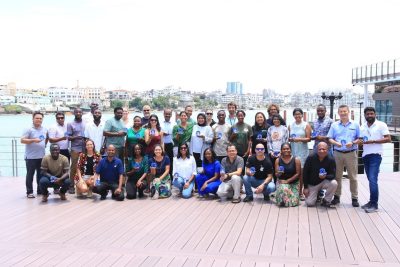
It was an enriching experience for the children, the crew and scientists. As a thank you, all of the school children gathered on the pier to sing songs, give us leis and wish us good luck and safe travel while we are in Fakarava.

Students had a chance to interact with the researchers onboard the ship

Students had a chance to interact with the researchers onboard the ship


Everyone onboard really appreciated this gesture and was thankful for the hospitality that has been shown to us, not only in Fakarava, but all over French Polynesia.

Group photo with all of the students, researchers, and officers and crew of the Golden Shadow

Group photo with all of the students, researchers, and officers and crew of the Golden Shadow


Reefs Around Rangiroa, Aratika and Raraka

Thursday, November 29th, 2012

November 28, 2012

Written by Dr. Andy Bruckner

After two weeks, we’ve completed reef assessments around Rangiroa, Aratika, and Raraka and are now examining Fakarava. Tuamotu reefs are dramatically different from Society Islands.  Besides the near absence of crown of thorns seastars (we’ve seen a handful in the lagoon), there is much more living coral, a higher diversity of coral species, and more diverse and abundant fish communities.

Shallow fore reef (5 m) on the leeward side of Fakarava with a high cover of plating and submassive Porites colonies and other species

Shallow fore reef (5 m) on the leeward side of Fakarava with a high cover of plating and submassive Porites colonies and other species


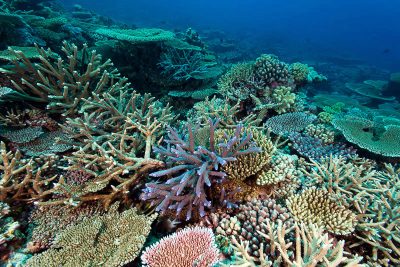
On the fore reef, dense assemblages of branching corals begin near the shore and extend down the slope to 5-10 m, becoming mixed and gradually dominated by larger boulder and plating corals at 10-20 m depth, followed by shingles of pore corals (Porites) and overlapping sheets of plating pore corals and lettuce corals (Porites & Pachyseris) on the fore reef slope, from 20-30 m and deeper.

Foliose sheets of ruffled lettuce coral (Pachyseris speciosa) at 30 m depth at Raraka

Foliose sheets of ruffled lettuce coral (Pachyseris speciosa) at 30 m depth at Raraka


These outer reefs vary considerably in species composition, with windward reefs having a mix of stout, bushy and tree-like corals (Acropora), branching cauliflower coral (Pocillopora), finger corals (Porites) and small massive faviid corals, and leeward reefs being dominated by Porites, plates of rice coral (Montipora), small boulders of star coral (Favia), and columns of Pavona coral.

Large thicket of Pacific elkhorn coral (Acropora clathrata) on an exposed shallow reef off Raraka

Large thicket of Pacific elkhorn coral (Acropora clathrata) on an exposed shallow reef off Raraka


The amount of coral varies at each site, with some completely covered in coral, some having fewer corals and a lot of fleshy algae, especially carpets of feather-like and grape-like green algae (Caulerpa) and mats of lettuce algae (Microdictyon), and some with large accumulations of rubble between patches of living coral.

Two species of macroalgae (Caulerpa racemosa and C. sertuloides) carpeting the reef substrate. Two branching rice corals (Montiopora) and red crustose coralline algae are visible. Scale bare is 90 cm.

Two species of macroalgae (Caulerpa racemosa and C. sertuloides) carpeting the reef substrate. Two branching rice corals (Montipora) and red crustose coralline algae are visible. Scale bare is 90 cm.


Lagoonal reefs are built on a framework of massive boulders of Porites.  Sites close to the cut (the channel connecting the fore reef to the lagoon) had a lot of live coral – unusually large helmet or dome-shaped colonies Porites (some over 5 meters across), and a mix of branching, plating, encrusting and foliose corals. Sites with less water exchange (e.g. closer to the center of the lagoon) often were covered in fleshy algae and had little coral, except near the water’s surface.

Typical Lagoonal patch reef in Rangiroa with unusually large Porites colonies and Pocillopora colonies

Typical lagoonal patch reef in Rangiroa with unusually large Porites colonies and Pocillopora colonies


Unraveling the cause of these differences is one part of the puzzle. We know that the same species of coral can look completely different on two reefs, changing shape depending on depth, amount of light, wave exposure and other environmental and biological factors.

Coral community on the top of a lagoonal pinnacle at 2 m depth

Coral community on the top of a lagoonal pinnacle at 2 m depth


For instance, we often see massive, mountainous boulders of Porites in sheltered shallow areas and these same species form plates or overlapping shingles in deeper water to maximize the amount of their surface exposed to sunlight.  On windward reefs, branching corals often had thick bases, short digitate or tree-like branches and colonies  spread out laterally, close to the bottom, with branches facing into the current to minimize chances of breakage. These stout, bushy corals exist in areas of high wave exposure because they spread through fragmentation, with broken branches settling on the bottom, reattaching and regrowing into a new colony.  In protected waters of the lagoon, branching species were more fragile, forming bottlebrush colonies, tangles of thin, erect branches, and bushes.

A broken colony of cauliflower coral (Pocillopora eydouxi) on a shallow wave-exposed for reef in Aratika. The branches are still alive and have fused to the bottom.

A broken colony of cauliflower coral (Pocillopora eydouxi) on a shallow wave-exposed for reef in Aratika. The branches are still alive and have fused to the bottom.


Determining why some reefs are healthier than others is another part of the puzzle. Even though coral cover is much higher, there are many more larger, older corals than we had observed in Society Islands, human populations are much smaller here, and certain species have been found with disease much more frequently.  We typically find a number of dead cauliflower corals (Pocillopora), in growth position, which we also saw in Society Islands, but these were primarily corals that had been eaten by crown of thorns starfish (COTS).  In Tuamotu, we’ve found very few recently dead corals that were eaten by COTS, but a high percentage (up to 10%) have recently dead (white) patches.  This is presumably a disease called white syndrome, but we know very little about its cause.

Pocillopora colonies with recent tissue loss due to white syndrome. The top colony is dead and show older mortality (reddish branches) and recent mortality. The other two corals have live tissue, recently dead white skeleton, and older dead patches colonized by algae.

Pocillopora colonies with recent tissue loss due to white syndrome. The top colony is dead and show older mortality (reddish branches) and recent mortality. The other two corals have live tissue, recently dead white skeleton, and older dead patches colonized by algae.


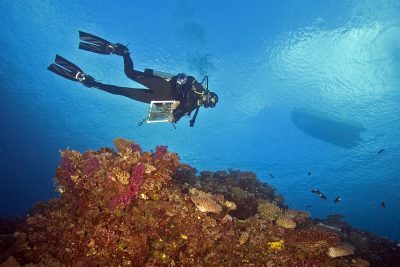
During each survey, I measure the size of all corals (healthy and diseased), and record how much of the coral is live, long dead (covered in algae), recently dead (white), and, when possible, identify why they have died.  We’ve also sampled some of the diseased corals to better understand the effects of the disease, in hopes of identifying a cause.

At least for now, the disease does not appear to be having a major impact on these reefs. As these species are a dominant corals on the fore reefs of Tuamotu, they exhibit very high rates of replacement, and they are considerably larger in size than what we saw in Society Islands.

(Photos by: Dr. Andy Bruckner)

Aerial Reconn of the Tuamotus

Sunday, November 18th, 2012

November 17, 2012

Our research in the Tuamotu archipelago began with an aerial survey, at an elevation of 500-1000 feet above sea level, using the Golden Eye seaplane. The Tuamotu islands constitute the largest archipelago in French Polynesia, spanning an area that is similar in size to western Europe (but with a land area of only about 850 km2), and including 77 of the 425 atolls of the world. Our surveys focus on Rangiroa, Aratika, Raraka, Fakarava, Toau and Niau, a group of atolls that form the Pallisers Islands, at the northwest end of Tuamotu.

A dramatic spur and groove fore reef structure on the south side of Rangiroa

A dramatic spur and groove fore reef structure on the south side of Rangiroa

Read the rest of Aerial Reconn of the Tuamotus »

Preparing and Waiting for the Tuamotus

Friday, November 16th, 2012

November 15, 2012

The Golden Shadow is docked in Papeete, Tahiti and the scientists are arriving tonight for our second mission in French Polynesia. Originally, we had planned a midnight departure to arrive at Rangiroa to start research on the 16th. However, after we had landed and got to the ship we found out that not everything goes to plan.

The Golden Fleet in port in Tahiti

The Golden Fleet in port in Tahiti

Read the rest of Preparing and Waiting for the Tuamotus »

Bringing the Message to Many

Thursday, October 18th, 2012

October 17, 2012

Written by Candice Jwazko

My two weeks aboard the Golden Shadow have come to a close. During that time, I spent the days diving with the science team.  At night, as the ship swayed with the swells of the ocean, I reflected on their research. I’ve always been interested in coral reefs and now I have an insider’s view that few have seen. I have discussed coral reef sustainability with scientists who’ve worked in this field long enough to see firsthand the changes that are occurring. Instead of an Internet search, I’ve been here, in the Pacific Ocean, watching the data being collected, discussing how it will be analyzed, and understanding the larger picture of coral reef health.

Expedition researchers at work on the reef

Expedition researchers at work on the reef

Read the rest of Bringing the Message to Many »

Thriving Alien and Declining Local Invertebrates

Saturday, October 13th, 2012

October 12, 2012

Written by Serge Andréfouët and Joseph Campanozzi

The French Polynesian scientists participating on the Society Islands mission took the opportunity to quantify the abundance of a number of invertebrate species that have, or may have, a commercial and food subsistence role in the near future. In particular, they investigated the abundance of a number of sea cucumbers species, giant clams (only Tridacna maxima is found everywhere in French Polynesia) and also the imported green snails, Turbo marmoratus and Trochus niloticus. Trochus snails were brought to Tahiti from Vanuatu nearly 50 years ago, and then transplanted to selected islands throughout French Polynesia.

The giant clam is prized for its flesh all over the Pacific Islands, but also for the aquarium market.

The giant clam is prized for its flesh all over the Pacific Islands, but also for the aquarium market.

Read the rest of Thriving Alien and Declining Local Invertebrates »

GRE Website YouTUBE Channel Follow on Facebook Follow on Twitter RSS Feed Updates LOF Website

Search

Calendar

May 2013
M T W T F S S
« Apr    
 12345
6789101112
13141516171819
20212223242526
2728293031  

Archives