Posts Tagged ‘reef fish’

The Fish of the Austral Islands

Saturday, April 27th, 2013

26th April 2013

Written by Dr. Serge Planes and Dr. Jeffrey Williams

After starting the barcoding of the total fish fauna at Moorea (Society Islands, French Polynesia) in 2006 under the BIOCODE project (http://mooreabiocode.org/), CRIOBE has spent the last 7 years continuing the genetic barcoding of coral reef fishes over the 118 islands, 5 archipelagos and 5.5 million km2 of French Polynesia. Of course the project could not visit every single island, but the project hoped to visit all 5 archipelagos for the fish surveying and sampling. Moorea has been sampled, the Gambier was surveyed in 2010, the Marquesas in 2008 and 2011, and now finally the Australs during this trip with the Global Reef Expedition. The Living Oceans Foundation has made it possible to survey fishes at Raivavae, Tubuai, Rurutu, Rimatara and Maria Islands.

We discovered this distinctive new species of yellow-barred Dwarfgoby in the Austral Islands, which is fully grown at about 25 mm in length. It lives on coral reefs at depths of about 25-30 meters.

We discovered this distinctive new species of yellow-barred Dwarfgoby in the Austral Islands, which is fully grown at about 25 mm in length. It lives on coral reefs at depths of about 25-30 meters


The survey resulted in the surveying of more than 300 species and we collected specimens representing about 14 new species that will be described over the coming years. In addition to these new species, this was also the opportunity to record new occurrences for many species previously unreported from the Austral Islands (about 20 new records). The results of this sampling program will be analyzed genetically and our findings will be made available internationally on the FISHBOL database.

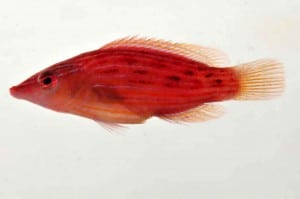
The colorful reddish pink wrasse is similar to the Eightstripe Wrasse, but we have discovered that this color form is actually an undescribed species in French Polynesia

The colorful reddish pink wrasse is similar to the Eightstripe Wrasse, but we have discovered that this color form is actually an undescribed species in French Polynesia

With this survey completed, we have now collected over 5000 vouchered fish samples for French Polynesia.  These samples will provide one of the most extensive databases of fishes worldwide for a region as large as French Polynesia.

(Photos by Jeff Williams)

To follow along and see more photos, please visit us on Facebook!  You can also follow the expedition on our Global Reef Expedition page, where there is more information about our research and team members.

Lessons from the Reef: Did You Know?

Friday, March 1st, 2013

March 1, 2013

By Eddie Gonzalez

It’s been two weeks since the Gambier portion of the Global Reef Expedition to French Polynesia ended. In less than two weeks, our science team will be heading back to French Polynesia to conduct research in Rangiroa. In the meantime, everyone is busy preparing travel itineraries, ensuring all supplies have been restocked, and confirming final research sites for the next voyage.

Coral as far as you can see.

Coral as far as you can see.


The time between missions is also spent looking at data, photos, and video collected so far. This short video (about 4.5 minute) was filmed during the Gambier mission as part of the Living Oceans Foundation CREW (Coral Reef Educator on the Water) program. It features Megan Berkle, a high school teacher from Los Angeles, CA, who joined the mission to help us expand our educational efforts. We hope you enjoy it and pass it on to your friends, family, and colleagues.

YouTube: Lessons from the Reef–Did You Know?

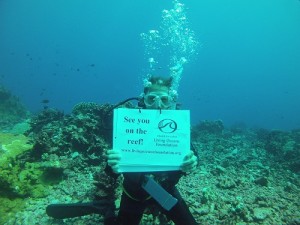
Megan says, "See you on the reef."

Megan says, “See you on the reef.”

(Photo credit: 1 and 2 by Eddie Gonzalez)

Hao Atoll at Eye Level

Sunday, January 20th, 2013

January 19, 2013

By Megan Berkle and Eddie Gonzalez

Research dives can be distilled down to lists of what is seen and what is not seen. Surveying the reef means figuring out what is there and what is missing. For the last few days, the science team has been jumping into a variety of sites inside the lagoon and outside the perimeter of Hao Atoll. As dive buddy teams enter the water, they scatter across the reef to deploy their instruments, gauges, transect lines, and quadrats with efficiency and purpose. It’s an amazing sight.

Divers descend to the reef to begin their surveys.

Divers descend to the reef to begin their surveys.

Clip boards and cameras record the species, size, distribution, abundance, and health of corals, sponges, fish, and invertebrates. By aggregating the observations, some early assessments are possible. For example, as in the other French Polynesia research sites, branching corals such as cauliflower coral (Pocillopora), table and staghorn corals (Acropora), thin crusts of corrugated leaf coral (Pavona), and fire coral (Millepora) are the more the common corals seen so far in Hao.

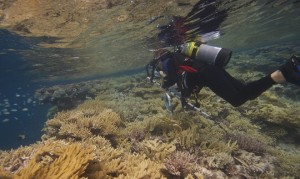
Dr. Andrew Bruckner, LOF Chief Scientist, scans the variety of coral.

LOF Chief Scientist, Dr. Andrew Bruckner, scans the variety of coral.

After each dive, the conversation on the dive boat quickly turns to the highlights. Fish ecologist, Badi Samaniego, caught a glimpse of the uncommon Chabanaud’s soapfish. On another dive, a giant manta ray (Manta alfredi) glided past the science team in the outer lagoon. Each dive reveals more about the underwater ecosystems at Hao Atoll.

A parrotfish, Chlorurus microrhinos, swims along the reef.

A parrotfish, Chlorurus microrhinos, swims along the reef.

(Photos by: 1 Brian Beck, 2 Joao Monteiro, and 3 Phil Renaud)

Celebrating Fish Diversity

Friday, December 7th, 2012

December 6, 2012

Written by Dr. Andy Bruckner

Fish communities in the Tuamotu Archipelago have been much more diverse than in Society Islands, especially on the fore reef.  The fish are not only more abundant, but they are larger overall, meaning greater biomass, which is good for reefs and for the human populations they must sustain.

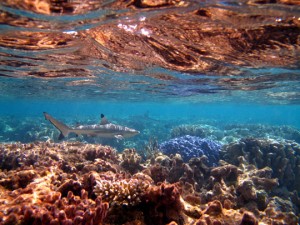
Two blacktip reef sharks patrol a reef at Fakarava

Two blacktip reef sharks patrol a reef at Fakarava


Typically each dive site hosts a large diversity of fish and fish schools, including apex predators, such as sharks, groupers, and snappers.

Large groupers are more abundant in the Tuamotus

Large groupers are more abundant in the Tuamotus


There were many more fish near channels and on reefs with very high relief and high coral cover.  Reefs dominated by fleshy algae, especially the lagoonal reefs, and areas damaged by storms had many fewer fish, but in general still more than in the Society Islands.

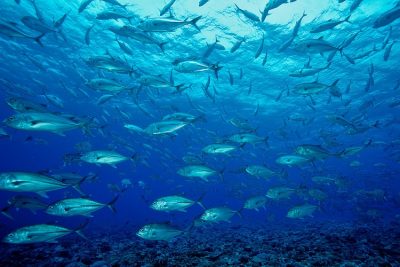
Schools of fish inhabit the reefs

Schools of fish inhabit the reefs


Though we are not studying fishing pressure on the reefs around French Polynesia, it is apparent that there are fewer fish being caught here due to their larger size, greater abundance and higher diversity when compared to the Society Islands.

(Photos by: 1 - 2 Dr. Brian Beck, 3 Serge Andrefouet)

If you liked this blog, you might also like reading about Fish Spotting in Jamaica.

Huahine: Home for the Small Ones

Tuesday, October 2nd, 2012

October 1, 2012

Written by Dr. Sonia Bejarano

At first sight, Huahines’ outer reefs appeared to lack vertical relief; the bottom was barren and without much life. It was obvious to all of us that a disturbance had impacted these reefs sometime in the past.  Locals indicated it was the result of an invasion of hungry crown-of-thorn-sea stars in 2008 and a cyclone in 2010.

A closer look at the reefs over the last couple of days, however, immersed us in a world of miniature creatures. A wide variety of young and healthy-looking corals thrived in the small crevices and crannies, and thousands of tiny fish constantly emerged from invisible refuges, crowding the blue water column like swarms of busy bees.

Tiny fish in the water column

Tiny fish in the water column

Read the rest of Huahine: Home for the Small Ones »

Dance of the Clownfish

Monday, September 24th, 2012

September 23, 2012

Written by Joao Monteiro

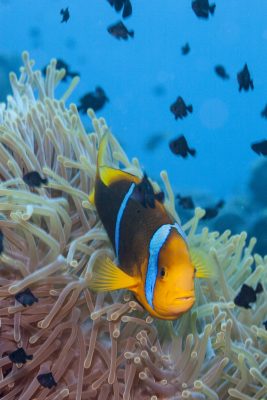
Clownfishes and anemonefishes are among the most iconic creatures residing in coral reefs. In Scilly and Bellinghausen, the science team sighted several colorful orange-finned anemonefishes (Amphirion chrysopterus) residing in anemones scattered throughout the shallows of the reef sites.

Orange-finned anemonefish (Amphirion chrysopterus) sitting in an anemone

Orange-finned anemonefish (Amphirion chrysopterus) sitting in an anemone

Read the rest of Dance of the Clownfish »

Badi Samaniego: The Human Fish Encyclopedia

Friday, September 21st, 2012

September 20, 2012

Written by Dr. Sonia Bejarano

It is no coincidence that this charismatic Filipino joined the Global Reef Expedition as a Foundation Fellow in its course across the Pacific Ocean. For the last 12 years of his life, Badi has been identifying and counting reef fish of all colours, sizes and shapes. What is remarkable about his skill, is that it takes an incredible photographic memory to ‘put a name to a face’ when it comes to identifying fish.

Badi Samaniego preparing for a scuba dive to survey reef fish

Badi Samaniego preparing for a scuba dive to survey reef fish


In the Pacific Ocean, trying to remember fish names when you are floating amidst extraordinarily colourful clouds of them could be as daunting as trying to remember the names (and surnames!) of more than a hundred of your friends at a party.

Read the rest of Badi Samaniego: The Human Fish Encyclopedia »

Scenes from Above

Monday, September 17th, 2012

September 16, 2012

Written by Dr. Andy Bruckner, Chief Scientist

Society Islands from 1000 feet offers a unique perspective of the beauty of French Polynesia as well as some of the challenges we face on the upcoming research mission.  We overflew the eight atolls, most which were roughly circular or elliptical in shape – some with a few low-lying islets covered in coconut palms and scrub forest and others built around rugged, steeply-sloping volcanoes.

Aerial reconnaissance flight path over the Society Islands

Aerial reconnaissance flight path over the Society Islands


Complex reef systems typically enclose deep water lagoons, only a few that are easily accessible, several that connect to the open ocean by a narrow, treacherous channel with a constant strong current, and others that are completely inaccessible and surrounded by a razor-sharp barrier reef.

Huahine Island

Huahine Island

Read the rest of Scenes from Above »

Rough Day at Bajo Nuevo

Monday, April 16th, 2012

April 15, 2012

Suffice it to say there will be no more photos of a mirror-like sea surface anytime soon. This morning we fought high winds and 1.5-meter swells in the channel that runs between Bajo Nuevo’s two main reefs, but still managed to get in one regular and two conch survey dives. There was a nearly 2-meter nurse shark waiting for us as soon as we hit the bottom. And, as expected, we found a place very different from Alice Shoal.

A peacock flounder

A peacock flounder

  Read the rest of Rough Day at Bajo Nuevo »

Healthy Corals at Alice Shoal

Sunday, April 15th, 2012

April 14, 2012

We made it to Bajo Nuevo this afternoon after a final productive day diving Alice Shoal. Though we didn’t find as much coral at Alice as we might have expected, there is positive news to report here, and chief scientist Andy Bruckner solved one last Alice riddle just before we left.

We didn't see many grouper at Alice Shoal but did find one lonely goliath grouper

We didn't see many grouper at Alice Shoal but did find one lonely goliath grouper

  Read the rest of Healthy Corals at Alice Shoal »

GRE Website YouTUBE Channel Follow on Facebook Follow on Twitter RSS Feed Updates LOF Website

Search

Calendar

June 2013
M T W T F S S
« May    
 12
3456789
10111213141516
17181920212223
24252627282930

Archives