Posts Tagged ‘reef fish identification’

The Fish of the Austral Islands

Saturday, April 27th, 2013

26th April 2013

Written by Dr. Serge Planes and Dr. Jeffrey Williams

After starting the barcoding of the total fish fauna at Moorea (Society Islands, French Polynesia) in 2006 under the BIOCODE project (http://mooreabiocode.org/), CRIOBE has spent the last 7 years continuing the genetic barcoding of coral reef fishes over the 118 islands, 5 archipelagos and 5.5 million km2 of French Polynesia. Of course the project could not visit every single island, but the project hoped to visit all 5 archipelagos for the fish surveying and sampling. Moorea has been sampled, the Gambier was surveyed in 2010, the Marquesas in 2008 and 2011, and now finally the Australs during this trip with the Global Reef Expedition. The Living Oceans Foundation has made it possible to survey fishes at Raivavae, Tubuai, Rurutu, Rimatara and Maria Islands.
We discovered this distinctive new species of yellow-barred Dwarfgoby in the Austral Islands, which is fully grown at about 25 mm in length. It lives on coral reefs at depths of about 25-30 meters.

We discovered this distinctive new species of yellow-barred Dwarfgoby in the Austral Islands, which is fully grown at about 25 mm in length. It lives on coral reefs at depths of about 25-30 meters


The survey resulted in the surveying of more than 300 species and we collected specimens representing about 14 new species that will be described over the coming years. In addition to these new species, this was also the opportunity to record new occurrences for many species previously unreported from the Austral Islands (about 20 new records). The results of this sampling program will be analyzed genetically and our findings will be made available internationally on the FISHBOL database.

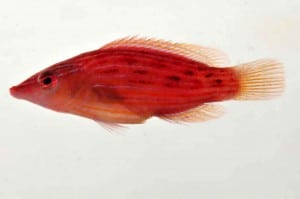
The colorful reddish pink wrasse is similar to the Eightstripe Wrasse, but we have discovered that this color form is actually an undescribed species in French Polynesia

The colorful reddish pink wrasse is similar to the Eightstripe Wrasse, but we have discovered that this color form is actually an undescribed species in French Polynesia

With this survey completed, we have now collected over 5000 vouchered fish samples for French Polynesia.  These samples will provide one of the most extensive databases of fishes worldwide for a region as large as French Polynesia.

(Photos by Jeff Williams)

To follow along and see more photos, please visit us on Facebook!  You can also follow the expedition on our Global Reef Expedition page, where there is more information about our research and team members.

Finding Angels

Thursday, February 21st, 2013

Written by Eva McClure

21st Feb. 2013

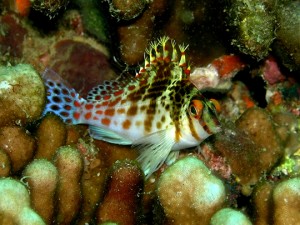
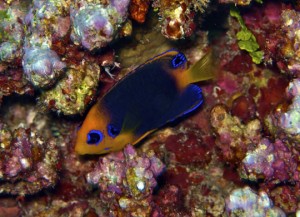
Spotting new fish species that you’ve never seen before and can’t put a name to is one of the many exciting and fulfilling aspects of being a fish surveyor with The Living Oceans Foundation’s Global Reef Expedition.  This latest expedition to the Gambier Archipelago in French Polynesia offered something particularly special – a sighting of a species of Pygmy Angelfish that according to best and current scientific knowledge has never  been seen before in this island group.  Introducing the Orangehead Pygmy Angelfish, Centropyge hotumatua. 


Orangehead Pygmy Angelfish

Orangehead Pygmy Angelfish


This colorful little critter was previously known to only occur in the far southern reaches of French Polynesia – the Austral Islands and Rapa Island (where GRE heads next!), as well as Pitcairn Island and Easter Island.  This is a rather narrow distribution for a fish species to have, so while spotting this fish in the Gambier’s might not sound that exciting at first, when you consider that from the Gambier’s its next known locations are ~700km to the southwest (Pitcairn’s) and ~1,000km to the east (Austral’s) over open ocean, it’s a pretty special find.


Angelfish generally lead a rather elusive and secretive life, and Pygmy Angels are usually under 10cm in length, so it’s not entirely surprising that the Orangehead Pygmy Angelfish has gone unnoticed in the Gambier’s for so long.  Further, the remoteness and relative anonymity of this island group as a superb diving location has no doubt helped keep this small fish hidden in the Gambier Islands until now.

Photo by Eva McClure

Hao Atoll at Eye Level

Sunday, January 20th, 2013

January 19, 2013

By Megan Berkle and Eddie Gonzalez

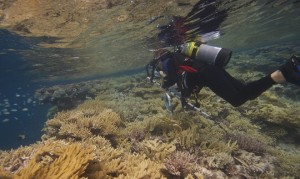
Research dives can be distilled down to lists of what is seen and what is not seen. Surveying the reef means figuring out what is there and what is missing. For the last few days, the science team has been jumping into a variety of sites inside the lagoon and outside the perimeter of Hao Atoll. As dive buddy teams enter the water, they scatter across the reef to deploy their instruments, gauges, transect lines, and quadrats with efficiency and purpose. It’s an amazing sight.

Divers descend to the reef to begin their surveys.

Divers descend to the reef to begin their surveys.

Clip boards and cameras record the species, size, distribution, abundance, and health of corals, sponges, fish, and invertebrates. By aggregating the observations, some early assessments are possible. For example, as in the other French Polynesia research sites, branching corals such as cauliflower coral (Pocillopora), table and staghorn corals (Acropora), thin crusts of corrugated leaf coral (Pavona), and fire coral (Millepora) are the more the common corals seen so far in Hao.

Dr. Andrew Bruckner, LOF Chief Scientist, scans the variety of coral.

LOF Chief Scientist, Dr. Andrew Bruckner, scans the variety of coral.

After each dive, the conversation on the dive boat quickly turns to the highlights. Fish ecologist, Badi Samaniego, caught a glimpse of the uncommon Chabanaud’s soapfish. On another dive, a giant manta ray (Manta alfredi) glided past the science team in the outer lagoon. Each dive reveals more about the underwater ecosystems at Hao Atoll.

A parrotfish, Chlorurus microrhinos, swims along the reef.

A parrotfish, Chlorurus microrhinos, swims along the reef.

(Photos by: 1 Brian Beck, 2 Joao Monteiro, and 3 Phil Renaud)

Badi Samaniego: The Human Fish Encyclopedia

Friday, September 21st, 2012

September 20, 2012

Written by Dr. Sonia Bejarano

It is no coincidence that this charismatic Filipino joined the Global Reef Expedition as a Foundation Fellow in its course across the Pacific Ocean. For the last 12 years of his life, Badi has been identifying and counting reef fish of all colours, sizes and shapes. What is remarkable about his skill, is that it takes an incredible photographic memory to ‘put a name to a face’ when it comes to identifying fish.

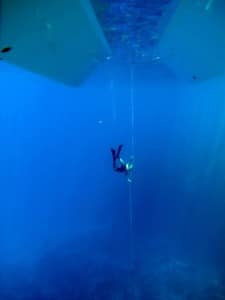
Badi Samaniego preparing for a scuba dive to survey reef fish

Badi Samaniego preparing for a scuba dive to survey reef fish


In the Pacific Ocean, trying to remember fish names when you are floating amidst extraordinarily colourful clouds of them could be as daunting as trying to remember the names (and surnames!) of more than a hundred of your friends at a party.

Read the rest of Badi Samaniego: The Human Fish Encyclopedia »

Final Reflections from Navassa

Monday, April 2nd, 2012
April 2, 2012
The mission to Navassa wrapped up on Friday. As the sun began to set, activity on the Golden Shadow continued. Laptops whirred while everyone entered their data for the week. Those not entering data compared notes, stories, and observations from the trip. Information about fish species, coral counts, discussions with the fishers and a lot more information will be compiled and processed by all the various organizations participating in the mission.
Mandy Karnauskas in the ship's office.

Mandy Karnauskas in the ship's office.

Fish Spotting (Scientifically)

Wednesday, March 14th, 2012

March 13, 2012

The swells had the final word today: we made only one dive, in the morning, off a rollicking Calcutta. The boat spent a few hours after lunch looking for a site that was protected from the swells and also had healthy coral, but no luck. So by 3 p.m. everyone was back on the Golden Shadow, which was rolling enough itself that the Captain decided to move the anchor slightly closer to Southwest Cay to keep the motion to a minimum. (You can estimate the size of the swells by what’s falling over on the dining table. Salt and pepper shakers = small, salad dressing = medium. Glasses tumbling? Big.)

Ferrying dive gear and divers to the Calcutta

Read the rest of Fish Spotting (Scientifically) »

Fish Spotting

Wednesday, August 17th, 2011

August 16, 2011

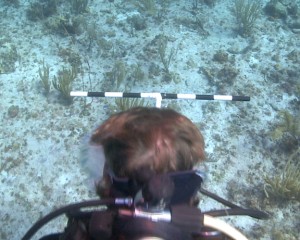
Have you ever wondered if reef fish communicate, sleep or defend a territory?  Scientific divers, Ken Marks and Dave Grenda, are on our team to survey and observe Caribbean reef fish in a quest to better understand how they contribute to reef health.  Ken and Dave have been participating in the Global Reef Expedition as our onboard fish experts.  Their assignment on each dive is to record a number of attributes about the fish populations in the Inaguas and Hogsty Reef. To achieve this objective, on each dive they reel out a 30-meter measuring tape, while swimming along holding a T-shaped meter stick used to estimate fish size and distance. This process is repeated a few times during each dive.  The diver records the species, sizes, and abundance of fishes encountered along the transect line.  This type of survey is known as a ‘belt transect’ and gives researchers a sample of reef fish density and biomass in a specific location.


Conducting a belt transect with a T-shaped meter stick off of Great Inagua, Bahamas

Conducting a belt transect with a T-shaped meter stick off of Great Inagua, Bahamas


Read the rest of Fish Spotting »

GRE Website YouTUBE Channel Follow on Facebook Follow on Twitter RSS Feed Updates LOF Website

Search

Calendar

May 2013
M T W T F S S
« Apr    
 12345
6789101112
13141516171819
20212223242526
2728293031  

Archives