Posts Tagged ‘porites lobata’

Rolling Stones

Wednesday, January 23rd, 2013

January 23, 2013

By Dr. Andrew Bruckner

Like other animals, corals need to reproduce to survive. Unlike most other animals, corals are attached to the seafloor and cannot move around to find a mate. To address this challenge, corals have developed several alternative reproductive patterns and modes of development. Some corals have separate sexes (gonochoric), while others are both male and female at the same time (hermaphroditic). Since self-fertilization is rare, every coral still needs a partner if they are going to successfully reproduce.
coral stuck in place

coral stuck in place


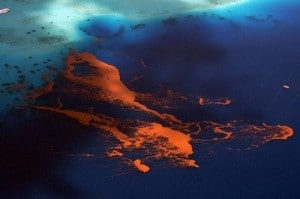
Usually, this is accomplished through synchronous spawning, whereby all colonies of a particular species release millions of gametes in unison, once per year, for a few hours, a certain number of days after the full moon (the exact timing is well documented and predictable from year to year). The eggs and sperm typically float to the surface, where they encounter other gametes of the same species, and fertilization occurs. The larvae then drift with the current for days to weeks, until they find a suitable place to attach and transform into a polyp. Very few of these larvae survive.

coral spawning slick

coral spawning slick


Other colonies are known as “brooders.” They may reproduce more frequently (sometimes monthly), usually producing fewer gametes at a time. Brooders need to be in close proximity because the female colony must take up sperm from the water column, and fertilization occurs internally. When the larvae are released from the female, they are better developed and have higher survival rates. They settle onto the reef and transform into a polyp much sooner.

Although sexual reproduction is the most common and the most important type of reproduction, corals also reproduce asexually by cloning themselves. A coral grows by constantly adding new polyps through a process known as budding. Corals can also increase in abundance through fragmentation, where branches that break off during storms reattach and continue growing. Other unique asexual reproductive strategies exist including polyp bailout, polyp expulsion, and asexual production of larvae; these offspring all lack a skeleton when first produced.

A more unusual strategy involves the production of “gemmae.” A single gemma starts as a mass of soft tissue on the sides or top of the coral that eventually develops a skeleton. It continues to grow, forming a small knob that will detach from the parent. The detached gemma looks just like the parent, except they are round or oval and completely covered in live tissue.

gemmae on Porites lobata

gemmae on Porites lobata


In the lagoonal habitats of Hao, one of the dominant frame-builders is the pore coral (Porites). This coral is long-lived, forming mountainous-shaped colonies that are several meters tall.  During our surveys, we found very few small colonies produced through sexual reproduction. This raises the question of how these corals are able to spread so successfully throughout the lagoon. Because wave action is minimal in lagoonal habitats and these corals produce a rigid skeleton, fragmentation is unlikely to be an important reproductive strategy. Until yesterday, we rarely found small fragments, as well.

Porites lobata

Porites lobata


On our fifth lagoonal dive, I encountered a very large (4 m tall) and very bumpy colony. Littered over the substrate and in depressions on the colony surface were hundreds of round to oval gemmae that ranged in size from 1 to 5 inches that originated from the colony. Most had tissue covering their entire skeleton and appeared to be actively growing, but they were completely unattached. The high number of these “rolling stones” produced by one colony of Porites, and their high survivorship, suggests this may be an important mode of reproduction for Porites in the Hao Lagoon.

rolling stones at base of coral

rolling stones at base of coral


 (Photos by: 1 Eddie Gonzalez, 2-5 Dr. Andrew Bruckner)

Triggerfish, Mussels and Coral

Monday, June 18th, 2012

June 15, 2012

Iliana Baums, a biologist at Penn State University, explained her research last night after dinner. She’s looking at Porites lobata, a major reef-building coral in the Pacific and Indian Oceans, and its identical-looking relative P. evermanni, and how they fit into the greater reef ecosystems. (These are what’s known as cryptic species, meaning they look the same morphologically but are genetically distinct.) She described the three-way interaction between the Porites corals, the mussels that bore into them, leaving distinctive keyhole-shaped holes, and the triggerfish that bite the coral trying to get at the mussels inside.

Porites lobata colony

Porites lobata colony

Read the rest of Triggerfish, Mussels and Coral »

Heading South

Monday, June 11th, 2012

June 10, 2012

This weekend marked the halfway point of the Galapagos expedition, both in time and in territory. After a week at Marchena, Darwin and Wolf, the latter two far to the north of the main group of islands, the ship will swing through a rough counterclockwise circle through the southern and western islands. We’ll stop at San Cristobal, Floreana and Isabela, and eventually circle back to Baltra over the coming week.

Saturday saw a few arrivals and departures, along with two dives in the Itibaca Canal between Baltra and Santa Cruz and an afternoon wall dive at Daphne Minor, a tiny islet north of Baltra, which was livened up by a few playful, curious sea lions. On Sunday morning, the Golden Shadow pulled up anchor and headed southwest for San Cristobal, the easternmost island in the Galapagos and home to the provincial capital, Puerto Baquerizo Moreno.

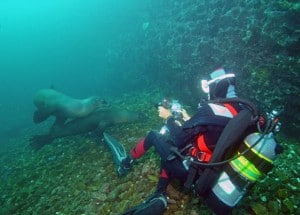
Two sea lions pose for a picture at Daphne Minor

Read the rest of Heading South »

GRE Website YouTUBE Channel Follow on Facebook Follow on Twitter RSS Feed Updates LOF Website

Search

Calendar

May 2013
M T W T F S S
« Apr    
 12345
6789101112
13141516171819
20212223242526
2728293031  

Archives