Posts Tagged ‘parrotfish’

Hao Atoll at Eye Level

Sunday, January 20th, 2013

January 19, 2013

By Megan Berkle and Eddie Gonzalez

Research dives can be distilled down to lists of what is seen and what is not seen. Surveying the reef means figuring out what is there and what is missing. For the last few days, the science team has been jumping into a variety of sites inside the lagoon and outside the perimeter of Hao Atoll. As dive buddy teams enter the water, they scatter across the reef to deploy their instruments, gauges, transect lines, and quadrats with efficiency and purpose. It’s an amazing sight.

Divers descend to the reef to begin their surveys.

Divers descend to the reef to begin their surveys.

Clip boards and cameras record the species, size, distribution, abundance, and health of corals, sponges, fish, and invertebrates. By aggregating the observations, some early assessments are possible. For example, as in the other French Polynesia research sites, branching corals such as cauliflower coral (Pocillopora), table and staghorn corals (Acropora), thin crusts of corrugated leaf coral (Pavona), and fire coral (Millepora) are the more the common corals seen so far in Hao.

Dr. Andrew Bruckner, LOF Chief Scientist, scans the variety of coral.

LOF Chief Scientist, Dr. Andrew Bruckner, scans the variety of coral.

After each dive, the conversation on the dive boat quickly turns to the highlights. Fish ecologist, Badi Samaniego, caught a glimpse of the uncommon Chabanaud’s soapfish. On another dive, a giant manta ray (Manta alfredi) glided past the science team in the outer lagoon. Each dive reveals more about the underwater ecosystems at Hao Atoll.

A parrotfish, Chlorurus microrhinos, swims along the reef.

A parrotfish, Chlorurus microrhinos, swims along the reef.

(Photos by: 1 Brian Beck, 2 Joao Monteiro, and 3 Phil Renaud)

Lagoon Life

Tuesday, April 17th, 2012

April 16, 2012

One of the most exciting aspects of this expedition is that every morning we get in the water having no idea what we’re about to find. There’s always something interesting to see, but sometimes the reefs we find are a little on the bland side. But what we saw on today’s second dive, chosen almost at random from the several large dark spots we could see around the lagoon, was something to travel for.

A view of Bajo Nuevo light and the lagoon from the Calcutta

A view of Bajo Nuevo light and the lagoon from the Calcutta

  Read the rest of Lagoon Life »

Rough Day at Bajo Nuevo

Monday, April 16th, 2012

April 15, 2012

Suffice it to say there will be no more photos of a mirror-like sea surface anytime soon. This morning we fought high winds and 1.5-meter swells in the channel that runs between Bajo Nuevo’s two main reefs, but still managed to get in one regular and two conch survey dives. There was a nearly 2-meter nurse shark waiting for us as soon as we hit the bottom. And, as expected, we found a place very different from Alice Shoal.
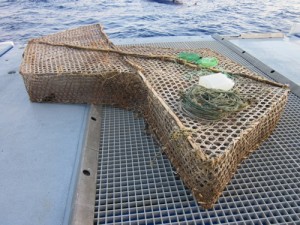
A peacock flounder

A peacock flounder

  Read the rest of Rough Day at Bajo Nuevo »

Virtual Connections

Thursday, March 29th, 2012

March 29, 2012

Throughout this week, students from two high schools—Gig Harbor High School in Gig Harbor, Washington and Corona del Sol High School in Tempe, Arizona—have been virtually following the Global Reef Expedition to learn more about the work of the Living Oceans Foundation. Recruited through the Coral Reef Educator on the Water (CREW) Program, the schools represent entirely different environments from that of Navassa. They recently had an opportunity to submit questions to Navassa Mission researchers.
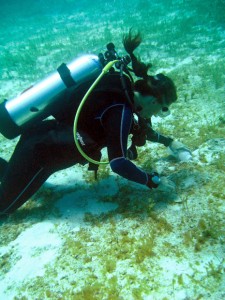
Our usual morning greeting.

Our usual morning greeting.

Read the rest of Virtual Connections »

Coral Reefs from the Ground Up

Sunday, March 18th, 2012

March 15, 2012

On each of today’s three dives, like all the others, the first thing Alexandra Dempsey does when she reaches the bottom is to pull out a plastic container about the size of a Nalgene water bottle, scoop it full of sand and tuck it away in a pocket before swimming off to other duties. These sediment sample collections are just one part of the expedition’s benthic (seafloor) research, led by Alex, Andy Ross and Rachel D’Silva.
Alexandra Dempsey scoops up sediment

When she returns to the Golden Shadow, Alex takes her bottle of wet sand to the lab and replaces the salt water with a solution of diluted bleach to neutralize any biological material. The bottles sit on a shelf until the expedition is over

Read the rest of Coral Reefs from the Ground Up »

Fish Spotting

Wednesday, August 17th, 2011

August 16, 2011

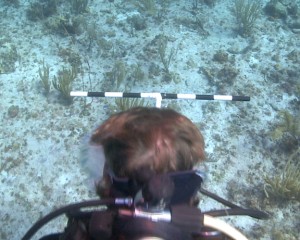
Have you ever wondered if reef fish communicate, sleep or defend a territory?  Scientific divers, Ken Marks and Dave Grenda, are on our team to survey and observe Caribbean reef fish in a quest to better understand how they contribute to reef health.  Ken and Dave have been participating in the Global Reef Expedition as our onboard fish experts.  Their assignment on each dive is to record a number of attributes about the fish populations in the Inaguas and Hogsty Reef. To achieve this objective, on each dive they reel out a 30-meter measuring tape, while swimming along holding a T-shaped meter stick used to estimate fish size and distance. This process is repeated a few times during each dive.  The diver records the species, sizes, and abundance of fishes encountered along the transect line.  This type of survey is known as a ‘belt transect’ and gives researchers a sample of reef fish density and biomass in a specific location.
 

Conducting a belt transect with a T-shaped meter stick off of Great Inagua, Bahamas

Conducting a belt transect with a T-shaped meter stick off of Great Inagua, Bahamas


Read the rest of Fish Spotting »

Best Wishes for Reef Fishes

Sunday, June 12th, 2011

June 12, 2011

Over the last ten days we were fortunate to have excellent weather and a hard working research team.  We completed surveys of representative reefs around both islands, hitting nearly every location we had planned.  Throughout this series of blogs, I mentioned a lot about the reef-builders, but have said little about reef fish and other megafauna.  We had a very talented team conducting quantitative belt transects to assess species abundance and size and local divers assessing species diversity.  We now have a detailed picture of the species diversity and population dynamics of reef-associated fishes. 
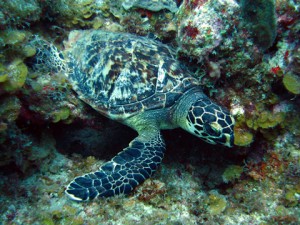
Like other locations in the Caribbean, we saw a lot of small reef fish, including large schools of chromis, bluehead wrasse, creole wrasses, hamlets, damselfishes, highhats and drums, soldierfish, and juveniles of many species.  However, there were few large fishes and certain species were completely absent.  Throughout the entire mission we did not see a single grouper and their close relatives, the hind and coney, were much smaller and less abundant than in most other locations. Snapper were notably absent. There was the occasional schoolmaster snapper, and a few other isolated individuals, but characteristic schools of schoolmaster snapper, large gray snapper, lane snapper, yellowtail snapper, mutton snapper and other species were rare or absent. Few pelagic predators were seen, other than a few small schools of horse eye jack and bar jack, and the isolated cero.

Butterflyfishes and angelfishes were present, but in very low numbers.  Only a few locations supported schools of grunts, and individual margates, hogfish and porkfish were seen only once or twice.  Queen triggerfish were also rare, but some exposed sites had large numbers of black durgon.

Few Queen triggerfish were found on the reef

Few Queen triggerfish were found on the reef

Read the rest of Best Wishes for Reef Fishes »

Exploring Monkey Shoals

Monday, June 6th, 2011
June 5, 2011

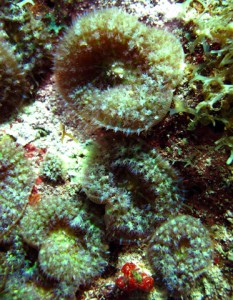
Our morning dives were located at Monkey Shoals, a submerged bank that lies about 3 miles offshore between St. Kitts and Nevis and west of the Narrows.  The reef structure is reminiscent of a Pacific atoll, without the typical emergent land encircling its perimeter.  The top of the shoal extends about 1 mile across, consisting of a relatively flat hardground habitat between 10-15 m in depth. A well-developed reef system encircles the perimeter, sloping gradually from about 15 m depth to a sand terrace at 30-40 m depth, before plummeting into deeper water.  This reef had a high amount of topographic relief, with many crevices, ledges and channels, mostly due to an extensive build-up of lobate and mountainous star coral.  These corals were often several meters in diameter, although most had died and were covered in fleshy algae, sponges and other encrustations.  Nevertheless, smaller colonies of these species abound and living patches of tissue survive at the bases of the larger corals and are beginning to regrow.  The reef substrate and dead skeletal surfaces of the star corals were also colonized by smaller brain corals, flower coral, cactus corals, finger corals, lettuce coral, mustard hill coral, and several other species, most of which were in excellent health. 
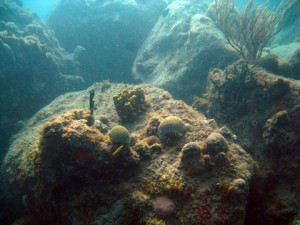
Sea fans were also common at this site, but other species of soft corals showed signs of a recent die-off.  All that remains of these is the hardened brownish central axis, which was often covered with fire coral.  We were told that the mortality event was due to an outbreak of flamingo tongues (Cyphoma gibbosum), an unusual gastropod mollusk with a creamy white mantle covered with irregular-shaped orange spots with black outlines.  This snail prefers to feed on soft corals, but usually leaves small feeding scars that rapidly heal.

Flamingo tongue (Cyphoma gibbosum)

Flamingo tongue (Cyphoma gibbosum)

We anchored on the top of the shoal in a large circular sand patch for our second dive, in an area called “the donut”.  In the center of the sandy area was a small patch reef with a vibrant fish community dominated by schools of grunts, small snappers, squirrelfish, parrotfish, wrasses and many other species.  At the edge of the sand, in about 10 m depth, was an undercut ledge about 50 cm in height that provided habitat and shelter for resting schools of snapper, grunts, glasseye snapper, soldierfish, highhats, nurse shark, and other reef fishes, as well as lobsters, crabs and other motile invertebrates.  Check out the video of these fish hanging out on YouTUBE.

Read the rest of Exploring Monkey Shoals »

First Day of Research

Sunday, June 5th, 2011
June 4, 2011

We began our research dives with two spots on the Atlantic side of the St. Kitts and Nevis, seaward of the narrows in a reef system known as Grid Iron.  This shallow reef stretches over 10 km from the northeastern end of Nevis to the coastline off St. Kitts.  Formerly a flourishing elkhorn coral reef at depths of 5-10 m, most of this coral died 30 years ago and dense interdigitated skeletons remain in growth position.  We did find a few survivors, some growing atop old skeletons and others sending branches up from the bottom. 

A surviving colony of elkhorn coral

A surviving colony of elkhorn coral

At the perimeter of the elkhorn coral thicket were unusually large (3-5 m diameter) colonies of lobate star coral (Montastraea annularis) and mountainous star coral (Montastraea faveolata).  Many of these had also had died, although a large number of the colonies still had small patches of live tissue on the topside of the lobe.  In some cases, these tissue remnants were actively resheeting over the skeletons and continuing their upward growth, resembling a juvenile coral. Large brain corals had suffered similar fate; many standing dead in place, others with small living tissue remnants dispersed over the colony surface.  However, a closer inspection of the reef revealed many signs of recovery.  A dozen species of coral had settled on the dead skeletons and were expanding outward.  While most of these were species that tend to be early colonizers and short-lived, such as mustard hill coral (Porites astreoides), we also saw a number of more long-lived massive corals like starlet coral (Siderastrea siderea) and brain corals (Diploria spp. and Colpophyllia natans).  A lot of the bottom was covered with fleshy seaweeds or macroalgae, especially a bushy brown macroalgae known as Dictyota. Underneath this alga, and also commonly seen covering dead coral heads was bright pink crustose coralline algae, which is a good sign as this is known to be preferred settlement surface for larval corals. 


Read the rest of First Day of Research »

GRE Website YouTUBE Channel Follow on Facebook Follow on Twitter RSS Feed Updates LOF Website

Search

Calendar

May 2013
M T W T F S S
« Apr    
 12345
6789101112
13141516171819
20212223242526
2728293031  

Archives