Posts Tagged ‘nurse shark’

The Sharks of Serranilla

Friday, April 20th, 2012

April 18, 2012

“The area was swarming with large sharks—or ‘gobblers,’ as we called them…The gobblers were a constant problem. At times there were as many as twenty nearby. They were of all species and sizes.”

That’s what underwater archaeologist and treasure hunter Robert Marx said of the waters surrounding Serranilla Bank after an expedition here in 1964. Marx was looking for the remains of the 15 gold-laden Spanish galleons that sunk here during a hurricane in 1665.
Hendra Agusman runs a tender past the lighthouse at Serranilla

Hendra Agusman runs a tender past the lighthouse at Serranilla


Read the rest of The Sharks of Serranilla »

Lagoon Life

Tuesday, April 17th, 2012

April 16, 2012

One of the most exciting aspects of this expedition is that every morning we get in the water having no idea what we’re about to find. There’s always something interesting to see, but sometimes the reefs we find are a little on the bland side. But what we saw on today’s second dive, chosen almost at random from the several large dark spots we could see around the lagoon, was something to travel for.

A view of Bajo Nuevo light and the lagoon from the Calcutta

A view of Bajo Nuevo light and the lagoon from the Calcutta

  Read the rest of Lagoon Life »

Shark Day

Monday, March 19th, 2012

March 17, 2012

St. Patrick’s Day saw the Calcutta leaving early for the far eastern end of Pedro Bank. The route took us across an area of deeper water and larger swells, so it took close to three hours of hard bouncing to cover the 41 km (25.5. mi) to Portland Rock, without a doubt one of the least inviting islets in the Caribbean. A nub of steep, sharp rock lashed by waves and covered with guano, it still had a few fisherman’s tents on top and a handful of fishing boats pulled up nearby.

Welcome to Portland Rock

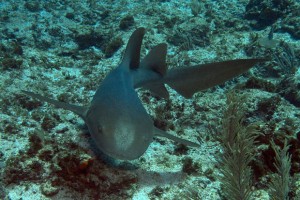
Unfortunately, even after asking these knowledgeable locals for advice, we weren’t able to find any spots with more than minimal coral cover, and the underwater visibility was low. Andy and Phil decided it would make better sense to backtrack another 30 minutes to tiny Blower Rock. The first dive was marked by huge colonies of star coral (Montastraea faveolata and M. annularis) up to 2.6 m (8.5 ft) across. We spotted our first nurse shark as soon as we entered the water, but Rachel soon got a closer look.

Read the rest of Shark Day »

Currents, Corals and a “Sleeping” Nurse Shark

Tuesday, March 13th, 2012

March 12, 2012

Whitecaps are never good news when you’re diving. Sure enough, the swell and breeze both grew overnight, though luckily not too big to take the Calcutta out. After a late start for some repairs, the dive boat brought the group to the first site of the day.  Under a merciless sun, everyone was happy to get in the water and set about their various tasks.

Brian Beck and CAPT Phil Renaud paired off to do transects: coral and photographic, respectively. Brian laid out a weighted 10-meter line on the bottom and proceeded to record every coral species for half a meter on either side, a slow, meticulous task that took the entire dive. Phil followed his own 10-meter line, taking high-resolution, digital photos of every square meter.

Back on the ship, these photos will be analyzed using an open-source program called Coral Point Count with Excel extension or CPCe. This gives you statistics on how much of the bottom each coral species (or whatever else you want to record) covers. It scatters any number of points on each photo, which you then have to tag as being a particular species of coral, healthy or not, or any other variable you want to record. It can take a long time — graduate school and internships involve a lot of this sort of work.

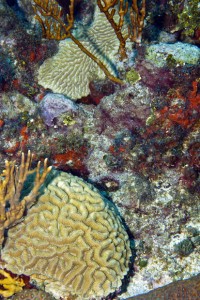
On his dive, Ken Marks spotted a species of coral that had just been described as new last November. Meandrina jacksoni is a hermatypic (stony) coral, meaning it helps build reefs with its calcium skeleton, as opposed to soft-bodies corals, which don’t. It looks a lot like Meandrina meandrites, the species it was originally lumped under, but its “brain” pattern has smaller ridges and whitish valleys. There are less than 100 hermatypic species in the Caribbean, so it’s a reef scientist’s dream to identify a new one.

Meandrina jacksoni (top) compared to Meandrina meandrites (bottom). See the difference?

Read the rest of Currents, Corals and a “Sleeping” Nurse Shark »

Best Wishes for Reef Fishes

Sunday, June 12th, 2011

June 12, 2011

Over the last ten days we were fortunate to have excellent weather and a hard working research team.  We completed surveys of representative reefs around both islands, hitting nearly every location we had planned.  Throughout this series of blogs, I mentioned a lot about the reef-builders, but have said little about reef fish and other megafauna.  We had a very talented team conducting quantitative belt transects to assess species abundance and size and local divers assessing species diversity.  We now have a detailed picture of the species diversity and population dynamics of reef-associated fishes. 

Like other locations in the Caribbean, we saw a lot of small reef fish, including large schools of chromis, bluehead wrasse, creole wrasses, hamlets, damselfishes, highhats and drums, soldierfish, and juveniles of many species.  However, there were few large fishes and certain species were completely absent.  Throughout the entire mission we did not see a single grouper and their close relatives, the hind and coney, were much smaller and less abundant than in most other locations. Snapper were notably absent. There was the occasional schoolmaster snapper, and a few other isolated individuals, but characteristic schools of schoolmaster snapper, large gray snapper, lane snapper, yellowtail snapper, mutton snapper and other species were rare or absent. Few pelagic predators were seen, other than a few small schools of horse eye jack and bar jack, and the isolated cero.

Butterflyfishes and angelfishes were present, but in very low numbers.  Only a few locations supported schools of grunts, and individual margates, hogfish and porkfish were seen only once or twice.  Queen triggerfish were also rare, but some exposed sites had large numbers of black durgon.

Few Queen triggerfish were found on the reef

Few Queen triggerfish were found on the reef

Read the rest of Best Wishes for Reef Fishes »

GRE Website YouTUBE Channel Follow on Facebook Follow on Twitter RSS Feed Updates LOF Website

Search

Calendar

June 2013
M T W T F S S
« May    
 12
3456789
10111213141516
17181920212223
24252627282930

Archives