Posts Tagged ‘Little Inagua’

Emily and Irene: A Tale of Two Storms

Wednesday, August 31st, 2011

August 31, 2011

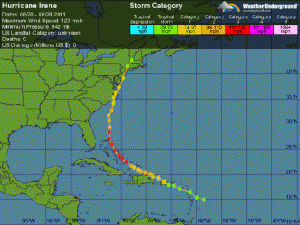
Prior to beginning our research at Little Inagua, we knew there was some “weather” occurring in the eastern Caribbean that we had to keep our eyes on.  At first, we thought we could leave one day early, transit back to Nassau, and avoid the storm.  However, when we awoke the morning of August 22nd, Captain Steve informed us that the questionable weather off to the east was blowing up into a Tropical Storm… known as Irene.
The path of Hurricane Irene

The path of Hurricane Irene

  Read the rest of Emily and Irene: A Tale of Two Storms »

Spawning Sponges at Little Inagua

Tuesday, August 30th, 2011

August 30, 2011

From August 19th-22nd, we experienced nothing but great wall diving around Little Inagua, which is always a diver’s delight.  The island of Little Inagua is five miles to the northeast of Great Inagua, and hosts a large Land and Sea Park. The island is 30 square miles and home only to herds of feral donkeys and goats, descendants of stock introduced by the French.   A protective reef surrounds Little Inagua on all sides, beginning at 14m depth and dropping nearly vertically to the ocean floor.


Nearly vertical wall off Little Inagua

Nearly vertical wall off Little Inagua

The winds come from the southeast in the summertime creating 4-6 foot swells and making scuba surveys on the south and east facing coastlines nearly impossible. Charts show the north and south ends of the island as sheer drop-offs with reefs almost exclusively on the east and west coasts.  This layout combined with the windy weather limited our research capabilities around Little Inagua to mostly the north and west sides.

Read the rest of Spawning Sponges at Little Inagua »

Science Without Borders®

Friday, August 5th, 2011

August 4, 2011

Science Without Borders® is a critical component of the Khaled bin Sultan Living Oceans Foundation’s Global Reef Expedition.  The founder, His Royal Highness Prince Khaled bin Sultan of the Kingdom of Saudi Arabia, was inspired by the well-known organization, Doctors Without Borders, to develop an initiative that could provide support for international marine conservation, public outreach and scientific research programs.  By complementing the objectives of our Global Reef Expedition, Science Without Borders® increases the potential to advance ocean preservation, protection and restoration around the globe.

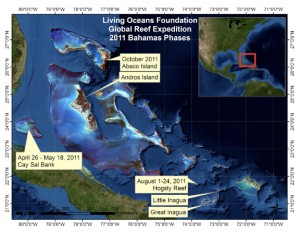
This year, three missions of the Global Reef Expedition are being carried out in the Bahamas.  The locations of these coral reef research projects include the Cay Sal Bank (held 26 April to 18 May, 2011), Great Inagua, Little Inagua and Hogsty Reef (in progress from 1 August to 24 August, 2011) and Abaco and Andros Islands (to be held in late September through mid-October, 2011).  The Science Without Borders® initiative is achieved for the Bahamas missions by means of collaboration with several Bahamian marine conservation organizations.  On the ship presently are four Bahamian scientific research divers, with two more joining the ship on the second half of the expedition.  These scientists represent various local organizations interested in contributing to the goals of the Global Reef Expedition while simultaneously achieving their own organization’s objectives.


2011 Bahamas Global Reef Expeditions with the Khaled bin Sultan Living Oceans Foundation

2011 Bahamas Global Reef Expeditions with the Khaled bin Sultan Living Oceans Foundation


Indira Brown is onboard to contribute her fish identification skills to the REEF (Reef Environmental Education Foundation) fish surveys that will be used on this expedition to assess fish diversity and abundance.  Indira comes to the expedition from the Bahamas Department of Marine Resources.  She will perform roving dive surveys to gain a comprehensive assessment of fish biodiversity around the Inaguas and Hogsty Reef.

Lindy Knowles will also be surveying fish at our study sites to contribute to the expedition’s evaluation of reef fish populations.  Lindy is an Assistant Parks Planner with the Bahamas National Trust in the Parks & Science Division.

On the team to contribute to the benthic (sea floor) and coral coverage studies is Agnessa Lundy, a scientific diver from The Nature Conservancy’s Bahamas Office.  Agnessa will help to identify and record the different species of algae, coral and other marine invertebrates we encounter.

Rounding out the Bahamian team on the present Global Reef Expedition is Krista Sherman.  Krista has a master’s degree in Marine Science and currently works for the Bahamas National Trust.  Krista’s marine invertebrate identification skills will be utilized in the expedition’s benthic and coral coverage research.


From Left to Right: Inidira Brown, Bahamas Dept. of Marine Resources; Krista Sherman, Bahamas National Trust; Angnessa Lundy, The Nature Conservancy Bahamas Office; Lindy Knowles, Bahamas National Trust

From Left to Right: Inidira Brown, Bahamas Dept. of Marine Resources; Krista Sherman, Bahamas National Trust; Agnessa Lundy, The Nature Conservancy Bahamas Office; Lindy Knowles, Bahamas National Trust


Tavares Thompson (a park warden on Andros Island for the Bahamas National Trust) and Alannah Vellacott (a biology major at the College of Bahamas) will join the second half of the expedition to conduct REEF and AGRRA fish surveys.

Thanks to Science Without Borders®, the research conducted in the Bahamas during the Global Reef Expedition will assist and support the Bahamian government’s decision-making process in determining the best courses of action to sustainably manage their valuable coral reef resources.


Written by Kit van Wagner

(Photo and Map by: Amanda Williams)

To follow along and see more photos, please visit us on Facebook! You can also follow the expedition on our Global Reef Expedition page, where there is more information about our research and our team members.


Welcome Back to the Bahamas!

Tuesday, August 2nd, 2011

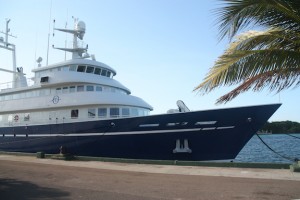
The screech of plane wheels, a jolt as the plane touches down, a muggy wait in line through Customs, a taxi ride to the cruise ship pier and a first glimpse of the Golden Shadow at the dock; in a nutshell this was the experience of most of the coral reef research team as they arrived in Nassau, Bahamas today.  The third leg of the Khaled bin Sultan Living Oceans Foundation’s Global Reef Expedition begins with the research team adjusting to life on the ship and stowing their gear, supplies, and equipment in anticipation of an early morning departure.


The Golden Shadow alongside the Nassau cruise ship pier

The Golden Shadow alongside the Nassau cruise ship pier


In addition to expedition preparations, several reporters from local media outlets came aboard the Golden Shadow to meet with Philip Renaud, the Executive Director of the Living Oceans Foundation.  Phil detailed the expedition’s goals and objectives to the reporters and answered their questions about how and where our coral reef research will be done.  Connecting with Bahamian news outlets is an important way for the Foundation to reach out to local people and share its updates, discoveries and accomplishments.  Several local press personnel will be participating in portions of the Inaguas Expedition.

As the reporters came and went, a moment’s reflection confirmed the saying, “There’s something for everyone.”  This certainly applied on-board today with the expedition’s research team sharing a wealth of backgrounds and expertise in fields as diverse as veterinarian pathology (the study of diseases in animals and in our case coral diseases), underwater videography, and reef fish feeding behaviors.


Executive Director, Philip Renaud is interviewed aboard the Golden Shadow

Executive Director, Philip Renaud is interviewed aboard the Golden Shadow by Gena Gibbs from the Bahamas Information Systems


The common denominator throughout the ship, however, is anticipation for exploration of the remote Inagua Islands and Hogsty Reef.  Great Inagua and Little Inagua together cover 645 square miles and are located less than 60 miles from the coasts of Cuba and Haiti in the far southeastern Bahamas.

Read the rest of Welcome Back to the Bahamas! »

GRE Website YouTUBE Channel Follow on Facebook Follow on Twitter RSS Feed Updates LOF Website

Search

Calendar

May 2013
M T W T F S S
« Apr    
 12345
6789101112
13141516171819
20212223242526
2728293031  

Archives