Posts Tagged ‘Jamaica’

Another Mission Begins: San Andres Archipelago

Thursday, April 12th, 2012

April 11, 2012

Last night, when most of expedition team arrived, the crew had the Golden Shadow anchored just off Jamaica’s Port Royal, at the mouth of Kingston Harbor. In the 16th and 17th centuries that was a pirate hotspot, but an earthquake submerged much of the town in 1692. Some historic remnants remain, but there was no time for sightseeing.

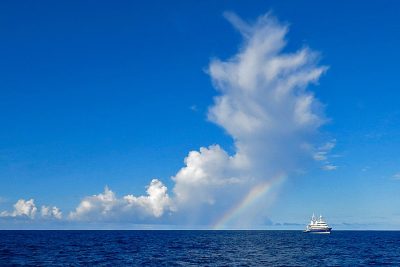
Everybody was onboard by sunset and we headed south at about 10 p.m. We couldn’t have asked for better conditions. Skies are clear, seas are flat calm, and forecasts say it should stay like this for at least a few days.


Flat calm seas

Flat calm seas

  Read the rest of Another Mission Begins: San Andres Archipelago »

Mission’s End

Thursday, March 22nd, 2012

March 19-20, 2012

The first day of spring was the last day of diving for the Pedro Bank mission. Winston “Shucksman” Kerr, a local fisherman, guided us to two sites within sight of the Golden Shadow. No nurse sharks today, but lots of coral, and two reef sharks appeared on the second dive. Nathalie Zenny speared a lionfish, which Winston neatly trimmed of its spines on board the Calcutta.

Winston “Shucksman” Kerr carefully trims off lionfish spines

The afternoon was a flurry of activity. Nathalie, Llewellyn, Andy Bruckner and a few others went to Middle Cay for a community meeting to explain the mission of the Global Reef Expedition and the Living Oceans Foundation and discuss all things reef-related.

Read the rest of Mission’s End »

The Other End of the Bank

Tuesday, March 20th, 2012

March 18, 2012

After a week of scuba, long boat rides and evenings filled with planning and data entry, the faces around the dinner table have grown progressively more tanned and tired. Sitting in the sun and moving a dozen or so 18-kg (40-lb) scuba tanks every day takes it out of you. It’s a good tired, though, the satisfied exhaustion of lots of work done well.

One reason everyone is tired: lifting scuba tanks every day

The second-to-last day of diving saw a brave boatload take the Calcutta 73 km (45 mi) to the far southwestern end of the Bank – two hours out and three hours back. And after all that, they only found two good dive sites. The first site, Northwest Ridge, had good coral reef structure, but a swift current. At the end of the dive, three researchers signaled for a pick-up by employing their “safety sausages,” neon-colored inflatable tubes that make you easy to spot when you surface far away from the boat.

Read the rest of The Other End of the Bank »

Shark Day

Monday, March 19th, 2012

March 17, 2012

St. Patrick’s Day saw the Calcutta leaving early for the far eastern end of Pedro Bank. The route took us across an area of deeper water and larger swells, so it took close to three hours of hard bouncing to cover the 41 km (25.5. mi) to Portland Rock, without a doubt one of the least inviting islets in the Caribbean. A nub of steep, sharp rock lashed by waves and covered with guano, it still had a few fisherman’s tents on top and a handful of fishing boats pulled up nearby.

Welcome to Portland Rock

Unfortunately, even after asking these knowledgeable locals for advice, we weren’t able to find any spots with more than minimal coral cover, and the underwater visibility was low. Andy and Phil decided it would make better sense to backtrack another 30 minutes to tiny Blower Rock. The first dive was marked by huge colonies of star coral (Montastraea faveolata and M. annularis) up to 2.6 m (8.5 ft) across. We spotted our first nurse shark as soon as we entered the water, but Rachel soon got a closer look.

Read the rest of Shark Day »

Mapping the Proposed Fish Sanctuary with the Starfish

Sunday, March 18th, 2012

March 16, 2012

Another long, three-dive day in the Calcutta, with more lionfish spearing and a sea turtle sighting. While almost everyone else was underwater, Steve Schill and his group—Sean Green, Junior Squire, and Azra Blythe-Mallet—were staying dry, although they were looking at the bottom in just as much detail. Based on the Twin Vee, Steve’s crew operates the brand-new Tritech Starfish 990f  sidescan sonar.

Sidescan sonar image, showing scanned areas to either side (brown) and unscanned area under the boat (black)

It looks like a little red plastic rocket, under 38 cm (15 in) long, but costs as much as a decent used car. This kind of sensor is often used by search and rescue teams for body recoveries, and also for surveys of wrecks, canals, lakes, ports and harbors—anywhere people want to know in detail what’s under water up to 35m (114 ft) deep.

Read the rest of Mapping the Proposed Fish Sanctuary with the Starfish »

Coral Reefs from the Ground Up

Sunday, March 18th, 2012

March 15, 2012

On each of today’s three dives, like all the others, the first thing Alexandra Dempsey does when she reaches the bottom is to pull out a plastic container about the size of a Nalgene water bottle, scoop it full of sand and tuck it away in a pocket before swimming off to other duties. These sediment sample collections are just one part of the expedition’s benthic (seafloor) research, led by Alex, Andy Ross and Rachel D’Silva.

Alexandra Dempsey scoops up sediment

When she returns to the Golden Shadow, Alex takes her bottle of wet sand to the lab and replaces the salt water with a solution of diluted bleach to neutralize any biological material. The bottles sit on a shelf until the expedition is over

Read the rest of Coral Reefs from the Ground Up »

Lionfish: Scourge of the Caribbean

Friday, March 16th, 2012

March 14, 2012

Today was a busy day: three dives and - finally – calm enough seas to launch the Twin V with Steve Schill’s sidescan sonar. The original plan was to do one dive, then stop by Middle Cay and ask the local fishermen for their thoughts on where to find good, protected patches of coral. But the visit was postponed after a fishing boat swung by the Calcutta as we were loading supplies and suggested a few locations on the spot. The crew of the Golden Shadow was happy to fill up their water container. Since the islands have no water sources besides rainfall, fresh water becomes currency out here, like a real-life version of the movie Waterworld.

Brown boobies like to follow the boats

The first dive took us to ridges of staghorn coral interspersed with deep sand pockets. A small nurse shark was resting under a low branch of coral. Toward the end of the dive, someone spotted a gaudy fish with red and black stripes and spots covering its body and long, wavy fins. Almost everyone in range had the same thought: who has the fish spear?

Read the rest of Lionfish: Scourge of the Caribbean »

Fish Spotting (Scientifically)

Wednesday, March 14th, 2012

March 13, 2012

The swells had the final word today: we made only one dive, in the morning, off a rollicking Calcutta. The boat spent a few hours after lunch looking for a site that was protected from the swells and also had healthy coral, but no luck. So by 3 p.m. everyone was back on the Golden Shadow, which was rolling enough itself that the Captain decided to move the anchor slightly closer to Southwest Cay to keep the motion to a minimum. (You can estimate the size of the swells by what’s falling over on the dining table. Salt and pepper shakers = small, salad dressing = medium. Glasses tumbling? Big.)

Ferrying dive gear and divers to the Calcutta

Read the rest of Fish Spotting (Scientifically) »

Currents, Corals and a “Sleeping” Nurse Shark

Tuesday, March 13th, 2012

March 12, 2012

Whitecaps are never good news when you’re diving. Sure enough, the swell and breeze both grew overnight, though luckily not too big to take the Calcutta out. After a late start for some repairs, the dive boat brought the group to the first site of the day.  Under a merciless sun, everyone was happy to get in the water and set about their various tasks.

Brian Beck and CAPT Phil Renaud paired off to do transects: coral and photographic, respectively. Brian laid out a weighted 10-meter line on the bottom and proceeded to record every coral species for half a meter on either side, a slow, meticulous task that took the entire dive. Phil followed his own 10-meter line, taking high-resolution, digital photos of every square meter.

Back on the ship, these photos will be analyzed using an open-source program called Coral Point Count with Excel extension or CPCe. This gives you statistics on how much of the bottom each coral species (or whatever else you want to record) covers. It scatters any number of points on each photo, which you then have to tag as being a particular species of coral, healthy or not, or any other variable you want to record. It can take a long time — graduate school and internships involve a lot of this sort of work.

On his dive, Ken Marks spotted a species of coral that had just been described as new last November. Meandrina jacksoni is a hermatypic (stony) coral, meaning it helps build reefs with its calcium skeleton, as opposed to soft-bodies corals, which don’t. It looks a lot like Meandrina meandrites, the species it was originally lumped under, but its “brain” pattern has smaller ridges and whitish valleys. There are less than 100 hermatypic species in the Caribbean, so it’s a reef scientist’s dream to identify a new one.

Meandrina jacksoni (top) compared to Meandrina meandrites (bottom). See the difference?

Read the rest of Currents, Corals and a “Sleeping” Nurse Shark »

Golden Shadow Heads to Jamaica’s Pedro Bank

Monday, March 12th, 2012

March 11, 2012

After a night boarding at Errol Flynn Marina at Port Antonio, Jamaica and a rolling crossing that left more than a few green faces and empty chairs at dinner, the Golden Shadow motored overnight to Pedro Bank, about 100 miles southwest of Kingston.

Loading up the Golden Shadow in Errol Flynn Marina, Port Antonio

Now we’re anchored off Southwest Cay, a.k.a. Bird Cay, one of four small, mostly empty islets that together cover a tenth of a square mile. It’s a strip of sand with a few bushes and palm trees and a long, low pile of what looks like bleached coral but is actually empty conch shells discarded by fishermen over the decades. Just beyond it is Middle Cay, one of two inhabited islets, with a Jamaican Coast Guard station, a research station built by The Nature Conservancy, and a scattering of fishing huts. Read the rest of Golden Shadow Heads to Jamaica’s Pedro Bank »

GRE Website YouTUBE Channel Follow on Facebook Follow on Twitter RSS Feed Updates LOF Website

Search

Calendar

May 2013
M T W T F S S
« Apr    
 12345
6789101112
13141516171819
20212223242526
2728293031  

Archives