Posts Tagged ‘herbivorous reef fish’

Reef Mysteries

Saturday, April 14th, 2012

April 13, 2012

At first, Alice Shoal seems something of a mystery. Many of the problems slamming reefs around the world are minimal here. This area doesn’t seem to be generally overfished, for instance, and there are no communities nearby to flood the place with algae-fueling pollution. Yet there’s not much coral here, the rocky bottom covered mostly by algae. And though less fished than other reefs in the region, on dive after dive we see almost no snappers and groupers, often sentinels of healthy reef systems.
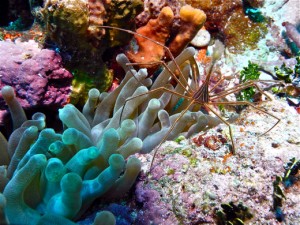
An arrow crab next to giant Caribbean anemone

An arrow crab next to giant Caribbean anemone

  Read the rest of Reef Mysteries »

Alice’s Fishes

Friday, April 13th, 2012

April 12, 2012

The reef at Alice Shoal was an impressive site today, as much for the human activity as the marine life. Rising up a few meters off the bottom I spotted divers working in pairs around me as far out as I could see. In between them were the welcome sight of countless fish—angels, huge surgeonfish, and loads of exquisite black durgeons.

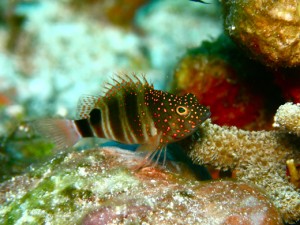
Redspotted hawkfish at Alice Shoal

Redspotted hawkfish at Alice Shoal


The reef here is in the 15 to 20 meter depth range, with most of the seafloor covered in algae and sponges. The contours are mild, with only the occasional rock ledge for fish or lobsters to hide beneath. There are corals here, but they’re sparse.

Each night the team comes together to discuss the day’s work. Tonight, the main topic was how much more plentiful, and in many cases larger, the fish are here compared to the to Pedro Bank, the site of an earlier mission. That’s not surprising, because Pedro Bank, about 130 kilometers northeast of Alice Shoal and much closer to Jamaica’s main island, is far less isolated, opening it to much heavier fishing. Here, we still haven’t seen a fishing boat.

Loading the Calcutta for our first dives at Alice Shoal

Loading the Calcutta for our first dives at Alice Shoal

  Read the rest of Alice’s Fishes »

How Does Wave Action Impact Grazing Reef Fish?

Saturday, August 13th, 2011

August 12, 2011

The Golden Shadow is back on the western shore of Great Inagua and the day has been packed with activity, as team members leave and arrive, new research projects are launched, and scientific surveys around Great Inagua continue.  Early this morning we bid farewell to our Bahamian friends who have been on board since the beginning of the expedition helping with scientific surveys of Great Inagua and Hogsty Reef.  Two new team members joined us today, Alannah Vellacott, a student at College of The Bahamas, and Tavares Thompson, Park Warden with the Bahamas National Trust.

One research team in particular is excited to begin following-up on previous research projects from the Cay Sal expedition (26 April to 18 May 2011).  Team Parrotfish is studying herbivorous reef fish, and is made up of Dr. Sonia Bejarano, a Living Oceans Foundation Fellow, and Christian Clark, the current North American Rolex Scholar.  Dr. Bejarano has been studying herbivorous reef fish internationally.  In the Bahamas, these are usually species of parrotfish and surgeonfish.  She is attempting to understand how many herbivorous fish live in an area (their abundance) and how much they feed in and around the coral reefs.  During the Cay Sal expedition, Dr. Bejarano used fish counts and underwater video cameras to record herbivorous reef fish abundance and feeding behavior respectively.


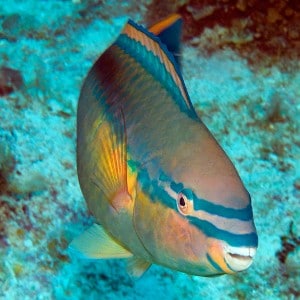
The Princess Parrotfish (Scarus taeniopterus) is a common herbivore on the reefs around Great Inagua

The Princess Parrotfish (Scarus taeniopterus) is a common herbivore on the reefs around Great Inagua

Read the rest of How Does Wave Action Impact Grazing Reef Fish? »

GRE Website YouTUBE Channel Follow on Facebook Follow on Twitter RSS Feed Updates LOF Website

Search

Calendar

May 2013
M T W T F S S
« Apr    
 12345
6789101112
13141516171819
20212223242526
2728293031  

Archives