Posts Tagged ‘Great Inagua’

Emily and Irene: A Tale of Two Storms

Wednesday, August 31st, 2011

August 31, 2011

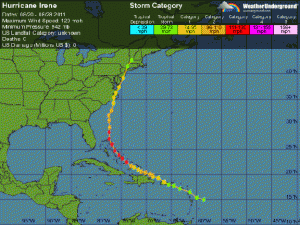
Prior to beginning our research at Little Inagua, we knew there was some “weather” occurring in the eastern Caribbean that we had to keep our eyes on.  At first, we thought we could leave one day early, transit back to Nassau, and avoid the storm.  However, when we awoke the morning of August 22nd, Captain Steve informed us that the questionable weather off to the east was blowing up into a Tropical Storm… known as Irene.
The path of Hurricane Irene

The path of Hurricane Irene

  Read the rest of Emily and Irene: A Tale of Two Storms »

Surveying with Sound Waves

Thursday, August 18th, 2011

August 17, 2011

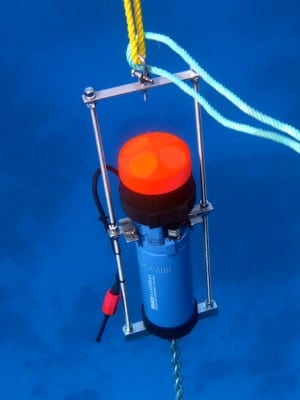
Ten days ago scientists and crew from the Golden Shadow deployed a piece of equipment known as a Recording Doppler Current Profiler (RDCP).  Today, team members collected it from the waters off the western side of Great Inagua.  The RDCP, a type of acoustic Doppler profiler, has been suspended over the sea floor collecting data at regular intervals to provide the expedition with some critical information that would be difficult, if not impossible, to collect manually.  The RDCP measures how fast water is moving as it passes over a set point from the sea floor to the surface; a vertical span is known as the water column.  A secured RDCP can measure the speed of the current at regular intervals from its anchorage to the surface.  The RDCP uses acoustic (sound) waves to measure water currents.  Like a dolphin using echolocation, the device sends out a series of pings.  These waves of sound bounce off of the surrounding environment and return to the instrument where any change in pitch is recorded.


The Recording Doppler Current Profiler (RDCP) suspended in the water column

The Recording Doppler Current Profiler (RDCP) suspended in the water column

Read the rest of Surveying with Sound Waves »

Fish Spotting

Wednesday, August 17th, 2011

August 16, 2011

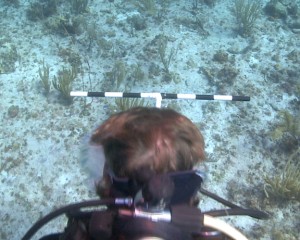
Have you ever wondered if reef fish communicate, sleep or defend a territory?  Scientific divers, Ken Marks and Dave Grenda, are on our team to survey and observe Caribbean reef fish in a quest to better understand how they contribute to reef health.  Ken and Dave have been participating in the Global Reef Expedition as our onboard fish experts.  Their assignment on each dive is to record a number of attributes about the fish populations in the Inaguas and Hogsty Reef. To achieve this objective, on each dive they reel out a 30-meter measuring tape, while swimming along holding a T-shaped meter stick used to estimate fish size and distance. This process is repeated a few times during each dive.  The diver records the species, sizes, and abundance of fishes encountered along the transect line.  This type of survey is known as a ‘belt transect’ and gives researchers a sample of reef fish density and biomass in a specific location.


Conducting a belt transect with a T-shaped meter stick off of Great Inagua, Bahamas

Conducting a belt transect with a T-shaped meter stick off of Great Inagua, Bahamas


Read the rest of Fish Spotting »

The Lionfish Predicament

Tuesday, August 16th, 2011

August 15, 2011

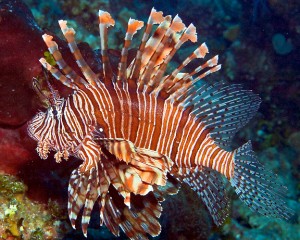
Although no one knows for certain how they came to be in the Caribbean Sea, lionfish are probably here to stay.  Living Oceans Foundation research divers have noted lionfish on every dive in Great Inagua and Hogsty Reef so far.  Atlantic and Gulf Rapid Reef Assessment (AGRRA) surveys first detected lionfish around Andros Island, Bahamas in 2007, although they may have been present prior to that date.  Since then, their numbers have been steadily rising, as has the size of the individual lionfish observed during survey dives.  Today, lionfish are present throughout the Caribbean.  In fact, lionfish have been spotted in the Western Atlantic Ocean as far north as Rhode Island, and as far south as Colombia.


Lionfish photographed on the reefs around Great Inagua, Bahamas

Lionfish photographed on the reefs around Great Inagua, Bahamas

Read the rest of The Lionfish Predicament »

Off the Deep End

Monday, August 15th, 2011

August 14, 2011

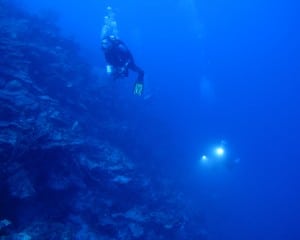
Like jumping feet first into the rabbit hole made famous in “Alice in Wonderland” by Lewis Carroll, the deeper you dive on a reef, the more things change in interesting ways.  “Curiouser and curiouser,” mused Alice as she delved into her subterranean world.   A diver passing through a deep coral reef might well think the same thing.  This morning, CAPT Phil Renaud, Executive Director of the Khaled bin Sultan’s Living Oceans Foundation and Dr. Bernhard Riegl of the National Coral Research Institute based out of Nova Southeastern University in Florida (supported by the Dive Safety Officer and Videographer), had a rare opportunity to experience the deep reef first-hand.  The purpose of their excursion into the depths was to compare a small portion of the deep reef around Great Inagua with the shallow reefs we have been surveying thus far on the expedition.


A sheer drop-off to deeper water on the reef around Great Inagua

A sheer drop-off to deeper water on the reef around Great Inagua


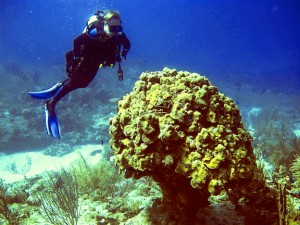
The divers immediately noticed that the hemi-spherical shapes many coral species adopt in the shallows morphed into a flat, plate-like formation at depth.  This growth pattern is caused by lower amounts of sunlight penetrating the water as depth increases.  To maximize growth rates and, in turn, the amount of sunlight being received by their zooxanthellae algae [zoo-zan-thel-ee], corals adopt a flat morphology at depth.  Individual coral animals, known as polyps, house a multitude of microscopic zooxanthellae in their tissues.  Thousands of specks of the minute algae photosynthesize, using carbon dioxide released by the coral as it metabolizes.  This process also provides the polyps with oxygen and organic nutrients.  The coral-zooxanthellae partnership is known as a symbiotic relationship.  In this case, because both parties benefit from their interactions, scientists refer to it as mutualism.


Deep-water corals exhibiting a flat plate-like morphology to maximize their ability to harvest available sunlight

Deep-water corals exhibiting a flat plate-like morphology to maximize their ability to harvest available sunlight


Read the rest of Off the Deep End »

The Dark Side of Corals

Sunday, August 14th, 2011

August 13, 2011

Over the past few decades there has been a rapid decline in the health of shallow water scleractinian corals (stony or hard corals).  Simultaneously, there has been a steady increase in the number of coral diseases being reported.  Many of these diseases have been identified by field characteristics – the color of the affected tissue, the shape of exposed skeleton, advancing patterns of tissue loss, or the presence of unusual structural features – rather than by the agent causing the disease.  For this reason, coral diseases have acquired names like black-band disease, red-band disease, dark spots, white pox disease and white plague.  Unfortunately, there have been relatively few scientific studies that have conclusively described the structural and cellular (morphological) changes underlying these different syndromes, or even the causes of the various changes.


Agaricia agaricites showing dark spots disease on reefs around Great Inagua

Agaricia agaricites showing dark spots disease on the reef around Great Inagua

Read the rest of The Dark Side of Corals »

How Does Wave Action Impact Grazing Reef Fish?

Saturday, August 13th, 2011

August 12, 2011

The Golden Shadow is back on the western shore of Great Inagua and the day has been packed with activity, as team members leave and arrive, new research projects are launched, and scientific surveys around Great Inagua continue.  Early this morning we bid farewell to our Bahamian friends who have been on board since the beginning of the expedition helping with scientific surveys of Great Inagua and Hogsty Reef.  Two new team members joined us today, Alannah Vellacott, a student at College of The Bahamas, and Tavares Thompson, Park Warden with the Bahamas National Trust.

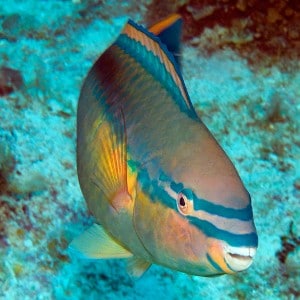
One research team in particular is excited to begin following-up on previous research projects from the Cay Sal expedition (26 April to 18 May 2011).  Team Parrotfish is studying herbivorous reef fish, and is made up of Dr. Sonia Bejarano, a Living Oceans Foundation Fellow, and Christian Clark, the current North American Rolex Scholar.  Dr. Bejarano has been studying herbivorous reef fish internationally.  In the Bahamas, these are usually species of parrotfish and surgeonfish.  She is attempting to understand how many herbivorous fish live in an area (their abundance) and how much they feed in and around the coral reefs.  During the Cay Sal expedition, Dr. Bejarano used fish counts and underwater video cameras to record herbivorous reef fish abundance and feeding behavior respectively.


The Princess Parrotfish (Scarus taeniopterus) is a common herbivore on the reefs around Great Inagua

The Princess Parrotfish (Scarus taeniopterus) is a common herbivore on the reefs around Great Inagua

Read the rest of How Does Wave Action Impact Grazing Reef Fish? »

Hogsty Reef: It’s No Pig Pen

Wednesday, August 10th, 2011

August 9, 2011

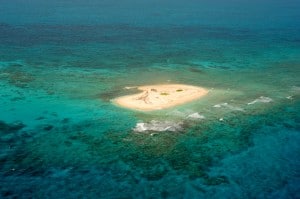
Early this morning, the Golden Shadow left its anchorage off Great Inagua and moved north to Hogsty Reef, one of only a few atolls in the Caribbean.  The opportunity to survey such a rare Bahamian coral formation is a true highlight of this leg of the Global Reef Expedition.  With a good weather forecast on the horizon, the research team opted to prioritize surveys of Hogsty Reef.


Eastern edge of Hogsty Reef, Bahamas

Eastern edge of Hogsty Reef, Bahamas


Charles Darwin first developed a hypothesis about how atolls form, describing an atoll as a more or less continuous reef surrounding a distinct lagoon.  Lagoons may contain small patch reefs, as does Hogsty’s lagoon.  In the Pacific, where they are far more common, atolls form when volcanic islands and the underlying subfloor, subside.  As the island sinks, the fringing reefs around the island continue to grow upward becoming a barrier reef surrounding the lagoon.

Atolls in the Caribbean are typically not volcanic in origin.  Scientists refer to them as “pseudo-atolls.”  However, they do have true atoll characteristics: an outer reef (fore reef), a perimeter rim (reef rim) and a central lagoon.  The outer reef starts in deep water with shallower portions subject to ocean swells that break around the circumference of the entire atoll.  The bottom depths around Hogsty Reef reach an incredible 1800 m.   Reef building corals start to grow in roughly 50 m of water, rising up to within a meter of the surface.  The perimeter rim contains both reef flats and islands.  Reef flats are shallow reef structures that are frequently exposed during low tides and subjected to heavy wave action.  Algae encrusted coral debris is plentiful here.  Waves around the rim of the atoll also form islands.  On Hogsty Reef there are two sandy islands in the perimeter rim.  Northwest Cay and Southeast Cay stand on either side of a gap on the western side of the atoll.  The Golden Shadow is currently anchored in this gap.


Satellite image of Hogsty Reef and its key components

Satellite image of Hogsty Reef and its key components


Read the rest of Hogsty Reef: It’s No Pig Pen »

Teamwork on the Reef

Monday, August 8th, 2011

August 7, 2011

Sunshine and calm seas greeted the Golden Shadow as she lay at anchor in Man of War Bay on the west side of Great Inagua.  After a quick breakfast, the first researchers set off to start the day’s survey work.  The scientists on board for the Inaguas leg of the Global Reef Expedition have been organized into several research teams.  Team Parrotfish is engaged in reef fish herbivory studies, while Team Barracuda members are responsible for recording the benthic organisms including coral coverage.  Team Eagle Ray is surveying fish, corals and any coral diseases they encounter during their underwater investigations.


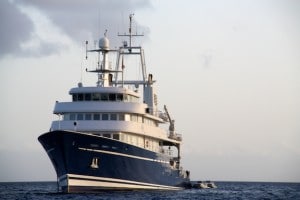
The Golden Shadow at anchor in Man of War Bay, Great Inagua

The Golden Shadow at anchor in Man of War Bay, Great Inagua


Team Worldview is responsible for creating underwater maps of the area.  They accomplish this in part by groundtruthing data that has been previously acquired from satellites and aerial photographs.  The team validates existing satellite map data by collecting depth soundings, taking videos of the seafloor, and making observations that will assist in the process of generating detailed habitat maps for the area.  Additionally, the team uses a technique called sub-bottom profiling, which utilizes highly specialized equipment to send out acoustic energy that penetrates beneath the sea floor.  The sound waves help the scientists identify and map the composition of sub-surface materials, such as sand and limestone rock.  The picture generated by this method of sampling reveals the arrangement of sub-surface materials and helps coral reef researchers understand more about the composition and structure of the reef.   For example, in the Bahamas deep, eroded formations known as blue holes will often occur in the limestone bedrock.  Sub-bottom profiling allows researchers to tell the difference between how deep a blue hole really is, and how much of it has been filled in by sand.  In this way, the acoustic surveys help to tell the story of the reef’s geological history.  This helps coral reef researchers to understand the bigger picture of reef formation and gradual changes over time.


Aerial view of a Bahamian blue hole in Cay Sal studied during the Cay Sal Global Reef Expedition. Note the transect line intersecting the geologic feature with two points labeled 'A' and 'B' on either side of the blue hole.

Aerial view of a Bahamian blue hole in Cay Sal studied during the Cay Sal Global Reef Expedition. Note the transect line intersecting the geologic feature with two points labeled 'A' and 'B' on either side of the blue hole.


Profile view of the blue hole pictured above, at the  point labeled 'B'.  This image was generated with acoustic sub-bottom profiling technology and clearly shows the limestone wall of the blue hole and the sand (or sediment) that has been deposited in the blue hole over time.

Profile view of the blue hole pictured above, at the point labeled 'B'. This image was generated with acoustic sub-bottom profiling technology and clearly shows the limestone wall of the blue hole and the sand (or sediment) that has been deposited in the blue hole over time.


Read the rest of Teamwork on the Reef »

The Reef at First Sight

Sunday, August 7th, 2011

August 6, 2011

At last we have reached the Inaguas!  After a few days underway, the Golden Shadow is laying at anchor off the western shore of Great Inagua.  Great Inagua is located between 20.9° to 21.4° North latitude and 73° to 73.9° West longitude.  As this blog is being written, divers are counting and identifying fish, corals and invertebrates, measuring coral coverage, searching for corals affected by disease, and mapping the underwater habitats of the area using high tech electronics.

The day began with checkout dives for the divers in need of a refresher and a brief soak in the cerulean waters.  Once everyone had all the details of dive gear and scientific sampling equipment sorted out, the real work began.  A small scouting team left the Golden Shadow in one of the rigid-hull inflatable boats (known as a RHIB, or a tender) to check out a reef they had spotted in aerial photographs on the over-flight reconnaissance mission several weeks ago (read more about that airborne expedition in a previously posted blog by clicking here).  The spot proved to be perfect for scientific study and was agreed upon as the first dive sight of the expedition.


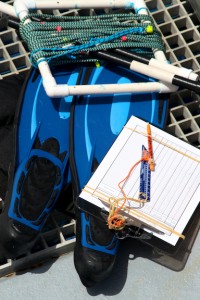
Data sheets, quadrats and meter sticks are just some of the equipment used to survey the coral reefs during the expedition

Data sheets, survey lines, quadrats and meter sticks are just some of the equipment used to survey the coral reefs during the expedition


After lunch, the first group of scientific divers departed for the dive site and began sampling and surveying.  Throughout the afternoon’s dives, the research divers were pleased to find healthy corals, representative fish populations and few signs of overfishing or damage from boat anchors.  Because the Inaguas are relatively isolated and support a small population of people (less than 2000 individuals), the man-made impacts and pressures that are all too common on many reefs are not immediately apparent here.


Research divers head out for the first fish, coral, and coral disease surveys of the Inaguas Global Reef Expedition

Research divers head out on the first fish, coral, and coral disease surveys of the Inaguas Global Reef Expedition


Read the rest of The Reef at First Sight »

GRE Website YouTUBE Channel Follow on Facebook Follow on Twitter RSS Feed Updates LOF Website

Search

Calendar

May 2013
M T W T F S S
« Apr    
 12345
6789101112
13141516171819
20212223242526
2728293031  

Archives