Posts Tagged ‘El Nino’

Part 2: Life, Death and Rebirth of a Coral Reef

Monday, October 1st, 2012

September 30, 2012

Written by Dr. Andy Bruckner

Life on a coral reef in French Polynesia can be extremely unforgiving. Natural factors, especially cyclones, crown of thorns seastar (COTS) outbreaks and coral bleaching events, have caused severe damage.  Fortunately, because of the isolation and low human population density, human impacts are relatively low, except near a few urban areas.
French Polynesia is located within an area of unusually strong cyclone activity. For the first 80 years of the 20th century, Society Islands was not affected by a single cyclone. Shortly thereafter, in 1982, 7 major storms struck the region. Since then, there have been another 85 cyclones, mostly coming from the south. There was a lull in storm activity between 2003-2006, and then 2 cyclones hit in 2007. Most recently, Tropical Cyclone Oli hit French Polynesia on February 3, 2010.

Tropical cyclones can be hundreds of kilometers wide, which would cover all of French Polynesia.

Tropical cyclones can be hundreds of kilometers wide, which would cover all of French Polynesia.

Read the rest of Part 2: Life, Death and Rebirth of a Coral Reef »

An Interview with Peter Glynn

Monday, June 18th, 2012

June 16, 2012

Peter Glynn, Professor of Marine Biology and Fisheries at the University of Miami, was one of the first scientists to study the coral reefs of the Galapagos. He’s the head of the U. Miami team on board the Golden Shadow, which includes four of his former students: Iliana Baums, Derek Manzello, Tyler Smith and Joshua Feingold.

Peter Glynn (L) and Bernhard Riegl at Concha y Perla lagoon

Peter Glynn (L) and Bernhard Riegl at Concha y Perla lagoon

How did you first get involved in studying the coral reefs in the Galapagos?

In 1974, Jerry Wellington was here with the Peace Corps surveying marine habitats for the Galapagos National Park. I was staff scientist at the Smithsonian Tropical Research Institute in Panama. When I got wind he was finding coral reefs, I hooked up with him and in 1975 we put together an expedition to survey all the coral reef habitats.

Read the rest of An Interview with Peter Glynn »

El Niño in the Galapagos

Tuesday, June 12th, 2012

June 12, 2012

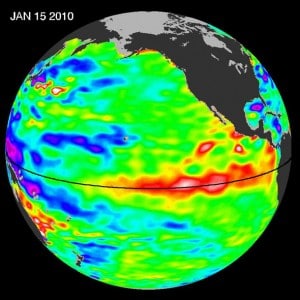
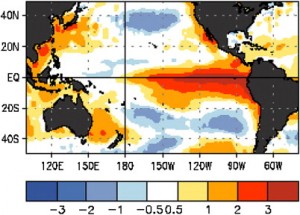
You can’t talk about coral in the Galapagos without talking about the atmospheric phenomenon called El Niño Southern Oscillation (ENSO). Normally, west-blowing trade winds push warm waters into the western Pacific Ocean. Every four or five years on average, though, the trade winds die down, or even reverse, and these warm waters move east as far as the west coast of South America, raising water temperatures as much as 7 to 10 degrees C.

NASA image of 2010 El Nino

NASA image of 2010 El Nino shows warm water (red areas) approaching South America

ENSO can last anywhere from nine months to two years—usually about a year and a half—but while it does, it affects weather around the world, and especially around the Galapagos. The phenomenon was called El Niño (“The Child” in Spanish) because it usually starts around Christmas. It’s considered to be linked to global warming, since it has been happening more often and with more drastic results as global temperatures have risen, but the root causes are still unclear.

Read the rest of El Niño in the Galapagos »

GRE Website YouTUBE Channel Follow on Facebook Follow on Twitter RSS Feed Updates LOF Website

Search

Calendar

May 2013
M T W T F S S
« Apr    
 12345
6789101112
13141516171819
20212223242526
2728293031  

Archives