Posts Tagged ‘currents’

Galapagos Currents

Thursday, June 7th, 2012

June 5, 2012

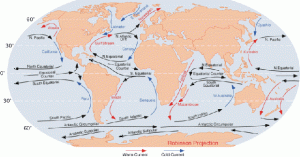
Why are the waters around the Galapagos Islands so rich with marine life? It’s because the islands are in a very special spot.  Oceanographically speaking, they at the intersection of five major ocean currents. Along with the equatorial surface weather, these currents help dictate the islands’ climate and their unique ecology, both above and below the water.
Ocean currents

Ocean currents

Ever since man has been coming to the Galapagos, we’ve been struck by how mild the climate is for being right on the equator. Charles Darwin wrote how surprisingly un-tropical the weather was, stating, “[It] is far from being excessively hot…excepting during one short season, very little rain falls, and even then it is irregular.” Being a genius, he also pinpointed the main reason, “[T]his seems chiefly caused by the singularly low temperature of the surrounding water, brought here by the great southern Polar current.”

Read the rest of Galapagos Currents »

Currents, Corals and a “Sleeping” Nurse Shark

Tuesday, March 13th, 2012

March 12, 2012

Whitecaps are never good news when you’re diving. Sure enough, the swell and breeze both grew overnight, though luckily not too big to take the Calcutta out. After a late start for some repairs, the dive boat brought the group to the first site of the day.  Under a merciless sun, everyone was happy to get in the water and set about their various tasks.

Brian Beck and CAPT Phil Renaud paired off to do transects: coral and photographic, respectively. Brian laid out a weighted 10-meter line on the bottom and proceeded to record every coral species for half a meter on either side, a slow, meticulous task that took the entire dive. Phil followed his own 10-meter line, taking high-resolution, digital photos of every square meter.

Back on the ship, these photos will be analyzed using an open-source program called Coral Point Count with Excel extension or CPCe. This gives you statistics on how much of the bottom each coral species (or whatever else you want to record) covers. It scatters any number of points on each photo, which you then have to tag as being a particular species of coral, healthy or not, or any other variable you want to record. It can take a long time — graduate school and internships involve a lot of this sort of work.

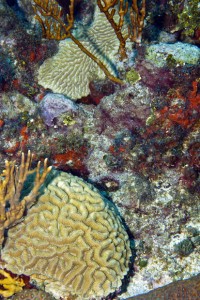
On his dive, Ken Marks spotted a species of coral that had just been described as new last November. Meandrina jacksoni is a hermatypic (stony) coral, meaning it helps build reefs with its calcium skeleton, as opposed to soft-bodies corals, which don’t. It looks a lot like Meandrina meandrites, the species it was originally lumped under, but its “brain” pattern has smaller ridges and whitish valleys. There are less than 100 hermatypic species in the Caribbean, so it’s a reef scientist’s dream to identify a new one.

Meandrina jacksoni (top) compared to Meandrina meandrites (bottom). See the difference?

Read the rest of Currents, Corals and a “Sleeping” Nurse Shark »

Surveying with Sound Waves

Thursday, August 18th, 2011

August 17, 2011

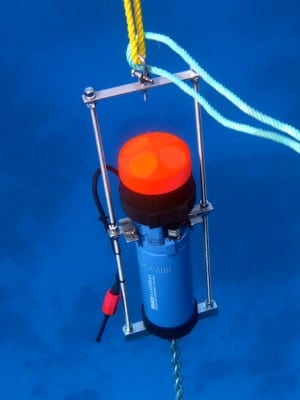
Ten days ago scientists and crew from the Golden Shadow deployed a piece of equipment known as a Recording Doppler Current Profiler (RDCP).  Today, team members collected it from the waters off the western side of Great Inagua.  The RDCP, a type of acoustic Doppler profiler, has been suspended over the sea floor collecting data at regular intervals to provide the expedition with some critical information that would be difficult, if not impossible, to collect manually.  The RDCP measures how fast water is moving as it passes over a set point from the sea floor to the surface; a vertical span is known as the water column.  A secured RDCP can measure the speed of the current at regular intervals from its anchorage to the surface.  The RDCP uses acoustic (sound) waves to measure water currents.  Like a dolphin using echolocation, the device sends out a series of pings.  These waves of sound bounce off of the surrounding environment and return to the instrument where any change in pitch is recorded.


The Recording Doppler Current Profiler (RDCP) suspended in the water column

The Recording Doppler Current Profiler (RDCP) suspended in the water column

Read the rest of Surveying with Sound Waves »

GRE Website YouTUBE Channel Follow on Facebook Follow on Twitter RSS Feed Updates LOF Website

Search

Calendar

May 2013
M T W T F S S
« Apr    
 12345
6789101112
13141516171819
20212223242526
2728293031  

Archives