Posts Tagged ‘coral’

Filling in the Gaps

Tuesday, March 12th, 2013

12th March 2013

Written by Dr.  Brian Beck

It was back in November when we first conducted research in Rangiroa. A delayed start to that research mission meant we were not able to complete all that we wanted to then, so we are now back filling in the gaps.

The ring of land that makes up the atoll isn’t very high and there are often gaps and breaks in the ring

The ring of land that makes up the atoll isn’t very high and there are often gaps and breaks in the ring


Last year we focused our efforts on the northern part of the atoll with 4 dives on the outside of the atoll and five dives in the lagoon. Now in just the first two days of surveying we have added an additional 6 sites on the outside of the atoll.

A map of Rangiroa showing the surveys done in November (red) and the surveys already done on this mission (green).

A map of Rangiroa showing the surveys done in November (red) and the surveys already done on this mission (green).


Reef communities can be very different from one side of the island to the other and this is why we want to take the time to survey as much of Rangiroa as possible. We will keep you updated as the days go by and we add more research sites.

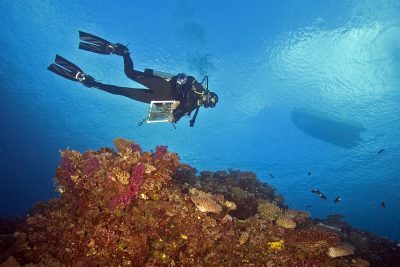
The reef on the outside of the atoll can quickly slope down to well over 40 meters depth

The reef on the outside of the atoll can quickly slope down to well over 40 meters depth


Photos by 1, Badi Samaniego, 3, Brian Beck

Lessons from the Reef: Did You Know?

Friday, March 1st, 2013

March 1, 2013

By Eddie Gonzalez

It’s been two weeks since the Gambier portion of the Global Reef Expedition to French Polynesia ended. In less than two weeks, our science team will be heading back to French Polynesia to conduct research in Rangiroa. In the meantime, everyone is busy preparing travel itineraries, ensuring all supplies have been restocked, and confirming final research sites for the next voyage.

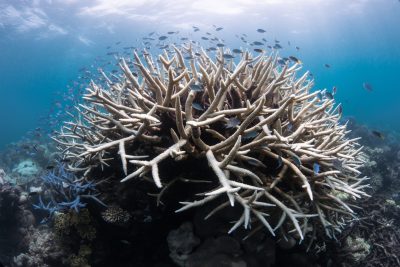
Coral as far as you can see.

Coral as far as you can see.


The time between missions is also spent looking at data, photos, and video collected so far. This short video (about 4.5 minute) was filmed during the Gambier mission as part of the Living Oceans Foundation CREW (Coral Reef Educator on the Water) program. It features Megan Berkle, a high school teacher from Los Angeles, CA, who joined the mission to help us expand our educational efforts. We hope you enjoy it and pass it on to your friends, family, and colleagues.

YouTube: Lessons from the Reef–Did You Know?

Megan says, "See you on the reef."

Megan says, “See you on the reef.”

(Photo credit: 1 and 2 by Eddie Gonzalez)

Acropora Gardens

Monday, February 11th, 2013

February 11, 2013

Written by Dr. Andrew Bruckner

Mangareva contains more diverse coral habitats than anything we have seen to date. Parts of the outside rim of the atoll are emergent. The cross sectional profile starts with a classic reef flat, 10 m wide in places and often extending more than 100 m from shore with small spillways connecting the lagoon and fore reef.  At the seaward edge of the reef flat is a reef crest, where reef growth is vigorous.  An extensive build-up of steep spurs. These project into the prevailing waves and are separated by narrow, deep channels.  At the seaward edge, the slope plunges steeply to depths of 50 m or more.  More than half of Mangareva is surrounded by a submerged barrier reef, 4-5 m deep at its shallowest point, with high wave energy and strong currents.  The submerged barrier also has a characteristic “spur and groove” formation.  The spurs here are much longer and wider and slope more gradually, stretching for 100s of meters between the lagoon and the deep reef.

Lagoonal reefs

Lagoonal reefs


Inside the lagoon are lagoonal fringing reefs, patch reefs, coral pinnacles, reticulate reefs, and an extensive deep water coral-encrusted lagoonal floor. Unlike other lagoonal habitats we have explored, vigorous coral growth occurs at the water’s surface, and many of the corals are periodically exposed at low tide.

Lagoonal acroporids exposed at low tide

Lagoonal acroporids exposed at low tide


Coral growth extends down the pinnacles, spurs or mounds to the lagoonal floor (25-30 m deep), and a deep coral framework on the lagoon floor supports a proliferant coral community to depths of 40 m or more.

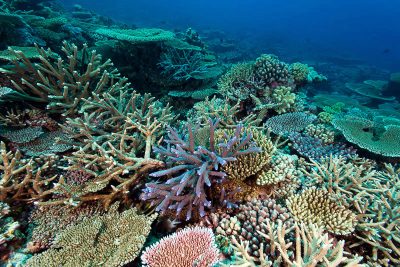
Diverse acropora

Diverse Acropora


The shallowest part of the lagoonal reef has the highest diversity of corals, especially the genus known as Acropora.  These acroporids take on a myriad of shapes and sizes: colonies have antler-like branches, low stumpy fingers, large flattened tables, thin, spindly branches, crusts, finely branched bushes, feathery spirals, bottlebrushes and more. They also can be yellow, brown, fluorescent blue, lime green, greyish white, red, or other colors of the rainbow.  They are unique among corals in that they possess two very different types of animals or polyps – most posses a single a very large tubular “axial” polyp on each branch and hundreds of smaller radial polyps.  These produce a very unique skeletal structure (known as corallite), which is used to help identify the species.  The corallite is basically a tube divided into six or twelve partitions (called septa).  Some of these corallites are tubular with round opening, some are pocket shaped, some resemble an earlobe and others look like an upside down nose.

Deep water plates of Montipora

Deep water plates of Montipora


We found dozens of species of acroporids on shallow lagoonal reefs, but these tend to occur in small clumps.  As you go deeper, the clumps get larger, often forming vast single species thickets tens to hundreds of meters in length.  This group and other corals also showed a very characteristic distribution or zonation pattern.  One table forming coral that was rare or absent in all other locations we have examined thus far in French Polynesia, formed vast stands at intermediate depths (5-10 m).  Below this, tall, thinly branched staghorn-type acroporids dominated.

Staghorn coral

Staghorn coral


Still deeper, the acroporids become less common and piles of free living mushroom corals (Fungia, Herpolitha, Sandolitha) coexist- hundreds may accumulate in a very small area, most the size and shape of a large dinner plate.

Piles of fungiid corals

Piles of fungiid corals


Still deeper, corals form delicate plates, rarer species like the elephant nose coral (Mycedium), lettuce corals (Pavona and Leptoceris), and foliaceous Montipora. Often the base of the reef had massive colonies of Pore coral – individual colonies were 3-4 m in diameter or larger.

Rare deep water plate of Mycedium

Rare deep water plate of Mycedium


Perhaps most interesting, each lagoonal reef had a different structure and a different assemblage of corals. One of the biggest challenges we face is understanding why.

(Photos by: Dr. Andrew Bruckner)

Cauliflower Coral

Tuesday, February 5th, 2013

February 5, 2013

Written by Joao Monteiro

Cauliflower corals, in the genus Pocillopora, are among the most widely distributed and most abundant corals found on the fore reef. These branching corals are covered with small bumps (called verrucae), which contain corallites and help in the identification of the genus.

Details of Pocillipora branches with the typical verrucae

Details of Pocillipora branches with the typical verrucae


Identification to species level, however, is hardly an easy job. This genus is very plastic, taking on a different shapes, sizes, color and appearance depending on habitat and environmental conditions. The same species from exposed reefs usually have thicker branches than those in sheltered areas and in some cases this variation occurs within a single location.

Two colonies of Pocillopora eydouxi with different appearance and color

Two colonies of Pocillopora eydouxi with different appearance and color


In French Polynesia, the research team has been able to easily recognize some species, but they have had difficulties distinguishing the Pocillopora corals that have characters that fit different species. Inspecting the skeleton structures under a microscope does not make this easier, as different species have overlapping features. For many, the scientists will have to resort to genetics to tell species apart. Sometimes, though, a unique structural feature can help distinguish two similar species.  In Tenarunga and Maria Est Atolls (Acteon Group), the scientists came across an almost hexagonal pattern surrounding packed colonies of one of the larger varieties of Pocillopora. This feature is a unique character of Pocillopora zelli, a species that had not been previously described to occur here.

Top view of Pocillopora zelli colonies with branch fusion resulting in geometrical pattern separating colonies

Top view of Pocillopora zelli colonies with branch fusion resulting in geometrical pattern separating colonies


The beauty of the almost mathematical pattern unveiled a new record for the local coral diversity and the range expansion of the distribution of Pocillopora zelli.

(Photos by: 1-2 Joao Monteiro, 3 Marie Kospartov)

If you liked this blog, you might also like: Corals in the Devil’s Crown from our Galapagos Mission.

Acidic Oceans

Friday, January 25th, 2013

January 24, 2013

By Dr. Brian Beck

“Ocean acidification” is a term you may have heard in relation to coral reefs. As carbon dioxide increases in the air, the amount in the ocean goes up as well. The increased carbon dioxide makes the ocean water more acidic, making it more difficult for corals to grow their calcium carbonate skeletons. This has several potential negative effects on the coral reef environment. In order to better understand the effects ocean acidification is having on our oceans, a researcher on each mission looks at the connection between water chemistry and coral growth rates.

Studying growth rates of corals like these (Porites) will help us to understand how ocean acidification is affecting coral growth.

Studying growth rates of corals like these (Porites) will help us to understand how ocean acidification is affecting coral growth.


Dr. Ian Enochs works for the University of Miami and NOAA and is helping to assess the impact of higher ocean acidity on the corals of French Polynesia. He has constructed an instrument that measures carbon dioxide, pH, temperature and salinity!

 Dr. Ian Enochs prepares his equipment to measure the water’s chemistry at each dive site.

Dr. Ian Enochs prepares his equipment to measure the water’s chemistry at each dive site.


Before every dive, he places a water pump connected to a surface unit over the side of the dive boat to measure the water chemistry. Dr. Enochs and his collaborators have conducted some exciting research in the past and we can’t wait to see what they find during the Global Reef Expedition.

The water pump is deployed during every dive.

The water pump is deployed during every dive.

 (Photos 1-3 by Dr. Brian Beck)

The Reef through Different Lenses

Tuesday, January 22nd, 2013

January 22, 2013

By Eddie Gonzalez

Mention coral reefs and most people think of sweeping landscapes of corals, sponges, and fish. While those do exist in Hao Atoll, researchers are also seeing the reef through different lenses.

Jeremy Kerr, research assistant at the National Coral Reef Institute, uses satellite imaging to get a sense of the spatial distribution of reef habitats and their geomorphology (the study of land forms and the processes that made them). As he states, “The bird’s eye view provided by satellites compliments the divers’ view. By combining the two perspectives, we better understand the underlying processes shaping these ecosystems.”

Overflight views of the reefs allow the researchers to see specific features and details of the reef habitat to help determine important areas for surveying by the survey teams.

Overflight view of Hao showing the fore reef.

Overflight view of Hao showing the fore reef.

On the other end of the field of view is the work of Jenna Moore from the Scripps Institution of Oceanography. She uses a dissecting microscope to view the reef at the macro level. By identifying invertebrates too small to be seen by the survey teams, she helps determine the full breadth of the reef’s biodiversity. Invertebrates are the most numerous and diverse group of animals on the reef forming an important part of the reef’s ecology.

Reef crab (1 cm wide), genus Pilodius

Reef crab (1 cm wide), genus Pilodius

 (Photos by: Image 1 Jeremy Kerr, 2 Dr. Andrew Bruckner, 3 Jenna Moore)

Lagoon Reefs of Fakarava

Sunday, December 9th, 2012

December 8, 2012

Written by Dr. Andy Bruckner

We have had many interesting dives within the lagoons around the Tuamotu Archipelago, but the Fakarava lagoonal habitats have been the most unique. There are thousands of small patch reefs that extend from the water’s surface to depths as great as 55 m.  Some have an emergent island with vegetation while others have a small emergent sand patch with some rubble and coral boulders, and others are totally submerged. Each type is unique in structure. In cases where the top of the submerged reef is 2-3 m below the surface, there is a community dominated by unusually large boulder-like Porites, some which can be over 15 m in width.

A Porites colony close to the surface with a dead top

A Porites colony close to the surface with a dead top


As the Porites colonies grow up to sea level, the tops of the colonies are exposed during very low tides, and they die, and then become colonized by branching corals (Acropora and Pocillopora).

Porites in shallow water that has been colonized by branching corals

Porites in shallow water that has been colonized by branching corals


Over time, the Porites colonies continue to expand outward, towards deeper water, but the colonies in the center die completely and are replaced completely by a branching coral community.  Eventually, the center resembles reef flats found on the atoll’s outer rim, with dense stands of small Acropora colonies and fields of large tree-like Acropora and an outer rind of Porites colonies. The surrounding slope is very steep, composed of sand, coral rubble and boulders that break off  from the rim of the reef flat.  The base of these structures is comprised of accumulations of old, dead coral colonies that rolled down the slope, and is covered by woven macroalgae, known as Microdictyon.

Microdictyon algae, crustose coralline algae and a small coral

Microdictyon algae, crustose coralline algae and a small coral


The boulders have very little coral growth, presumably because recruitment is inhibited by steep slopes and debris covering the slope. The water is also much more turbid than outer reefs at the same depth due to the high photosynthesis of the benthic communities and the poor flushing of the atoll. There is, however, often a dense aggregation of finely branched, tall and spindly Acropora colonies that can survive in this environment because the wave exposure is so low and the colonies are too tall to be buried by sediments.

Delicate, upright, branching "spindly" Acropora colonies at the base of a lagoonal patch reef

Delicate, upright, branching “spindly” Acropora colonies at the base of a lagoonal patch reef

(Photos by: Dr. Andy Bruckner)

If you liked this blog, you might also like: Lagoon Life from our Colombia mission.

Reefs Around Rangiroa, Aratika and Raraka

Thursday, November 29th, 2012

November 28, 2012

Written by Dr. Andy Bruckner

After two weeks, we’ve completed reef assessments around Rangiroa, Aratika, and Raraka and are now examining Fakarava. Tuamotu reefs are dramatically different from Society Islands.  Besides the near absence of crown of thorns seastars (we’ve seen a handful in the lagoon), there is much more living coral, a higher diversity of coral species, and more diverse and abundant fish communities.

Shallow fore reef (5 m) on the leeward side of Fakarava with a high cover of plating and submassive Porites colonies and other species

Shallow fore reef (5 m) on the leeward side of Fakarava with a high cover of plating and submassive Porites colonies and other species


On the fore reef, dense assemblages of branching corals begin near the shore and extend down the slope to 5-10 m, becoming mixed and gradually dominated by larger boulder and plating corals at 10-20 m depth, followed by shingles of pore corals (Porites) and overlapping sheets of plating pore corals and lettuce corals (Porites & Pachyseris) on the fore reef slope, from 20-30 m and deeper.

Foliose sheets of ruffled lettuce coral (Pachyseris speciosa) at 30 m depth at Raraka

Foliose sheets of ruffled lettuce coral (Pachyseris speciosa) at 30 m depth at Raraka


These outer reefs vary considerably in species composition, with windward reefs having a mix of stout, bushy and tree-like corals (Acropora), branching cauliflower coral (Pocillopora), finger corals (Porites) and small massive faviid corals, and leeward reefs being dominated by Porites, plates of rice coral (Montipora), small boulders of star coral (Favia), and columns of Pavona coral.

Large thicket of Pacific elkhorn coral (Acropora clathrata) on an exposed shallow reef off Raraka

Large thicket of Pacific elkhorn coral (Acropora clathrata) on an exposed shallow reef off Raraka


The amount of coral varies at each site, with some completely covered in coral, some having fewer corals and a lot of fleshy algae, especially carpets of feather-like and grape-like green algae (Caulerpa) and mats of lettuce algae (Microdictyon), and some with large accumulations of rubble between patches of living coral.

Two species of macroalgae (Caulerpa racemosa and C. sertuloides) carpeting the reef substrate. Two branching rice corals (Montiopora) and red crustose coralline algae are visible. Scale bare is 90 cm.

Two species of macroalgae (Caulerpa racemosa and C. sertuloides) carpeting the reef substrate. Two branching rice corals (Montipora) and red crustose coralline algae are visible. Scale bare is 90 cm.


Lagoonal reefs are built on a framework of massive boulders of Porites.  Sites close to the cut (the channel connecting the fore reef to the lagoon) had a lot of live coral – unusually large helmet or dome-shaped colonies Porites (some over 5 meters across), and a mix of branching, plating, encrusting and foliose corals. Sites with less water exchange (e.g. closer to the center of the lagoon) often were covered in fleshy algae and had little coral, except near the water’s surface.

Typical Lagoonal patch reef in Rangiroa with unusually large Porites colonies and Pocillopora colonies

Typical lagoonal patch reef in Rangiroa with unusually large Porites colonies and Pocillopora colonies


Unraveling the cause of these differences is one part of the puzzle. We know that the same species of coral can look completely different on two reefs, changing shape depending on depth, amount of light, wave exposure and other environmental and biological factors.

Coral community on the top of a lagoonal pinnacle at 2 m depth

Coral community on the top of a lagoonal pinnacle at 2 m depth


For instance, we often see massive, mountainous boulders of Porites in sheltered shallow areas and these same species form plates or overlapping shingles in deeper water to maximize the amount of their surface exposed to sunlight.  On windward reefs, branching corals often had thick bases, short digitate or tree-like branches and colonies  spread out laterally, close to the bottom, with branches facing into the current to minimize chances of breakage. These stout, bushy corals exist in areas of high wave exposure because they spread through fragmentation, with broken branches settling on the bottom, reattaching and regrowing into a new colony.  In protected waters of the lagoon, branching species were more fragile, forming bottlebrush colonies, tangles of thin, erect branches, and bushes.

A broken colony of cauliflower coral (Pocillopora eydouxi) on a shallow wave-exposed for reef in Aratika. The branches are still alive and have fused to the bottom.

A broken colony of cauliflower coral (Pocillopora eydouxi) on a shallow wave-exposed for reef in Aratika. The branches are still alive and have fused to the bottom.


Determining why some reefs are healthier than others is another part of the puzzle. Even though coral cover is much higher, there are many more larger, older corals than we had observed in Society Islands, human populations are much smaller here, and certain species have been found with disease much more frequently.  We typically find a number of dead cauliflower corals (Pocillopora), in growth position, which we also saw in Society Islands, but these were primarily corals that had been eaten by crown of thorns starfish (COTS).  In Tuamotu, we’ve found very few recently dead corals that were eaten by COTS, but a high percentage (up to 10%) have recently dead (white) patches.  This is presumably a disease called white syndrome, but we know very little about its cause.

Pocillopora colonies with recent tissue loss due to white syndrome. The top colony is dead and show older mortality (reddish branches) and recent mortality. The other two corals have live tissue, recently dead white skeleton, and older dead patches colonized by algae.

Pocillopora colonies with recent tissue loss due to white syndrome. The top colony is dead and show older mortality (reddish branches) and recent mortality. The other two corals have live tissue, recently dead white skeleton, and older dead patches colonized by algae.


During each survey, I measure the size of all corals (healthy and diseased), and record how much of the coral is live, long dead (covered in algae), recently dead (white), and, when possible, identify why they have died.  We’ve also sampled some of the diseased corals to better understand the effects of the disease, in hopes of identifying a cause.

At least for now, the disease does not appear to be having a major impact on these reefs. As these species are a dominant corals on the fore reefs of Tuamotu, they exhibit very high rates of replacement, and they are considerably larger in size than what we saw in Society Islands.

(Photos by: Dr. Andy Bruckner)

Bringing the Message to Many

Thursday, October 18th, 2012

October 17, 2012

Written by Candice Jwazko

My two weeks aboard the Golden Shadow have come to a close. During that time, I spent the days diving with the science team.  At night, as the ship swayed with the swells of the ocean, I reflected on their research. I’ve always been interested in coral reefs and now I have an insider’s view that few have seen. I have discussed coral reef sustainability with scientists who’ve worked in this field long enough to see firsthand the changes that are occurring. Instead of an Internet search, I’ve been here, in the Pacific Ocean, watching the data being collected, discussing how it will be analyzed, and understanding the larger picture of coral reef health.

Expedition researchers at work on the reef

Expedition researchers at work on the reef

Read the rest of Bringing the Message to Many »

Thriving Alien and Declining Local Invertebrates

Saturday, October 13th, 2012

October 12, 2012

Written by Serge Andréfouët and Joseph Campanozzi

The French Polynesian scientists participating on the Society Islands mission took the opportunity to quantify the abundance of a number of invertebrate species that have, or may have, a commercial and food subsistence role in the near future. In particular, they investigated the abundance of a number of sea cucumbers species, giant clams (only Tridacna maxima is found everywhere in French Polynesia) and also the imported green snails, Turbo marmoratus and Trochus niloticus. Trochus snails were brought to Tahiti from Vanuatu nearly 50 years ago, and then transplanted to selected islands throughout French Polynesia.

The giant clam is prized for its flesh all over the Pacific Islands, but also for the aquarium market.

The giant clam is prized for its flesh all over the Pacific Islands, but also for the aquarium market.

Read the rest of Thriving Alien and Declining Local Invertebrates »

GRE Website YouTUBE Channel Follow on Facebook Follow on Twitter RSS Feed Updates LOF Website

Search

Calendar

May 2013
M T W T F S S
« Apr    
 12345
6789101112
13141516171819
20212223242526
2728293031  

Archives