Posts Tagged ‘coral reefs’

“Let’s name the zones, the zones, the zones of the reefs…of Raivavae and Tubuai”

Saturday, April 20th, 2013

19th April 2013

Written by Dr. Andy Bruckner

Coral communities on the first two islands in the Australs were very unusual, compared to all other reefs we looked at in French Polynesia. Unlike other fore reef communities, a very wide shelf surrounded each island, extending from the reef crest, adjacent to the lagoon, hundreds of meters offshore before plunging steeply to the depths.

A typical mid depth assemblage of hard (Leptoria, Astreopora and Pocillopora) and soft corals

A typical mid depth assemblage of hard (Leptoria, Astreopora and Pocillopora) and soft corals


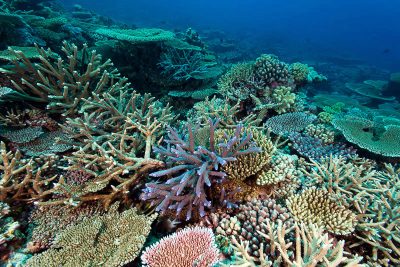
The shallow reef transitioned from a high energy reef crest dominated by branching corals, mostly stout finger corals and thick tables of Acropora and cauliflower corals (Pocillopora), to a spur and groove structure with narrow scoured hard-bottom channels and wide flattened spurs. The spurs in shallow water (to 10 m depth) were constructed mostly of low-lying massive star corals (Astreopora), with some larger outcrops containing other massive species such as Favia and a brain coral (Leptoria) seen previously only in Mangareva, along with short, stout branched and digitate Acroporids and Pocillopora.

Astreopora becomes more dominant in about 8 meters of water

Astreopora becomes more dominant in about 8 meters of water


From 10-15 m depth, the grooves were colonized by small pore corals (Porites) and an unusual massive coral we had not seen before (Hydonophora), while other encrusting, plating and boulder corals were found on the tops of the spurs. We also found another unique coral which forms potato-chip shaped colonies and extends its yellow to lime green polyps in the day (Turbinaria) and several other sheeting corals on the sides of spurs.

A colony of Turbinaria

A colony of Turbinaria


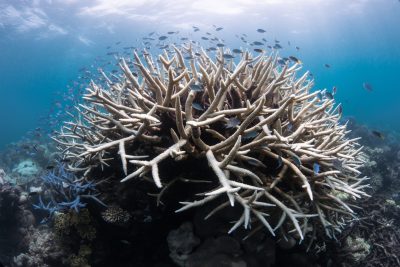
Many areas from 5-15 m depth had high numbers of soft corals, many which were over 2 m in diameter. In deeper water, the reef gradually transitions from Astreopora to a community with very dense cover of large massive and lobate corals (Favia stelligera, Pavona clavus), flower corals (Lobophyllia) and dense thickets of stout-branched staghorn corals (Acropora). At 20-25 m depth another species that forms large tables (Acropora cytherea) become abundant; we only observed this species in Mangareva as well. Still deeper, these are progressively replaced by large flattened domes of pore coral (Porites), some that are over 5 m in diameter and centuries old.

Pavona surrounding large colonies of Lobophyllia

Pavona surrounding large colonies of Lobophyllia

A big table of Acropora cytherea

A big table of Acropora cytherea

(Photos by Andrew Bruckner)

To follow along and see more photos, please visit us on Facebook!  You can also follow the expedition on our Global Reef Expedition page, where there is more information about our research and team members.

Lessons Learned

Thursday, March 28th, 2013

28th March 2013

Written by CREW member Jim Evans

Probably the most significant thing I learned on this trip is that it is possible for coral to be resilient to environmental stresses. It was exciting to see the reaction of researchers who studied the coral reefs in the lagoon of Rangiroa over ten years ago. They said that in 1998 the reefs were devastated, but now life has returned to the reefs.

Jim Evans having a skype call with two classes on the east coast of the US while off the coast of Moorea

Jim Evans having a webchat with two classes on the east coast of the US while off the coast of Moorea


We visited coral reefs of the coast of Moorea, which were devoid of life to a greater degree than Rangiroa. Although the reefs still appear somewhat lifeless, the researchers commented on how coral recruits are present, which is the first step in the revival of a reef. And the main lesson I have learned here that I will bring back to my students is that there is still hope.

Healthy reef with high coral cover off the coast of Rangiroa

Healthy reef with high coral cover off the coast of Rangiroa


However, if we continue to treat our planet the way we do, that hope can dwindle. If we continue to let environmental stresses such as climate change affect our coral reefs, they may in time lose that resilience and we may lose them forever.

Jim Evans enjoying the coral cover on the shallow reef

Jim Evans enjoying the coral cover on the shallow reef

(Photos by 1-3 Brian Beck)

To follow along and see more photos, please visit us on Facebook!  You can also follow the expedition on our Global Reef Expedition page, where there is more information about our research and team members.

Coral Recruitment in the Garden of Good and Evil: How baby corals get started on coral reefs

Friday, March 22nd, 2013

21st March 2013

Written by Dr. Bob Steneck

Corals in tropical reefs are like trees in a forest. We all know from the tiny acorn, the mighty oak tree grows but where do the mighty corals come from?   You’d think we know all there is to know about where baby corals come from and how they get started on coral reefs but we don’t.  When I started graduate school no one knew how or when coral reproduction occurred.

Dr. Bob Steneck from the University of Maine

Dr. Bob Steneck from the University of Maine


Then coral spawning was observed – it is linked to the full moon in late summer and when it happens it is like a snow storm in reverse.  Tiny white bundles of coral eggs release all at once and float to the surface. They get fertilized and a small oblong larva covered in tiny hairs (cilia) floats and develops into a baby coral.  The trick for this tiny larvae (which is about the size of a pencil dot on a piece of paper) is how does it find a good place to live in a coral reef.  Coral larvae are blind and they cannot swim but they can adjust their buoyancy.  My research considers the environment baby corals encounter that affect their choice of where they will glue themselves to the reef and being their long life.  Most coral reefs are comprised of coral (logically) but corals are terrible places for larvae to settle since they’d get eaten.  So the rest of the coral reef that is mostly covered in different types of seaweeds can be tasted and evaluated by the tiny coral larvae.  The bigger seaweeds are bad places for baby corals – the seaweed can beat them up and some seaweeds can poison the newly settled corals.  However, limestone producing coralline algae is a different story.

Bob takes notes along his transect in Rangiroa

Bob takes notes along his transect in Rangiroa


Some of the coralline species actually attract baby corals, allows them to settled and they grow best there and fewer of them die.  My research examines that association.  I consider how receptive different coral reefs are to settling coral larvae.  Reefs that have more “recruitment” of baby corals, will recover quicker from a hurricane, crown of thorns starfish outbreak or a coral bleaching event.  Figuring out how baby corals get started on reefs may help managers and policy makers improve the fate of these stressed ecosystems.

Some new coral   recruits nestled in crustose coralline algae (CCA)

Some new coral recruits nestled in crustose coralline algae (CCA)

(Photos by 1 & 2 – Brian Beck; 3-Bob Steneck)

To follow along and see more photos, please visit us on Facebook!  You can also follow the expedition on our Global Reef Expedition page, where there is more information about our research and team members.


Teacher on board

Monday, March 18th, 2013

17th March 2013

Written by Dr. Brian Beck

Our Coral Reef Educator on the Water (CREW) program is still running and we have the privilege of having Jim Evans on board with us. Jim is from the Washington D.C. area and works for School Without Walls; a high school that provides students with learning opportunities around the city and outside the classroom.

High school science teacher Jim Evans is our current CREW participant

High school science teacher Jim Evans is our current CREW participant

Since he has been with us in Rangiroa we have kept Jim very busy. Already he has been in the water learning about different aspects of coral reef ecology. He is also learning about all of the different research projects that we have going on during this mission. On top of all of the coral reef research, he also is learning about the Golden Shadow and what it takes to operate a ship of this size.

Jim swims in front of a large Porites coral colony

Jim swims in front of a large Porites coral colony


Jim is going to take what he learns with us and use it to develop new activities for teaching lessons about coral reef ecology.

Jim helping perform benthic transects.

Jim helping perform benthic transects.


(Photos by Brian Beck)

To follow along and see more photos, please visit us on Facebook!  You can also follow the expedition on our Global Reef Expedition page, where there is more information about our research and team members.


Lessons from the Reef: Did You Know?

Friday, March 1st, 2013

March 1, 2013

By Eddie Gonzalez

It’s been two weeks since the Gambier portion of the Global Reef Expedition to French Polynesia ended. In less than two weeks, our science team will be heading back to French Polynesia to conduct research in Rangiroa. In the meantime, everyone is busy preparing travel itineraries, ensuring all supplies have been restocked, and confirming final research sites for the next voyage.

Coral as far as you can see.

Coral as far as you can see.


The time between missions is also spent looking at data, photos, and video collected so far. This short video (about 4.5 minute) was filmed during the Gambier mission as part of the Living Oceans Foundation CREW (Coral Reef Educator on the Water) program. It features Megan Berkle, a high school teacher from Los Angeles, CA, who joined the mission to help us expand our educational efforts. We hope you enjoy it and pass it on to your friends, family, and colleagues.

YouTube: Lessons from the Reef–Did You Know?

Megan says, "See you on the reef."

Megan says, “See you on the reef.”

(Photo credit: 1 and 2 by Eddie Gonzalez)

Finding Angels

Thursday, February 21st, 2013

Written by Eva McClure

21st Feb. 2013

Spotting new fish species that you’ve never seen before and can’t put a name to is one of the many exciting and fulfilling aspects of being a fish surveyor with The Living Oceans Foundation’s Global Reef Expedition.  This latest expedition to the Gambier Archipelago in French Polynesia offered something particularly special – a sighting of a species of Pygmy Angelfish that according to best and current scientific knowledge has never  been seen before in this island group.  Introducing the Orangehead Pygmy Angelfish, Centropyge hotumatua. 


Orangehead Pygmy Angelfish

Orangehead Pygmy Angelfish


This colorful little critter was previously known to only occur in the far southern reaches of French Polynesia – the Austral Islands and Rapa Island (where GRE heads next!), as well as Pitcairn Island and Easter Island.  This is a rather narrow distribution for a fish species to have, so while spotting this fish in the Gambier’s might not sound that exciting at first, when you consider that from the Gambier’s its next known locations are ~700km to the southwest (Pitcairn’s) and ~1,000km to the east (Austral’s) over open ocean, it’s a pretty special find.


Angelfish generally lead a rather elusive and secretive life, and Pygmy Angels are usually under 10cm in length, so it’s not entirely surprising that the Orangehead Pygmy Angelfish has gone unnoticed in the Gambier’s for so long.  Further, the remoteness and relative anonymity of this island group as a superb diving location has no doubt helped keep this small fish hidden in the Gambier Islands until now.

Photo by Eva McClure

Acropora Gardens

Monday, February 11th, 2013

February 11, 2013

Written by Dr. Andrew Bruckner

Mangareva contains more diverse coral habitats than anything we have seen to date. Parts of the outside rim of the atoll are emergent. The cross sectional profile starts with a classic reef flat, 10 m wide in places and often extending more than 100 m from shore with small spillways connecting the lagoon and fore reef.  At the seaward edge of the reef flat is a reef crest, where reef growth is vigorous.  An extensive build-up of steep spurs. These project into the prevailing waves and are separated by narrow, deep channels.  At the seaward edge, the slope plunges steeply to depths of 50 m or more.  More than half of Mangareva is surrounded by a submerged barrier reef, 4-5 m deep at its shallowest point, with high wave energy and strong currents.  The submerged barrier also has a characteristic “spur and groove” formation.  The spurs here are much longer and wider and slope more gradually, stretching for 100s of meters between the lagoon and the deep reef.

Lagoonal reefs

Lagoonal reefs


Inside the lagoon are lagoonal fringing reefs, patch reefs, coral pinnacles, reticulate reefs, and an extensive deep water coral-encrusted lagoonal floor. Unlike other lagoonal habitats we have explored, vigorous coral growth occurs at the water’s surface, and many of the corals are periodically exposed at low tide.

Lagoonal acroporids exposed at low tide

Lagoonal acroporids exposed at low tide


Coral growth extends down the pinnacles, spurs or mounds to the lagoonal floor (25-30 m deep), and a deep coral framework on the lagoon floor supports a proliferant coral community to depths of 40 m or more.

Diverse acropora

Diverse Acropora


The shallowest part of the lagoonal reef has the highest diversity of corals, especially the genus known as Acropora.  These acroporids take on a myriad of shapes and sizes: colonies have antler-like branches, low stumpy fingers, large flattened tables, thin, spindly branches, crusts, finely branched bushes, feathery spirals, bottlebrushes and more. They also can be yellow, brown, fluorescent blue, lime green, greyish white, red, or other colors of the rainbow.  They are unique among corals in that they possess two very different types of animals or polyps – most posses a single a very large tubular “axial” polyp on each branch and hundreds of smaller radial polyps.  These produce a very unique skeletal structure (known as corallite), which is used to help identify the species.  The corallite is basically a tube divided into six or twelve partitions (called septa).  Some of these corallites are tubular with round opening, some are pocket shaped, some resemble an earlobe and others look like an upside down nose.

Deep water plates of Montipora

Deep water plates of Montipora


We found dozens of species of acroporids on shallow lagoonal reefs, but these tend to occur in small clumps.  As you go deeper, the clumps get larger, often forming vast single species thickets tens to hundreds of meters in length.  This group and other corals also showed a very characteristic distribution or zonation pattern.  One table forming coral that was rare or absent in all other locations we have examined thus far in French Polynesia, formed vast stands at intermediate depths (5-10 m).  Below this, tall, thinly branched staghorn-type acroporids dominated.

Staghorn coral

Staghorn coral


Still deeper, the acroporids become less common and piles of free living mushroom corals (Fungia, Herpolitha, Sandolitha) coexist- hundreds may accumulate in a very small area, most the size and shape of a large dinner plate.

Piles of fungiid corals

Piles of fungiid corals


Still deeper, corals form delicate plates, rarer species like the elephant nose coral (Mycedium), lettuce corals (Pavona and Leptoceris), and foliaceous Montipora. Often the base of the reef had massive colonies of Pore coral – individual colonies were 3-4 m in diameter or larger.

Rare deep water plate of Mycedium

Rare deep water plate of Mycedium


Perhaps most interesting, each lagoonal reef had a different structure and a different assemblage of corals. One of the biggest challenges we face is understanding why.

(Photos by: Dr. Andrew Bruckner)

Coral Bommies and Patch Reefs

Sunday, January 27th, 2013

January 27, 2013

By Dr. Andrew Bruckner

Navigation hazards are many in Hao Atoll, due to a myriad of submerged patch reefs that rise to the surface from the 60 m deep lagoon floor. These reefs are distributed in a seemingly random pattern. Some are circular and few centimeters below the surface, some are narrow and elongate, and others are little more than a pinnacle, a meter or so wide and a few meters in height. Unlike those in Fakarava, none of the patch reefs have an associated island or an emergent reef framework. They contain some of the same corals, but the corals vary in distribution and abundance from one patch reef to another, and a dominant species on one may be completely absent from another.

Hoa patch reefs

Hoa patch reefs


How do these form? One theory is that they are built on a framework of the massive pore coral, Porites. Porites forms large mountainous colonies around the rim of many of these reefs. These corals grow up to the water’s surface and then their upper surfaces die, due to aerial exposure during low tides. This provides substrate for the settlement and growth of branching corals, mostly bushy, bottlebrush, arborescent and thickly branched Acropora, which prefer shallow depths.

Acropora top

Acropora top


Even though parts of the Porites colonies eventually die, they continue growing outward, causing the reef to expand laterally in size. Because of the high turbidity and limited water motion in the lagoon, Porites exhibits low survival in deeper water, so they are usually dominant from 2-5 m depth. Over time, the shallows develop a mushroom-shape, with an extensive system of undercut ledges, caves and crevices at the base of the Porites colonies.

Porites

Porites


Below 5 m, the reef slopes steeply. The bottom consists mostly of sand, scattered boulders and rubble—broken branches, mollusk shells, and a lot of other debris—produced in shallow water that tumbles down the slope. Few corals can survive here, except on some of the rocky outcrops. At the base of the steep slope (12-15 m) is a dense band of thinly-branched tangles of staghorn coral (Acropora horrida), often 1-2 m in height and 20-30 m wide.

patch reef slope

patch reef slope


Below 15 m, the slope is much more gradual, continuing to 40-60 m depth. These deeper areas are mostly sand and rubble, interspersed with boulders and pinnacles of varying height and diameter. The pinnacles were draped with long strands of fleshy green algae (mostly Caulerpa) and occasionally disc-shaped calcareous green algae (Halimeda), with a thick layer of bright pink coralline algae beneath the green algae.

Caulerpa on pinnacle

Caulerpa on pinnacle

crustose coralline algae under green algae

crustose coralline algae under green algae


The pinnacles also support a high diversity of small encrusting, plating and branching corals, and numerous flat-topped bushy (corymbose) corals (Acropora granulosa), but live coral cover is generally low.

pinnacle with A granulosa

pinnacle with A granulosa


Why do some of the pinnacles make it to the water’s surface and form a large patch reef, while others appear to give up? One possibility is that these may have formed when sea level was lower, each starting as an individual coral or a few corals that settle in close proximity on a rocky substrate. Over time, some of these corals die from disease, or predation, or they are smothered by algae, sediment or debris. Others flourish, growing quickly to keep up with rising sea level.

deep pinnalce

deep pinnacle


To determine what the pinnacles are constructed from, we collected a small pinnacle. These structures are highly bioeroded and have lots of nooks and crannies, yet they are very stable and difficult to break apart. What was surprising is that the pinnacle was not formed from a single coral. In fact, recognizable coral made up very little of the matrix. Most consisted of rubble, sand, shells and small corals that had been cemented together with coralline algae. This pinnacle was from shallow water (13 m), adjacent to rim of the atoll. In these areas, it is possible that storm-generated rubble and sediment is a much more important component of the framework, bound together by coralline algae. Deeper pinnacles may in fact consist of a coral skeleton in growth position. To verify this, we plan to collect a few more pinnacles from deeper water, when we begin our work in Mangareva next week.

(Photos 1-8 by Dr. Andrew Bruckner)

Acidic Oceans

Friday, January 25th, 2013

January 24, 2013

By Dr. Brian Beck

“Ocean acidification” is a term you may have heard in relation to coral reefs. As carbon dioxide increases in the air, the amount in the ocean goes up as well. The increased carbon dioxide makes the ocean water more acidic, making it more difficult for corals to grow their calcium carbonate skeletons. This has several potential negative effects on the coral reef environment. In order to better understand the effects ocean acidification is having on our oceans, a researcher on each mission looks at the connection between water chemistry and coral growth rates.

Studying growth rates of corals like these (Porites) will help us to understand how ocean acidification is affecting coral growth.

Studying growth rates of corals like these (Porites) will help us to understand how ocean acidification is affecting coral growth.


Dr. Ian Enochs works for the University of Miami and NOAA and is helping to assess the impact of higher ocean acidity on the corals of French Polynesia. He has constructed an instrument that measures carbon dioxide, pH, temperature and salinity!

 Dr. Ian Enochs prepares his equipment to measure the water’s chemistry at each dive site.

Dr. Ian Enochs prepares his equipment to measure the water’s chemistry at each dive site.


Before every dive, he places a water pump connected to a surface unit over the side of the dive boat to measure the water chemistry. Dr. Enochs and his collaborators have conducted some exciting research in the past and we can’t wait to see what they find during the Global Reef Expedition.

The water pump is deployed during every dive.

The water pump is deployed during every dive.

 (Photos 1-3 by Dr. Brian Beck)

Rolling Stones

Wednesday, January 23rd, 2013

January 23, 2013

By Dr. Andrew Bruckner

Like other animals, corals need to reproduce to survive. Unlike most other animals, corals are attached to the seafloor and cannot move around to find a mate. To address this challenge, corals have developed several alternative reproductive patterns and modes of development. Some corals have separate sexes (gonochoric), while others are both male and female at the same time (hermaphroditic). Since self-fertilization is rare, every coral still needs a partner if they are going to successfully reproduce.

coral stuck in place

coral stuck in place


Usually, this is accomplished through synchronous spawning, whereby all colonies of a particular species release millions of gametes in unison, once per year, for a few hours, a certain number of days after the full moon (the exact timing is well documented and predictable from year to year). The eggs and sperm typically float to the surface, where they encounter other gametes of the same species, and fertilization occurs. The larvae then drift with the current for days to weeks, until they find a suitable place to attach and transform into a polyp. Very few of these larvae survive.

coral spawning slick

coral spawning slick


Other colonies are known as “brooders.” They may reproduce more frequently (sometimes monthly), usually producing fewer gametes at a time. Brooders need to be in close proximity because the female colony must take up sperm from the water column, and fertilization occurs internally. When the larvae are released from the female, they are better developed and have higher survival rates. They settle onto the reef and transform into a polyp much sooner.

Although sexual reproduction is the most common and the most important type of reproduction, corals also reproduce asexually by cloning themselves. A coral grows by constantly adding new polyps through a process known as budding. Corals can also increase in abundance through fragmentation, where branches that break off during storms reattach and continue growing. Other unique asexual reproductive strategies exist including polyp bailout, polyp expulsion, and asexual production of larvae; these offspring all lack a skeleton when first produced.

A more unusual strategy involves the production of “gemmae.” A single gemma starts as a mass of soft tissue on the sides or top of the coral that eventually develops a skeleton. It continues to grow, forming a small knob that will detach from the parent. The detached gemma looks just like the parent, except they are round or oval and completely covered in live tissue.

gemmae on Porites lobata

gemmae on Porites lobata


In the lagoonal habitats of Hao, one of the dominant frame-builders is the pore coral (Porites). This coral is long-lived, forming mountainous-shaped colonies that are several meters tall.  During our surveys, we found very few small colonies produced through sexual reproduction. This raises the question of how these corals are able to spread so successfully throughout the lagoon. Because wave action is minimal in lagoonal habitats and these corals produce a rigid skeleton, fragmentation is unlikely to be an important reproductive strategy. Until yesterday, we rarely found small fragments, as well.

Porites lobata

Porites lobata


On our fifth lagoonal dive, I encountered a very large (4 m tall) and very bumpy colony. Littered over the substrate and in depressions on the colony surface were hundreds of round to oval gemmae that ranged in size from 1 to 5 inches that originated from the colony. Most had tissue covering their entire skeleton and appeared to be actively growing, but they were completely unattached. The high number of these “rolling stones” produced by one colony of Porites, and their high survivorship, suggests this may be an important mode of reproduction for Porites in the Hao Lagoon.

rolling stones at base of coral

rolling stones at base of coral


 (Photos by: 1 Eddie Gonzalez, 2-5 Dr. Andrew Bruckner)

GRE Website YouTUBE Channel Follow on Facebook Follow on Twitter RSS Feed Updates LOF Website

Search

Calendar

May 2013
M T W T F S S
« Apr    
 12345
6789101112
13141516171819
20212223242526
2728293031  

Archives