Posts Tagged ‘coral disease’

Lessons from the Reef: Did You Know?

Friday, March 1st, 2013

March 1, 2013

By Eddie Gonzalez

It’s been two weeks since the Gambier portion of the Global Reef Expedition to French Polynesia ended. In less than two weeks, our science team will be heading back to French Polynesia to conduct research in Rangiroa. In the meantime, everyone is busy preparing travel itineraries, ensuring all supplies have been restocked, and confirming final research sites for the next voyage.
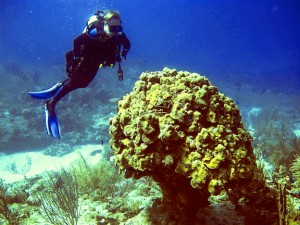
Coral as far as you can see.

Coral as far as you can see.


The time between missions is also spent looking at data, photos, and video collected so far. This short video (about 4.5 minute) was filmed during the Gambier mission as part of the Living Oceans Foundation CREW (Coral Reef Educator on the Water) program. It features Megan Berkle, a high school teacher from Los Angeles, CA, who joined the mission to help us expand our educational efforts. We hope you enjoy it and pass it on to your friends, family, and colleagues.

YouTube: Lessons from the Reef–Did You Know?

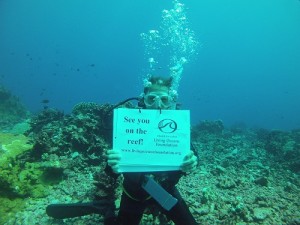
Megan says, "See you on the reef."

Megan says, “See you on the reef.”

(Photo credit: 1 and 2 by Eddie Gonzalez)

The Legacy Site – What Will the Future Tell?

Friday, October 12th, 2012

October 11th, 2012

Written by Candice Jwaszko

The Khaled bin Sultan Living Oceans Foundation works on a global scale to improve our understanding of coral reef health and the ecological integrity of coral reef ecosystems. Pollution, coastal development, overfishing, climate change, disease, and predation can negatively impact coral reefs. To see how reefs change over time as a result of these and other factors, scientists set up “Legacy sites”, observational areas that can be compared over time. These sites can provide incredible insight into the future of coral reefs, and their resiliency to ecological disturbances.

Society Islands Legacy Site

Society Islands Legacy Site

Read the rest of The Legacy Site – What Will the Future Tell? »

Reality TV – The Reef

Thursday, October 11th, 2012

October 10, 2010

Written by Candice Jwaszko

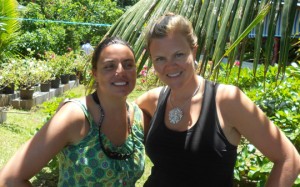
French Polynesia is a long way from my hometown of St. Albert in Alberta, Canada. For many of my students, coral reefs are an abstract concept. Fortunately, in my short time with the science team, I have acquired many amazing examples I can bring back to the classroom that can add context to the subjects I teach my students. I’ve seen firsthand how reef diversity can be measured by using various types of transects and quadrats. I’ve observed how relationships between fish size and abundance can help the team assess reef health. Photographs and videos document the issues affecting the corals. Each dive brings their research to life, and helps me to understand the complexity involved in their data collection.

Dr. Sonia Bejarano and Candice Jwaszko

Dr. Sonia Bejarano and Candice Jwaszko

Read the rest of Reality TV – The Reef »

Teacher Gets Schooled on CREW*

Monday, October 8th, 2012

October 7, 2012

Written by Candice Jwaszko

When I arrived on the Golden Shadow on October 1st as part of the Coral Reef Educator on the Water program, I knew I would be participating in a very unique opportunity – to be able to witness firsthand the research being done on coral reefs with the Khaled bin Sultan Living Oceans Foundation. As an educator coming from Alberta, Canada, I was excited and curious about what sort of issues would be specific to French Polynesia, and their similarity to coral reefs worldwide.

There was so much going on that first day, I simply tried to keep up and watch as much as I could. There were researchers setting up equipment I had never seen, discussions of coral diseases and water acidity, and assessments of dive sites for their survey potential. I soon found myself underwater with the research team. It was unlike any diving I’ve done to date. Unlike recreational scuba diving, these researchers are here with specific objectives, and each dive is meant to count.

Hello from underwater in French Polynesia

Hello from underwater in French Polynesia

Read the rest of Teacher Gets Schooled on CREW* »

Seeing Pink Spots

Tuesday, June 5th, 2012

June 4, 2012

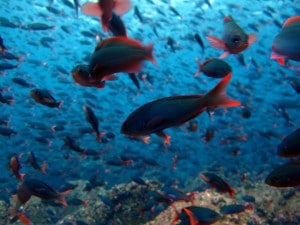
When we entered the water for our first research dive at Wolf island, the first thing we saw were thousands upon thousands of fish. The fish were so numerous it made seeing the bottom difficult. Underneath the clouds of fish the dominant species of coral was Porites lobata, a lobed pore coral. This species forms massive, helmet-shaped or hemispherical colonies that can exceed 3 m in diameter and 2 m high.

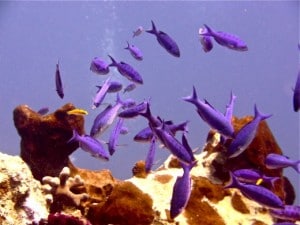
Thick schools of fish

Thick schools of fish

This long-lived coral is slow growing  (1-2 cm/year), but is generally more resistant to diseases and bleaching than other corals.  It recovered fairly quickly from two severe El Niño events (1982-1983 and 1997-1998) and it is the dominant species around both Wolf and Darwin Islands.

Read the rest of Seeing Pink Spots »

Colombia Wrap-up

Thursday, May 3rd, 2012

April 26, 2012

If you took a quick look on Google Earth at the northern San Andres Archipelago, specifically at the three banks the team visited on this latest mission, you’d think they looked pretty similar. But we found instead that each has its own unique, and important character.

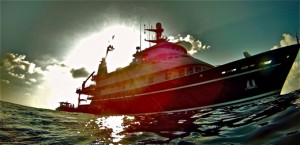
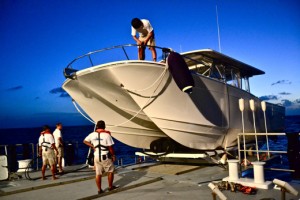
Golden Shadow at sunset

Golden Shadow at sunset


Read the rest of Colombia Wrap-up »

Mind-Blowing Dive Site

Tuesday, April 24th, 2012

April 22, 2012

Happily, some minds were in fact blown on today’s first dive. The groundtruthing team had promised they found an incredible reef and they did not lie.

We were on the farthest side of the bank from where the Golden Shadow is anchored, the more eastern of two main lagoons. From where we hit the water we had our best view yet of a rusty old cargo ship that ran aground here sometime in the 1990s.

Sonia Bejarano running a transect through the star coral mounds

Sonia Bejarano running a transect through the star coral mounds


On the bottom we found a classic reef rising up from a sandy bottom about 12 meters down almost to the surface. We kicked past mound after mound of large star coral colonies. The fish were plentiful and of more species than any but the fish experts among us could count.

Read the rest of Mind-Blowing Dive Site »

Wandering Bajo Nuevo’s corals

Thursday, April 19th, 2012

April 17, 2012

Our afternoon dive today was more surreal than most. We were on the far side of Bajo Nuevo’s lagoon and instead of a large, defined reef mound, we were wandering through what looked like a field of monuments. They were coral pillars, some two or three meters high.

Coral pillar

Coral pillar at Bajo Nuevo

  Read the rest of Wandering Bajo Nuevo’s corals »

The Dark Side of Corals

Sunday, August 14th, 2011

August 13, 2011

Over the past few decades there has been a rapid decline in the health of shallow water scleractinian corals (stony or hard corals).  Simultaneously, there has been a steady increase in the number of coral diseases being reported.  Many of these diseases have been identified by field characteristics – the color of the affected tissue, the shape of exposed skeleton, advancing patterns of tissue loss, or the presence of unusual structural features – rather than by the agent causing the disease.  For this reason, coral diseases have acquired names like black-band disease, red-band disease, dark spots, white pox disease and white plague.  Unfortunately, there have been relatively few scientific studies that have conclusively described the structural and cellular (morphological) changes underlying these different syndromes, or even the causes of the various changes.


Agaricia agaricites showing dark spots disease on reefs around Great Inagua

Agaricia agaricites showing dark spots disease on the reef around Great Inagua

Read the rest of The Dark Side of Corals »

GRE Website YouTUBE Channel Follow on Facebook Follow on Twitter RSS Feed Updates LOF Website

Search

Calendar

May 2013
M T W T F S S
« Apr    
 12345
6789101112
13141516171819
20212223242526
2728293031  

Archives