Posts Tagged ‘Charles Darwin’

Goodbye to the Galapagos

Tuesday, June 19th, 2012

June 17, 2012

The last day of research brought us to Urvina Bay on the west side of Isabela Island. In passing from Pueto Ayora around the southern end of Isabela, we followed the same route that Darwin took aboard the Beagle in 1835. In his book The Voyage of the Beagle, he wrote how the signs of recent volcanic activity were everywhere in these young western islands:

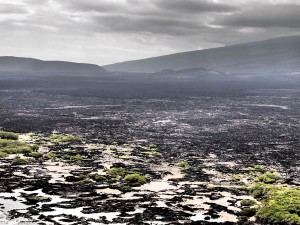
SEPTEMBER 29, 1835. We doubled the south-west extremity of Albemarle [Isabela] Island, and the next day were nearly becalmed between it and Narborough [Fernandina] Island. Both are covered with immense deluges of black naked lava, which have flowed either over the rims of the great caldrons, like pitch over the rim of a pot in which it has been boiled, or have burst forth from smaller orifices on the flanks; in their descent they have spread over miles of the sea-coast. On both of these islands eruptions are known to have taken place; and in Albemarle we saw a small jet of smoke curling from the summit of one of the great craters.

Urvina Bay, Isabela Island

Lava flow at Urvina Bay, Isabela Island

Read the rest of Goodbye to the Galapagos »

Corals in the Devil’s Crown

Tuesday, June 12th, 2012

June 11, 2012

After just one dive at San Cristobal Island, the team decided the water was too rough, so the Golden Shadow moved on. We woke Monday to overcast skies at Floreana, the southernmost of the five inhabited islands. Monday brought three dives at the Corona del Diablo, the “Devil’s Crown,” a ring of jagged rocks on the island’s south side formed by a partially submerged basalt volcanic cone. Strong currents sweep around and through the formation, which is only a few meters deep inside and full of life.
Pocillopora coral

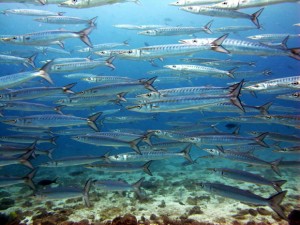
The coral seemed to be recovering here, including large stands of Pavona and Porites, one of which was four meters by two meters. Outside of the crown we found some Pocillopora, a few Cycloseris colonies, which are very rare, and extensive beds of both Psammocora and Diaseris, each stretching for over a hundred meters. This was the first time we had found Diaseris alive, in abundance. Sea turtles, rays, a school of barracuda and multiple parrotfish over two feet long all made appearances.

Read the rest of Corals in the Devil’s Crown »

Darwin’s Theory of Evolution

Friday, June 8th, 2012

June 7, 2012

The story of how these not-incredibly-attractive islands in the middle of the Pacific became world famous starts on December 27, 1831, when the H.M.S. Beagle sailed from Plymouth, England on a five-year round-the-world voyage. On board was an unpaid naturalist named Charles Darwin, age 22.

The Beagle followed the coastline of South America and reached the Galapagos in September 1835. Darwin spent 19 days ashore on the islands of San Cristóbal, Floreana, Santiago, and Isabela, collecting samples, observing animals and taking notes. What he discovered provided crucial clues to what some have called “the single best idea anyone has ever had.”

Depiction of the H.M.S. Beagle by Conrad Martens

Depiction of the H.M.S. Beagle by Conrad Martens

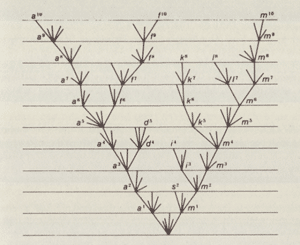
Darwin had left England a firm believer in the Biblical story of creation, but already he had seen things that challenged the idea: dinosaur bones in Argentina, fossilized seashells high in the Andes. In the Galapagos, he pondered tortoise shells and finch beaks that were similar, but noticeably different from island to island. Could these somehow have come from a single common ancestor, molded by their different environments?

Read the rest of Darwin’s Theory of Evolution »

GRE Website YouTUBE Channel Follow on Facebook Follow on Twitter RSS Feed Updates LOF Website

Search

Calendar

May 2013
M T W T F S S
« Apr    
 12345
6789101112
13141516171819
20212223242526
2728293031  

Archives