Posts Tagged ‘bleaching’

There and Back Again, a Scientist’s Journey

Monday, March 25th, 2013

23rd March 2013

Written by Dr. Peter Mumby

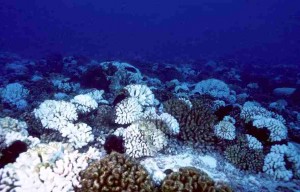
In 1998, we visited Rangiroa Atoll shortly after sea temperatures rose 6 degrees greater than summer norms and caused massive coral bleaching. Virtually all of the branching coral Pocillopora died and a quarter of the mound-shaped coral, Porites, lost almost all their ‘skin’. Many of these mound-shaped corals were several hundred years old but were reduced to fragments of their former selves in a matter of months. It’s a little like an oak forest being reduced to mere oak saplings.

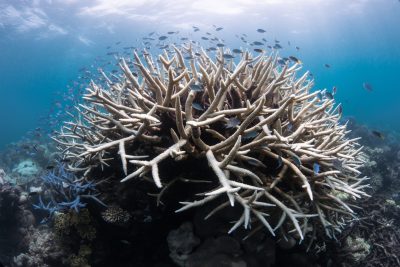
Bleached Pocillopora colonies in 1998

Bleached Pocillopora colonies in Rangiroa in 1998

Dr. Pete Mumby diving by dead Porites colonies

Dr. Peter Mumby diving by dead Porites colonies in 1998

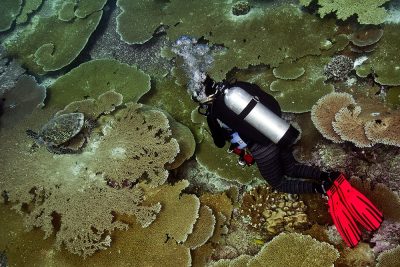
Revisiting these reefs fifteen years later, we found incredible recovery. The branching corals have rebounded in profusion but surprisingly, the Porites have also recovered. This is new to science – we had no idea that these long-lived corals could recover so dramatically. It seems that the little fragments of living coral managed to regrow over the dead skeleton. One way to visualize this is to imagine that you peeled back an orange to leave just a tiny piece of peel. That represents what the coral bleaching did to the coral surface. Now imagine that the remaining fragment of orange peel grew back leaving you with the original orange.

Large healthy Porites colonies at Rangiroa. There were the same colonies that had suffered a mortality event in 1998 and are mostly healthy today.

Large healthy Porites colonies at Rangiroa. There were the same colonies that had suffered a mortality event in 1998 and are mostly healthy today.


Finding that some corals have great regenerative capability gives us hope that corals are more vigilant towards climate change impacts than we thought.

Dr. Pete Mumby observing the same reef on this mission

Dr. Peter Mumby observing the same reef on this mission

(Photos by 1 – Prof. Jean Jaubert; 3-4 Brian Beck)

To follow along and see more photos, please visit us on Facebook!  You can also follow the expedition on our Global Reef Expedition page, where there is more information about our research and team members.


Hogsty’s New Reef Recruits

Friday, August 12th, 2011

August 11, 2011

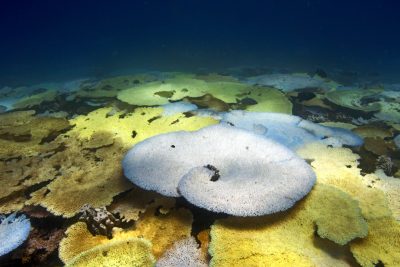
In 1997-1998, the marine equivalent of a massive and destructive forest fire overwhelmed numerous coral reefs around the world.  Caribbean coral biologists still speak of the bleaching event of 1998 in reverential tones.  A powerful El Niño season was a factor in generating extreme tropical sea surface temperatures.  As a consequence, over-stressed corals everywhere released their symbiotic algae known as zooxanthellae [zoh-zan-thel-ee].  This phenomenon is known as coral bleaching.

Millions of microscopic zooxanthellae play a critical role in a coral colony’s ability to both metabolize, and process waste.  The tiny algae also give corals their color.  When zooxanthellae are released into the water column, the remaining coral head appears as white as its underlying calcium carbonate skeleton.   A coral colony can survive for a limited time without zooxanthellae, as long as environmental conditions return to normal.  Slowly, new zooxanthellae will reappear in the coral tissues, and the corals, although susceptible to disease and algal overgrowth, having a fighting chance of recovery.  However, in 1998, conditions did not level out and an estimated 16% of the world’s corals died (Wilkinson 2000).  In some regions, the rate of mortality was probably much higher, and the relatively shallow western Caribbean  and Bahamas were likely hit especially hard.


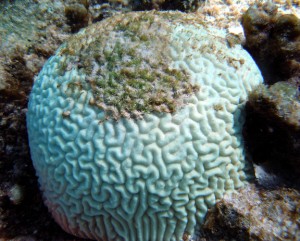
A bleached brain coral becoming overgrown with algae.  Photo: NOAA

A bleached brain coral becoming overgrown with algae. Photo: NOAA


To understand our initial observations taken at eight study sites on Hogsty Reef, thirteen years after the 1998 massive bleaching event, let’s return now to the forest fire analogy.  Imagine large, healthy coral heads on a reef as the old growth trees of a forest.  When a raging fire burns through a forest, it destroys almost all of the young seedlings and saplings, leaving behind only a few of the strongest old-growth trees.  However, any remaining live trees are weakened and damaged by the fire and are susceptible to diseases and parasites.  The surviving trees are also responsible for reseeding the forest with the next generation of seedlings.


Read the rest of Hogsty’s New Reef Recruits »

The Changing Face of Caribbean Reefs

Thursday, June 9th, 2011
June 7, 2011

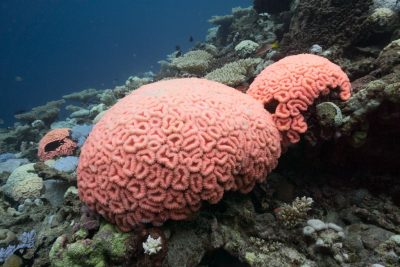
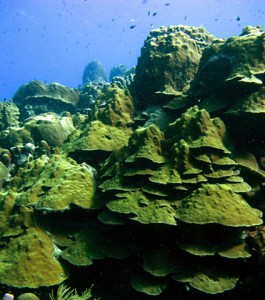
Our morning dive at Sandy Point was like travelling through time, with glimpses of the past and a foreshadowing of future directions of reef growth visible simultaneously.  Built on a foundation of 200-500 year old corals, many over 5 m in diameter and 7-8 meters tall, the reef consisted predominantly of star coral colonies (Montastraea faveolata) that were completely live back in 1990.  These corals grew together like a chain of mountains, extending from depths of 25m to 10-12 m below the water’s surface. 

Mountainous star coral (Montastraea faveolata) once looked like this. (Photo taken in Bonaire, July 2010)

Mountainous star coral (Montastraea faveolata) once looked like this. (Photo taken in Bonaire, July 2010)


The shape of many of these corals was similar to a child’s drawing of a Christmas tree – each colony having a sharply pointed peak, with a series of overlapping shingles layered down the sides.  Other corals were reminiscent of the moguls on an expert ski slope in Colorado, although they were colored golden brown, green and dark brown instead of white. 

Live mountainous star coral (Montastraea faveolata) shingles (bar = 1 m)

Live mountainous star coral (Montastraea faveolata) shingles (bar = 1 m)

Read the rest of The Changing Face of Caribbean Reefs »

GRE Website YouTUBE Channel Follow on Facebook Follow on Twitter RSS Feed Updates LOF Website

Search

Calendar

May 2013
M T W T F S S
« Apr    
 12345
6789101112
13141516171819
20212223242526
2728293031  

Archives