Posts Tagged ‘Atlantic and Gulf Rapid Reef Assessment’

Coral Reefs from the Ground Up

Sunday, March 18th, 2012

March 15, 2012

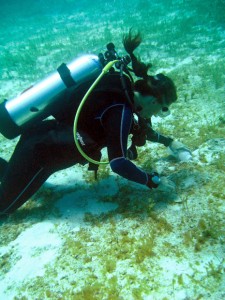
On each of today’s three dives, like all the others, the first thing Alexandra Dempsey does when she reaches the bottom is to pull out a plastic container about the size of a Nalgene water bottle, scoop it full of sand and tuck it away in a pocket before swimming off to other duties. These sediment sample collections are just one part of the expedition’s benthic (seafloor) research, led by Alex, Andy Ross and Rachel D’Silva.

Alexandra Dempsey scoops up sediment

When she returns to the Golden Shadow, Alex takes her bottle of wet sand to the lab and replaces the salt water with a solution of diluted bleach to neutralize any biological material. The bottles sit on a shelf until the expedition is over

Read the rest of Coral Reefs from the Ground Up »

Fish Spotting (Scientifically)

Wednesday, March 14th, 2012

March 13, 2012

The swells had the final word today: we made only one dive, in the morning, off a rollicking Calcutta. The boat spent a few hours after lunch looking for a site that was protected from the swells and also had healthy coral, but no luck. So by 3 p.m. everyone was back on the Golden Shadow, which was rolling enough itself that the Captain decided to move the anchor slightly closer to Southwest Cay to keep the motion to a minimum. (You can estimate the size of the swells by what’s falling over on the dining table. Salt and pepper shakers = small, salad dressing = medium. Glasses tumbling? Big.)
Ferrying dive gear and divers to the Calcutta

Read the rest of Fish Spotting (Scientifically) »

First Day of Research

Sunday, June 5th, 2011
June 4, 2011

We began our research dives with two spots on the Atlantic side of the St. Kitts and Nevis, seaward of the narrows in a reef system known as Grid Iron.  This shallow reef stretches over 10 km from the northeastern end of Nevis to the coastline off St. Kitts.  Formerly a flourishing elkhorn coral reef at depths of 5-10 m, most of this coral died 30 years ago and dense interdigitated skeletons remain in growth position.  We did find a few survivors, some growing atop old skeletons and others sending branches up from the bottom. 
A surviving colony of elkhorn coral

A surviving colony of elkhorn coral

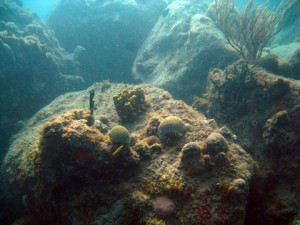
At the perimeter of the elkhorn coral thicket were unusually large (3-5 m diameter) colonies of lobate star coral (Montastraea annularis) and mountainous star coral (Montastraea faveolata).  Many of these had also had died, although a large number of the colonies still had small patches of live tissue on the topside of the lobe.  In some cases, these tissue remnants were actively resheeting over the skeletons and continuing their upward growth, resembling a juvenile coral. Large brain corals had suffered similar fate; many standing dead in place, others with small living tissue remnants dispersed over the colony surface.  However, a closer inspection of the reef revealed many signs of recovery.  A dozen species of coral had settled on the dead skeletons and were expanding outward.  While most of these were species that tend to be early colonizers and short-lived, such as mustard hill coral (Porites astreoides), we also saw a number of more long-lived massive corals like starlet coral (Siderastrea siderea) and brain corals (Diploria spp. and Colpophyllia natans).  A lot of the bottom was covered with fleshy seaweeds or macroalgae, especially a bushy brown macroalgae known as Dictyota. Underneath this alga, and also commonly seen covering dead coral heads was bright pink crustose coralline algae, which is a good sign as this is known to be preferred settlement surface for larval corals. 


Read the rest of First Day of Research »

Building Local Research Capacity

Saturday, June 4th, 2011
June 3, 2011

In continuation of the Foundation’s efforts in outreach and education, the Foundation’s Chief Scientist, Dr. Andy Bruckner, led a coral reef monitoring workshop for St. Kitt’s divers and conservation officers on board the M/Y Golden Shadow.  The day opened with a discussion about the global coral reef crisis, changes to Caribbean coral reefs over the last three decades, and factors triggering reef degradation. This was followed by an overview of the objectives of the GRE, how the research we conduct will fill critical knowledge gaps and aid in the development of actions that can mitigate local impacts, enhance the resilience of coral reefs and ensure the persistence of these threatened ecosystems locally and globally.  Participants gained an understanding of the linkages between reef fishes, algae and corals, how a balanced ecosystem can help promote rapid recovery following large-scale disturbances, and local actions that are necessary to protect and restore vulnerable coral reef ecosystems.  They explored some of the tools available for marine spatial planning, how we develop these tools, and how they can be applied to meet conservation needs and ensure sustainable use of coral reef resources.  This led into a discussion on the importance of rapid assessments in defining the current baseline, threats, and health of coral reefs, and the need for continued monitoring to evaluate changes in response to management.  The classroom sessions ended with an introduction to the methods we are using in St. Kitts and Nevis and in other locations we examine during the GRE.  Participants received three sets of underwater identification cards depicting reef building corals, coral diseases, and ecological resilience indicators.
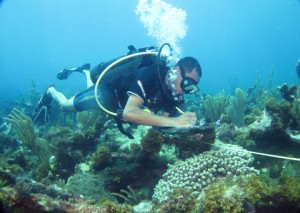
In the afternoon, 12 divers and 2 snorkelers headed out on the Golden Shadow’s two small catamaran dive boats to a shallow reef in order to practice the survey methods.  The Living oceans Foundation is using a standardized survey approach that Bruckner developed and tested in the Red Sea, and further refined during our 2010 Caribbean field surveys. This combines attributes of the AGRRA survey approach, the IUCN resilience assessment approach and additional components on substrate quality, coral structure, algal communities and nuisance species.  By employing a standardized method at all locations we visit, we will be able to assess the health and resilience of these sites and make valuable comparisons among different locations.  Divers were split into three 2-3 person buddy teams, each with an instructor (Andy, Amanda and James). 

Graeme Browne conducts a benthic survey

Graeme Browne conducts a benthic survey

Read the rest of Building Local Research Capacity »

Welcome to St. Kitts and Nevis

Tuesday, May 31st, 2011

June 1, 2011

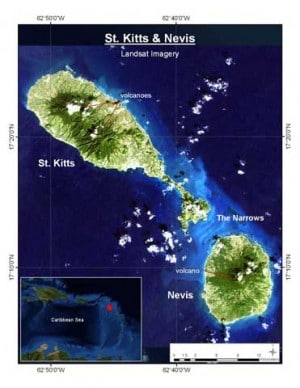
Today we are embarking on the second leg of the Global Reef Expedition. Destination: the Federation of St. Kitts (AKA Saint Christopher) and Nevis.   The twin islands are part of the West Indies, in the eastern Caribbean, roughly east of Antigua and Barbuda, north of Montserrat and south Saba. Together, having  a total landmass of just 262 km2, St. Kitts is slightly larger (168 km2) than Nevis (94 km2).  St. Kitts and Nevis are located about 2 miles apart, separated by a shallow channel called the Narrows.  They are both volcanic islands; in essence, they are summits of a submerged mountain range which forms the eastern boundary of the Caribbean tectonic plate. These lush islands are known for their dense tropical rainforest, mountain streams and an inland lake, lava formations, white, sandy beaches, and a strong British influence. These islands were home to the first British and French colonies in the Caribbean, achieving full independence in 1983. The total population is about 50,000, with most people residing in St. Kitts (38,000).

Map of St. Kitts and Nevis

Map of St. Kitts and Nevis

Read the rest of Welcome to St. Kitts and Nevis »

GRE Website YouTUBE Channel Follow on Facebook Follow on Twitter RSS Feed Updates LOF Website

Search

Calendar

May 2013
M T W T F S S
« Apr    
 12345
6789101112
13141516171819
20212223242526
2728293031  

Archives