June 9, 2011
As the Living Oceans Foundation circumnavigates the globe, one of our core activities is rapid assessments of the health and resilience of coral reefs. Our assessments tell us about the diversity and population structure of corals and fishes, the types and amount of algae, and interactions among these species. We can determine if a reef is stressed and why and, if it has been impacted by a past event, how likely it is to rebound. One measure in particular we use is the age (size) distribution of the corals and how many small corals (recruits) that settled within the last 1-2 years. The basic assumption, if there is good settlement and recruitment of new corals, is that there is a source population providing these corals to the reef, the habitat quality is good enough to promote settlement, and conditions allow for growth and survival of these corals. As we explore reefs of St. Kitts and Nevis, it’s been a mixed bag. We found some sites with a lot of recruits and others with few.
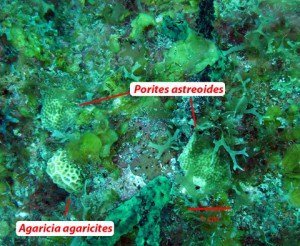
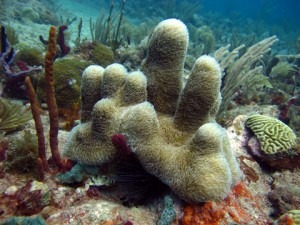
We look more closely at the species of recruits, the amount of algae and herbivory, and other measures to understand why there are differences between sites. We know certain corals, known as brooders, tend to have very high levels of settlement. Brooders are species that may reproduce multiple times in a year. Fertilization is internal and the parents raise the young (brood) until they are much larger and competent (ready to settle), so that they will attach to the bottom, differentiate from a planula larvae into a coral polyp very quickly, and exhibit higher rates of early survival. Brooders tend to be the dominant small corals you see on a reef, especially after a disturbance. The two most common brooders are mustard hill coral (Porites astreoides) and lettuce coral (Agaricia agaricites). In St. Kitts, Porites is by far the dominant coral in terms of numbers of colonies. It has carpeted the bottom and colonized the skeletons of other corals that have died. Agaricia is less common, although some reefs have a lot of these corals.

Porites and Agaricia coral recruits
Read the rest of Establishing Legacy Sites »