
search-icon
Stranded in Tahiti?

There are a lot of moving parts involved with a research mission. If one of these parts does not work, say the engines of the Golden Shadow, everything else shuts down. That has been the case so far on this mission. Before our dives on Friday, we were told that the part was delayed until Sunday, which meant that we wouldn’t leave until Monday (possibly Tuesday) afternoon. However, when we got up from our first dive in Tahiti we were greeted with good news. The part had arrived early from Australia and we were going to be able to head to Rangiroa Saturday afternoon.

All of the schedule changing means a lot of impromptu planning for the Chief Scientist Dr. Andy Bruckner. When we first found out that we would not be able to leave Tahiti on time he quickly had to look at maps and charts and talk with local scientists and Captain Steve Breen to plan a short research schedule around Tahiti. The delay in Tahiti also means that we need to reduce the number of days we have to work in Rangiroa. This again means more schedule changing by Dr. Bruckner and company.
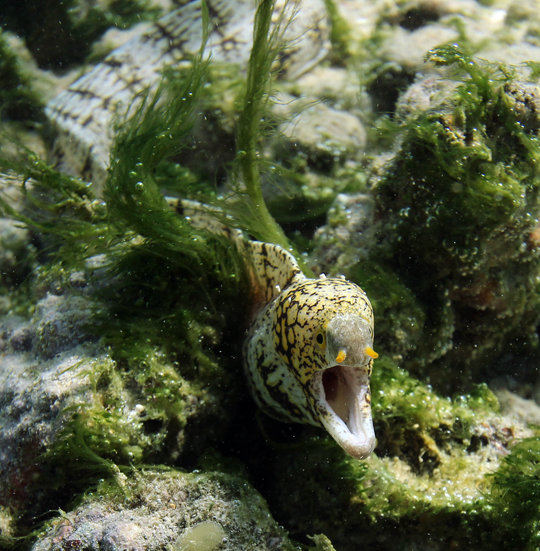
An eel emerges from some algae to greet the camera in Tahiti.
An eel emerges from some algae to greet the camera in Tahiti

While in Tahiti we have been fortunate enough to use the Golden Osprey as a diving platform. The Osprey has provided us with ample room for tanks, cameras, equipment and researchers. We were able to survey 5 sites around the southwest side of Tahiti. These are areas that have not been surveyed and will provide a good comparison for the other islands we will be visiting. The reefs we saw are similar to those we surveyed last month around the Society Islands in terms of coral structure and fish population. Now, we are looking forward to pulling away from the dock and heading to the Tuamotus.
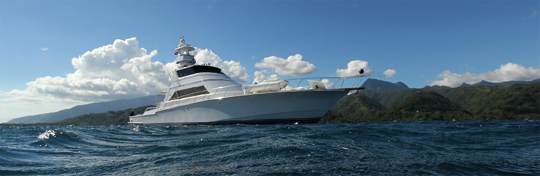
The Golden Osprey is kindly serving as our dive boat until the Golden Shadow can get underway again

(Photos by: Serge Andrefouet)

To follow along and see more photos, please visit us on Facebook! You can also follow the expedition on our Global Reef Expedition page, where there is more information about our research and team members.
Related Posts

World Oceans Day: Protecting the Ecosystems That Protect Us

This World Oceans Day, the global community is being challenged to think differently about the ocean.

The 2026 World Oceans Day theme, “Reimagine: Beyond the World We Know, A New Relationship With Our Ocean,” invites us to recognize that the ocean is not something distant or separate from our lives. It regulates our climate, supports our economies, provides food for billions of people, and sustains the natural systems that make life on Earth possible.

Few places illustrate this connection more clearly than the coastal ecosystems that protect our shores and support marine life. While coral reefs, mangrove forests, and seagrass meadows are often…

Read More

After the Storm: Standing with Our J.A.M.I.N. Family in Jamaica

There are moments in this work that feel heartbreakingly familiar.

Two weeks after we completed our Jamaica Awareness of Mangroves in Nature (J.A.M.I.N.) programming, Hurricane Melissa made landfall. A powerful Category 5 hurricane, Melissa is now tied with Hurricane Allen in 1980 for the strongest winds ever recorded in an Atlantic storm. Like Hurricane Dorian, which devastated The Bahamas in 2019, Melissa will be remembered as one of the strongest hurricanes on record in the region.

For 11 years, the University of the West Indies Discovery Bay Marine Laboratory and William Knibb Memorial High School have been more than program partners. They have welcomed us into their classrooms and labs, shared meals and laughter, and committed themselves to educating their students about mangroves and coastal resilience. These colleagues and students are not distant collaborators. They are family.

And they were hit hard…

Read More
Privacy Overview

This website uses cookies so that we can provide you with the best user experience possible. Cookie information is stored in your browser and performs functions such as recognising you when you return to our website and helping our team to understand which sections of the website you find most interesting and useful.  You can view our complete Privacy Policy here.

Strictly Necessary Cookies

Most of our cookies are used to improve website security and reduce spam. These cookies should be enabled at all times. They also enable us to save your preferences for cookie settings.

3rd Party Cookies

This website uses Google Analytics to collect anonymous information such as the number of visitors to the site, and the most popular pages. Keeping this cookie enabled helps us to improve our website.