
search-icon
Sponge Spawning at Little Inagua

From August 19th-22nd, we experienced nothing but great wall diving around Little Inagua, which is always a diver’s delight.  The island of Little Inagua is five miles to the northeast of Great Inagua, and hosts a large Land and Sea Park. The island is 30 square miles and home only to herds of feral donkeys and goats, descendants of stock introduced by the French.   A protective reef surrounds Little Inagua on all sides, beginning at 14m depth and dropping nearly vertically to the ocean floor.
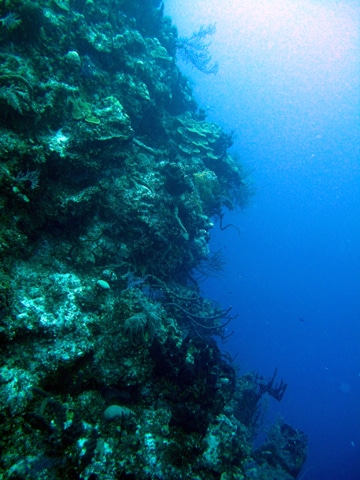
 

Nearly vertical wall off Little Inagua

The winds come from the southeast in the summertime creating 4-6 foot swells and making scuba surveys on the south and east facing coastlines nearly impossible. Charts show the north and south ends of the island as sheer drop-offs with reefs almost exclusively on the east and west coasts.  This layout combined with the windy weather limited our research capabilities around Little Inagua to mostly the north and west sides.

Our work during this trip has been on selected components of the reef system: reef-building corals, fishes, and algae. Sponges are outside of our focus, but are a major component in many reef structures. There are between 5000 and 10,000 species of sponge. The wide range in numbers is indicative of how poorly studied this group has been. Most studies have focused on chemical compounds produced by sponges, which may prove useful as sources for new pharmaceutical drugs.

Eye-Catching Sponge Spawning at Little Inagua

Sponges have a simplistic anatomy, containing neither skeleton nor body organs. Reproduction in these animals is also fairly uncomplicated, but it is eye catching. During sponge spawning, sperm cells are released through outflow openings making it look as if the sponge is smoking.
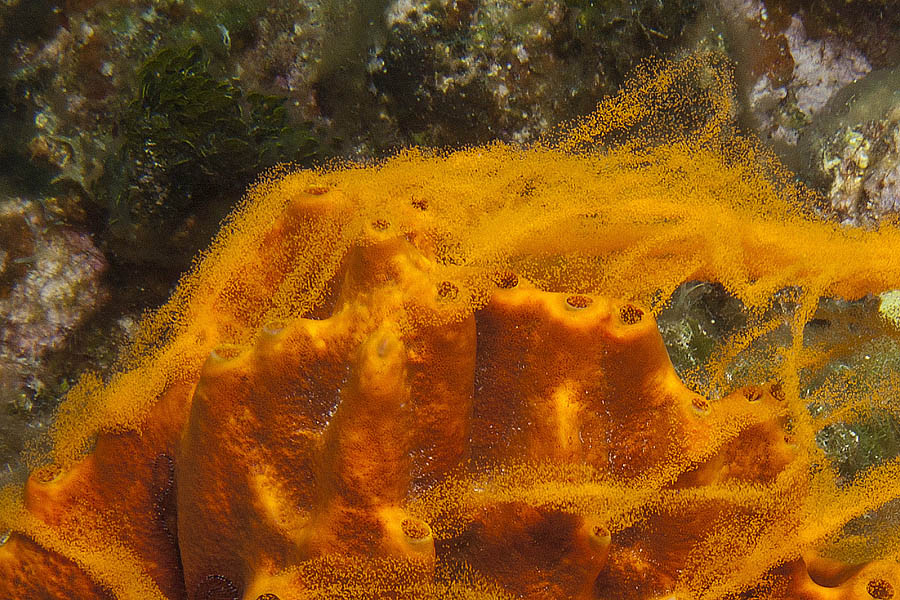
Brown encrusting octopus sponge spawning on the reef at Little Inagua


Most sponges are hermaphrodites, which means they function as both sexes simultaneously. If sperm makes it through the water column to another sponge of the same species, fertilization takes place within the sponge. Some species of sponges release the fertilized eggs within mucus filaments. With luck, the eggs will hatch into larvae that will settle down on the reef to form new sponges.

On the northwest side of Little Inagua we noticed several sponges called the Brown Encrusing Octopus Sponge (Ectyoplasia ferox). This brown to orange sponge is so named because one of its growth forms evokes the shape of an octopus arm with the outflow openings resembling sucker discs. These caught our attention because August is the usual time for sponge spawning in this species and several of the sponges were seen casting off mats of bright orange eggs.
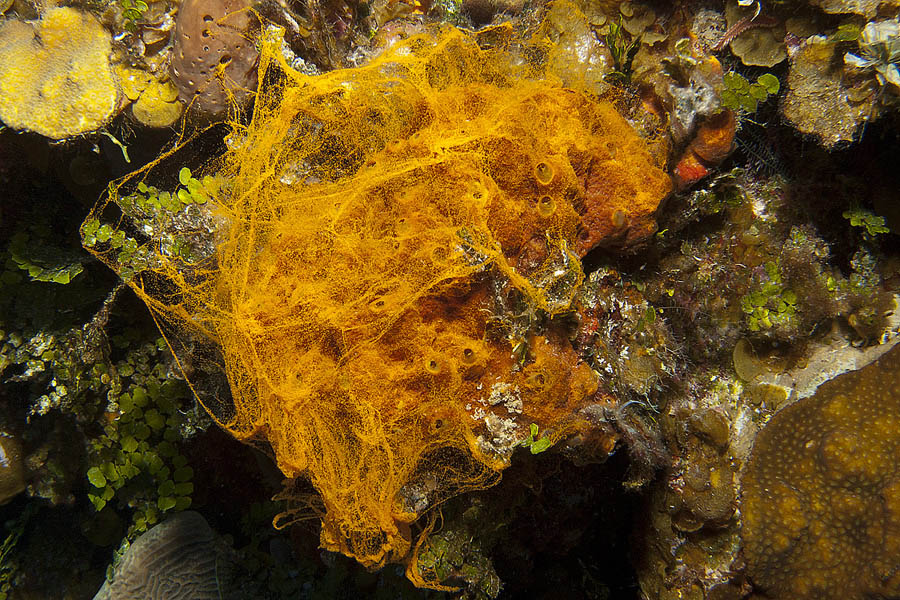
 

Casting off mats of bright orange eggs


Written by Ken Marks and Amanda Williams

(Photo/Images by:  1  Amanda Williams, 2-3 Ken Marks)

To follow along and see more photos, please visit us on Facebook! You can also follow the expedition on our Global Reef Expedition page, where there is more information about our research and our team members.
Related Posts

World Oceans Day: Protecting the Ecosystems That Protect Us

This World Oceans Day, the global community is being challenged to think differently about the ocean.

The 2026 World Oceans Day theme, “Reimagine: Beyond the World We Know, A New Relationship With Our Ocean,” invites us to recognize that the ocean is not something distant or separate from our lives. It regulates our climate, supports our economies, provides food for billions of people, and sustains the natural systems that make life on Earth possible.

Few places illustrate this connection more clearly than the coastal ecosystems that protect our shores and support marine life. While coral reefs, mangrove forests, and seagrass meadows are often…

Read More

After the Storm: Standing with Our J.A.M.I.N. Family in Jamaica

There are moments in this work that feel heartbreakingly familiar.

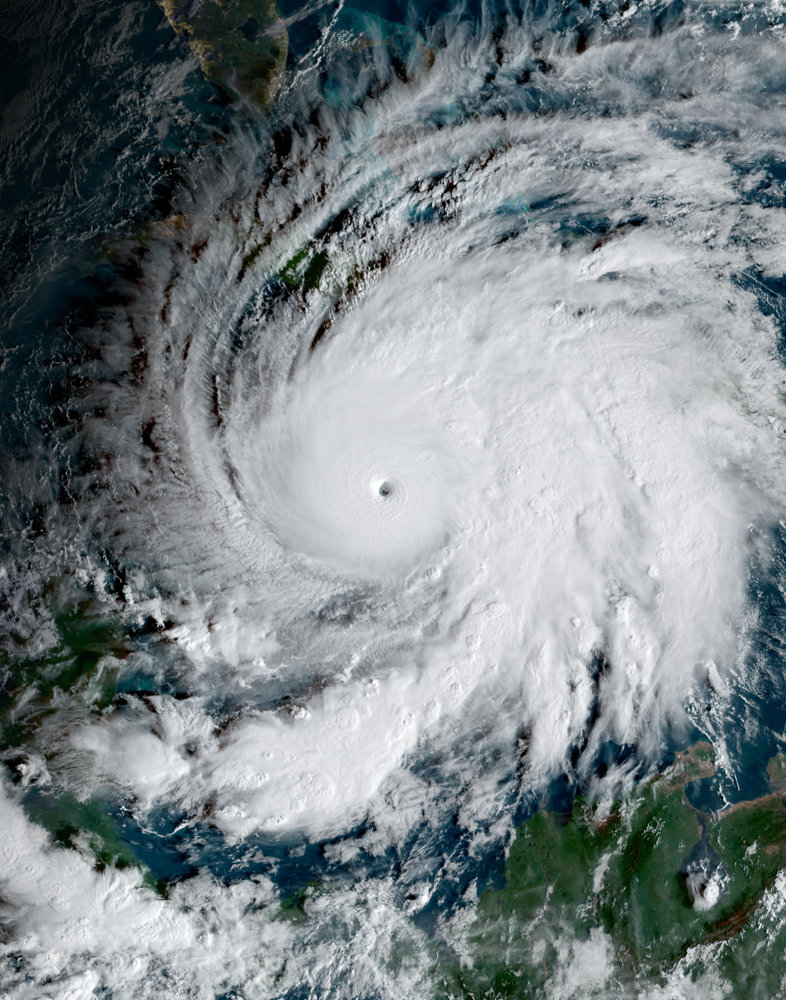
Two weeks after we completed our Jamaica Awareness of Mangroves in Nature (J.A.M.I.N.) programming, Hurricane Melissa made landfall. A powerful Category 5 hurricane, Melissa is now tied with Hurricane Allen in 1980 for the strongest winds ever recorded in an Atlantic storm. Like Hurricane Dorian, which devastated The Bahamas in 2019, Melissa will be remembered as one of the strongest hurricanes on record in the region.

For 11 years, the University of the West Indies Discovery Bay Marine Laboratory and William Knibb Memorial High School have been more than program partners. They have welcomed us into their classrooms and labs, shared meals and laughter, and committed themselves to educating their students about mangroves and coastal resilience. These colleagues and students are not distant collaborators. They are family.

And they were hit hard…

Read More
Privacy Overview

This website uses cookies so that we can provide you with the best user experience possible. Cookie information is stored in your browser and performs functions such as recognising you when you return to our website and helping our team to understand which sections of the website you find most interesting and useful.  You can view our complete Privacy Policy here.

Strictly Necessary Cookies

Most of our cookies are used to improve website security and reduce spam. These cookies should be enabled at all times. They also enable us to save your preferences for cookie settings.

3rd Party Cookies

This website uses Google Analytics to collect anonymous information such as the number of visitors to the site, and the most popular pages. Keeping this cookie enabled helps us to improve our website.