search-icon
Something’s Fishy Around Here

A fish sandwich? Think again. You may want to leave the fish on the reef, if you live in Mangareva.  There’s a good chance it may be ciguateric and you may get ciguatera poisoning.  Ciguatera fish poisoning (CFP) is seafood intoxication caused by the consumption of tropical reef fishes contaminated with a type of microalgae called a dinoflagellate.  The dinoflagellate belongs to the genus Gambierdiscus, which was first identified in the Gambier Islands (hence the scientific name) after a severe outbreak in the late 1960s.  Gambierdiscus usually occur on benthic algae, increasing in abundance after some type of disturbance degrades a coral reef, such as a cyclone, bleaching event, or, in the case of French Polynesia in the 1960s, nuclear testing.

Gambierdiscus under a microscope, the cause of ciguatera poisoning.

Ciguatera Poisoning

The dinoflagellates produce a potent neurotoxin (ciguatoxin) that is bioaccumulated (built-up in the tissue) and biotransformed along the trophic chain first to the herbivorous fishes, then to carnivorous fish. The population of these microalgae usually blooms 10 months after a coral die-off and then it takes about 4 months for it to pass up the food chain and cause outbreaks in humans. There are now 11 known species of Gambierdiscus.  They affect tropical areas in the Caribbean Sea, and the Pacific and Indian Oceans. Some 50-100,000 cases of ciguatera poisoning or CFP are reported every year.  If you eat a ciguatoxic fish, you’ll know within about 2 hours via digestive disorders, followed by neurological symptoms ranging from temperature reversal, tingling, itching, muscular pains, chronic fatigue, and numbness.  These symptoms may last a few weeks or even a lifetime.  Symptoms following consumption of a second ciguatoxic fish at a later date are even worse, as the toxin accumulates in your body.
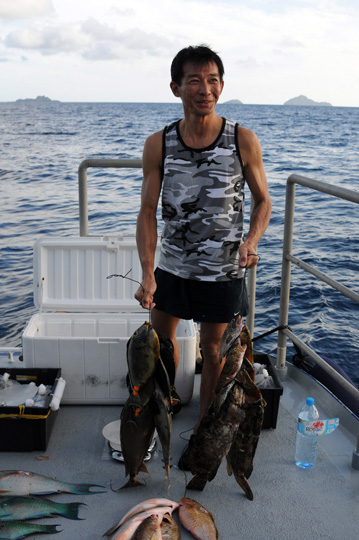
Andre Ung holds up the string of fish
Andre Ung holds up a string of toxic fish


Ciguatera poisoning has occurred since at least the 7th century, in China and it was commonly reported among explorers in the 16th century.  In French Polynesia, mass intoxications were reported in Bora Bora in the 1960s, followed by the Gambiers, but little research was done until about a decade ago.  Monitoring sites were first established here last year, and five scientists from Institute Louis Malardé and IRD are with us during this expedition to follow-up on this work.  It takes one to two very long days for the researchers to work one site. The day starts with a quantitative survey of the bottom (100 m X 100 m area) to determine how much and what type of fleshy algae are present, the amount of dead coral, and how much turf algae is present. One species of turf is a preferred habitat for the dinoflagellate (Amphiroa rigida).  This alga is collected and then washed through a fine mesh filter to remove and collect the microalgae.

Red algae Amphiroa that the dinoflagellates settle on


If there is a bloom (this year, a bloom was identified in one site off Rikitea), then enough of the Gambierdiscus can be collected to allow determination of the species using molecular tools (PCR).  Finally, a subsample of the known toxic fish is collected.
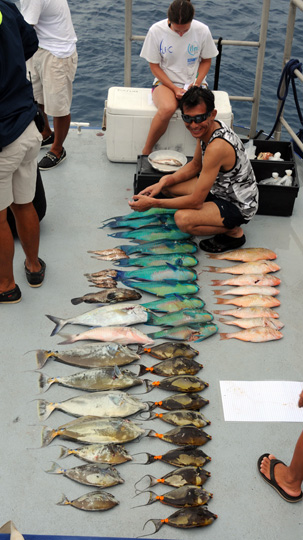
The day's catch includes two species of parrotfish (Chlorurus micorhinos, Hipposcarus longiceps) , unicornfish/surgeonfish (Naso lituratus and N. unicornis), two groupers (Epinephelus merva and E. tauvina), Parapeneus barberinus and a jack (Carangoides orthogrammus), all species known to be ciguatoxic here.
The day’s catch includes two species of parrotfish (Chlorurus micorhinos, Hipposcarus longiceps) , unicornfish/surgeonfish (Naso lituratus and N. unicornis), two groupers (Epinephelus merva and E. tauvina), Parapeneus barberinus and a jack (Carangoides orthogrammus), all species known to be ciguatoxic here.


On the ship, the fish are cleaned and filets are carefully weighed and frozen for analysis, but strictly kept for research purposes and are not to be consumed!
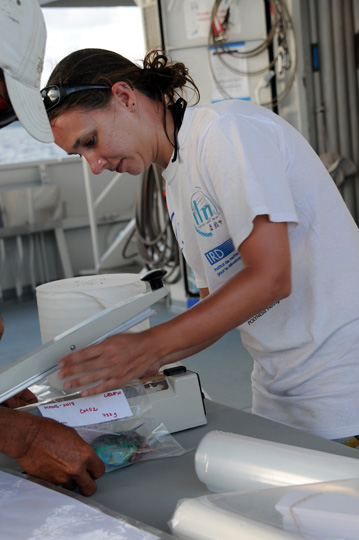
Dr. Melaine Roue weighs and bags fish for freezing


The research team has conducted a very thorough study, completing the three sites they established last year and establishing three new sites. Remarkably, 2012 and 2013 represent the first comprehensive Gambierdiscus assessments ever done in the Gambiers!

(Photos by: Dr. Andy Bruckner)
Related Posts

World Oceans Day: Protecting the Ecosystems That Protect Us

This World Oceans Day, the global community is being challenged to think differently about the ocean.

The 2026 World Oceans Day theme, “Reimagine: Beyond the World We Know, A New Relationship With Our Ocean,” invites us to recognize that the ocean is not something distant or separate from our lives. It regulates our climate, supports our economies, provides food for billions of people, and sustains the natural systems that make life on Earth possible.

Few places illustrate this connection more clearly than the coastal ecosystems that protect our shores and support marine life. While coral reefs, mangrove forests, and seagrass meadows are often…

Read More

After the Storm: Standing with Our J.A.M.I.N. Family in Jamaica

There are moments in this work that feel heartbreakingly familiar.

Two weeks after we completed our Jamaica Awareness of Mangroves in Nature (J.A.M.I.N.) programming, Hurricane Melissa made landfall. A powerful Category 5 hurricane, Melissa is now tied with Hurricane Allen in 1980 for the strongest winds ever recorded in an Atlantic storm. Like Hurricane Dorian, which devastated The Bahamas in 2019, Melissa will be remembered as one of the strongest hurricanes on record in the region.

For 11 years, the University of the West Indies Discovery Bay Marine Laboratory and William Knibb Memorial High School have been more than program partners. They have welcomed us into their classrooms and labs, shared meals and laughter, and committed themselves to educating their students about mangroves and coastal resilience. These colleagues and students are not distant collaborators. They are family.

And they were hit hard…

Read More
Privacy Overview

This website uses cookies so that we can provide you with the best user experience possible. Cookie information is stored in your browser and performs functions such as recognising you when you return to our website and helping our team to understand which sections of the website you find most interesting and useful.  You can view our complete Privacy Policy here.

Strictly Necessary Cookies

Most of our cookies are used to improve website security and reduce spam. These cookies should be enabled at all times. They also enable us to save your preferences for cookie settings.

3rd Party Cookies

This website uses Google Analytics to collect anonymous information such as the number of visitors to the site, and the most popular pages. Keeping this cookie enabled helps us to improve our website.