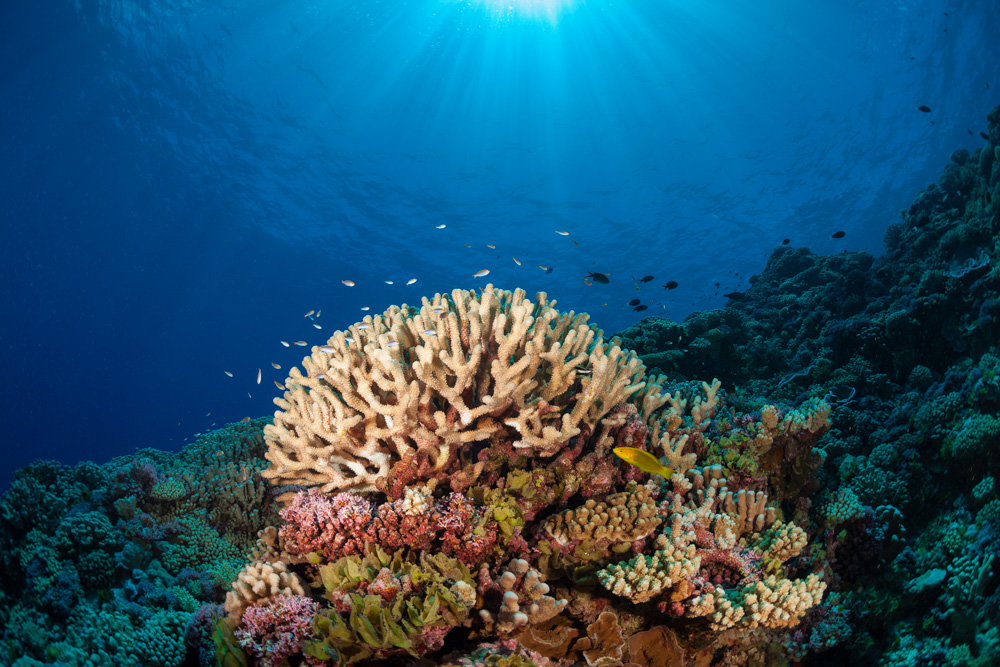
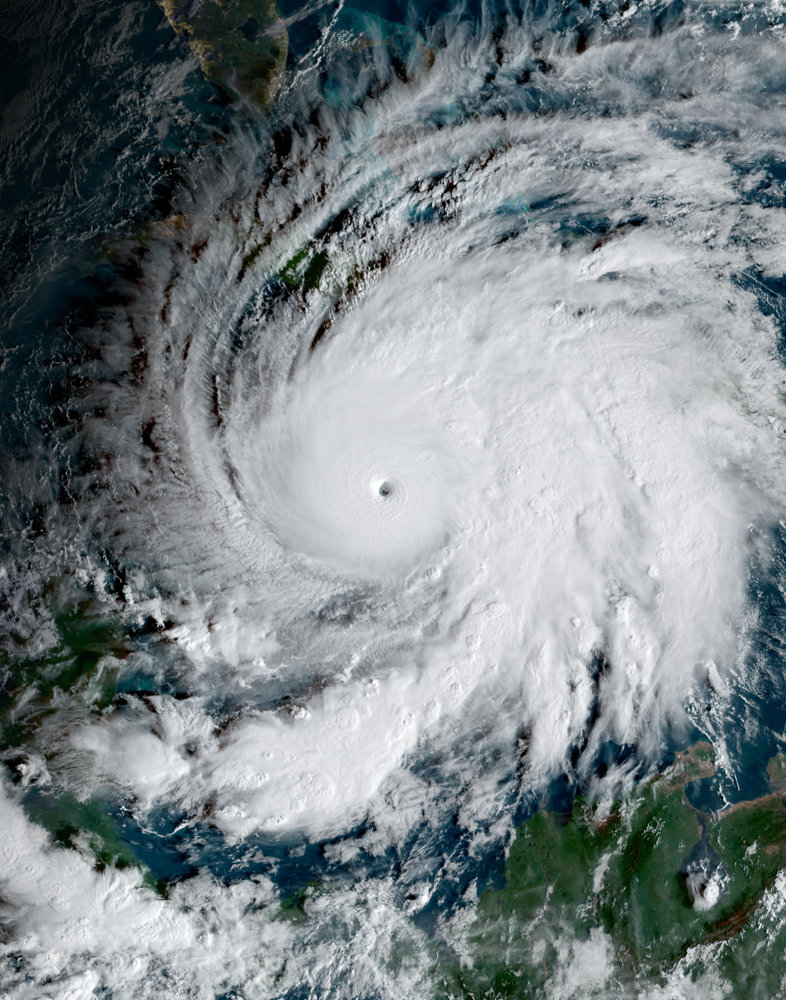
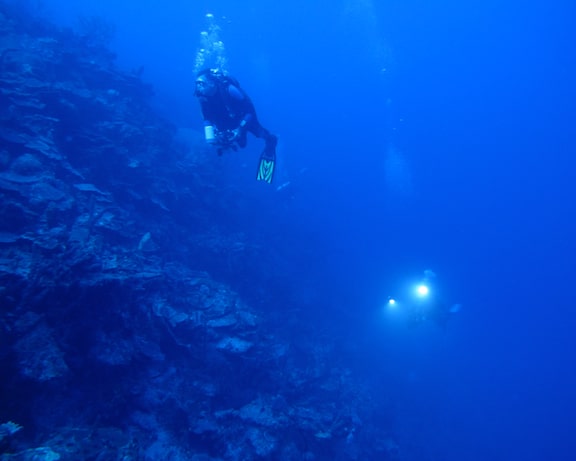
Like jumping feet first into the rabbit hole made famous in “Alice in Wonderland” by Lewis Carroll, the deeper you dive on a reef, the more things change in interesting ways. “Curiouser and curiouser,” mused Alice as she delved into her subterranean world. A diver passing through deep-water corals might well think the same thing. This morning, CAPT Phil Renaud, Executive Director of the Khaled bin Sultan’s Living Oceans Foundation and Dr. Bernhard Riegl of the National Coral Research Institute based out of Nova Southeastern University in Florida (supported by the Dive Safety Officer and Videographer), had a rare opportunity to experience the deep reef first-hand. The purpose of their excursion into the depths was to compare a small portion of the deep reef around Great Inagua with the shallow reefs we have been surveying thus far on the expedition.
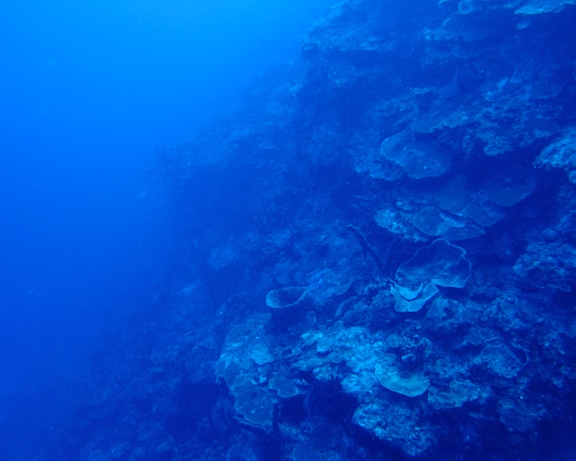
The divers immediately noticed that the hemi-spherical shapes many coral species adopt in the shallows morphed into a flat, plate-like formation at depth. This growth pattern is caused by lower amounts of sunlight penetrating the water as depth increases. To maximize growth rates and, in turn, the amount of sunlight being received by their zooxanthellae algae [zoo-zan-thel-ee], deep-water corals adopt a flat morphology. Individual coral animals, known as polyps, house a multitude of microscopic zooxanthellae in their tissues. Thousands of specks of the minute algae photosynthesize, using carbon dioxide released by the coral as it metabolizes. This process also provides the polyps with oxygen and organic nutrients. The coral-zooxanthellae partnership is known as a symbiotic relationship. In this case, because both parties benefit from their interactions, scientists refer to it as mutualism.
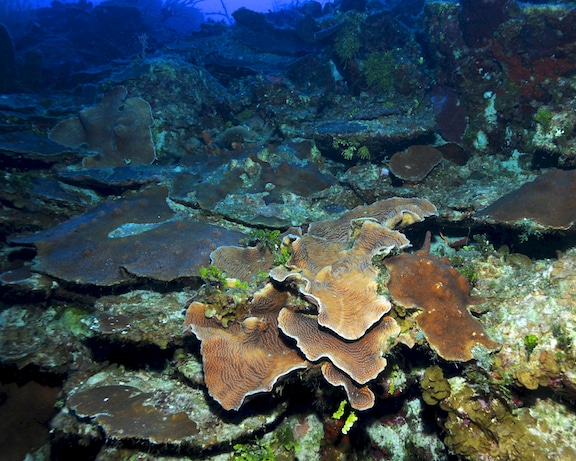
The divers also noted that unlike shallow corals, the tentacles of deep-water polyps tend to be extended in daytime. This is because deep-water corals have a diet that is more dependent on plankton and bacteria caught directly out of the water column, than on the products of photosynthesis. Additionally, the color of coral species changed with depth as the symbiotic algae generate more photosynthetic pigments and in greater density to harvest light more effectively. All of these modifications in morphology can make identifying deep-water corals tricky, as many of the usual indicators cannot be used.
The divers completed a rapid deep-water coral survey during their dive, which including taking many photographs. They found that the species diversity making up the deeper reef off Great Inagua is similar to that of the shallow reef. They also noted comparable patterns of coral disease, algal growth, and considerable coral mortality. Although far more study is needed, these initial observations are one piece of information implying that corals in deeper waters are not exempt from factors impacting shallower corals. Although the Global Reef Expedition is focusing on the study of shallow reefs, we value these occasional surveys of the deeper world of corals.
Written by Kit van Wagner
(Photo/Images by: 1 & 3 Nick Cautin, 2 CAPT Philip Renaud)
To follow along and see more photos, please visit us on Facebook! You can also follow the expedition on our Global Reef Expedition page, where there is more information about our research and our team members.