
search-icon
Local Management to the ‘Reef’ Rescue

Across the world, coral reefs and fisheries are in crisis. In Fiji over the past few decades, increased demands for cash income and material goods, coupled with growing populations and access to markets, have led to substantially increased pressure on coastal and marine resources. Some estimates indicate that Fiji already can no longer meet its food security needs from coastal fisheries.

But Fijians are very positive people. In the midst of all of this doom and gloom, local communities are taking action. Residents of coastal villages across Fiji, including here in Lau Province, are establishing their own local marine protected areas and enforcing their own local management rules.

LMMA Network: Locally Managed Marine Area, Local Marine Protected Areas (MPA)
Community members from Totoya Island watch as a sperm whale’s tooth (tabua) is presented as a formal offering for the establishment of Daveta Tabu, a locally managed MPA. (c) Keith Ellenbogen

Present day local marine resource management in Fiji and throughout the Pacific is built on long-standing traditions of land and sea tenure and local authority over resource use. Through this ownership also comes an obligation to look after the environment, which is an important part of indigenous Fijian culture.

Locally Managed Marine Areas: LMMA Network

More recently, conservation and management organizations have embraced this local willingness to implement resource management, and programs to revitalize customary management practice, such as the Locally Managed Marine Area (LMMA) network have spread throughout the region. The LMMA network is composed of government, NGO, academic and private sector organizations that all assist local communities to better manage their coastal fisheries, while sharing knowledge and best practice. Currently there are over 400 participating communities in the Fiji LMMA network that have informally established 415 no-take fisheries closures across 257 traditional fisheries management areas (qoliqoi).
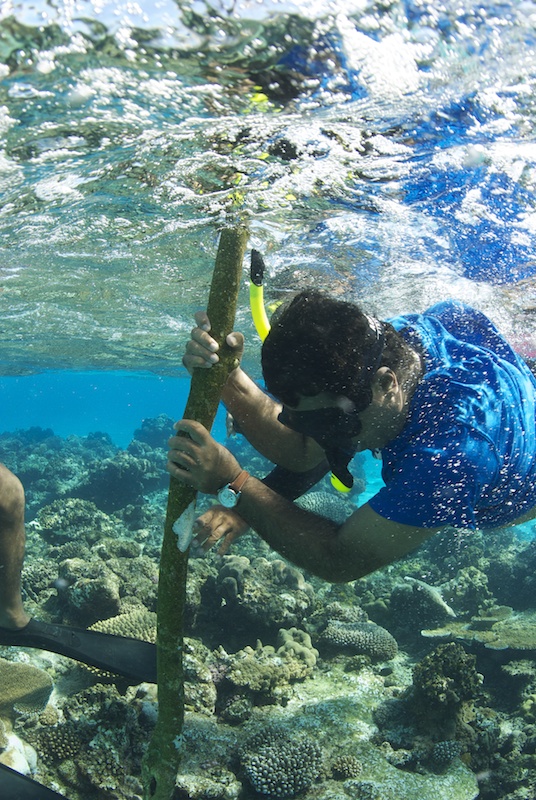
Roko Sau, Josefa Cinavilakeba, places a tree trunk in the reef on Totoya to mark the boundary of a locally managed MPA. (c) Keith Ellenbogen

As part of the Global Reef Expedition, the Living Oceans Foundation is working with the Fiji LMMA network specifically to collect data on reef habitats to identify the best locations to establish new marine protected areas (MPAs) or to assess whether current MPAs are working. In addition, the Foundation will provide communities and the Lau Provincial Office with detailed maps to assist them to delineate management zone boundaries. In the meantime, the Fiji LMMA network’s Eastern Division representative, Roko Sau Josefa Cinavilakeba, is consulting with FLMMA communities on land to identify their management challenges.

The vision of the Fiji LMMA network is “to have everlasting marine resources for our descendants.”
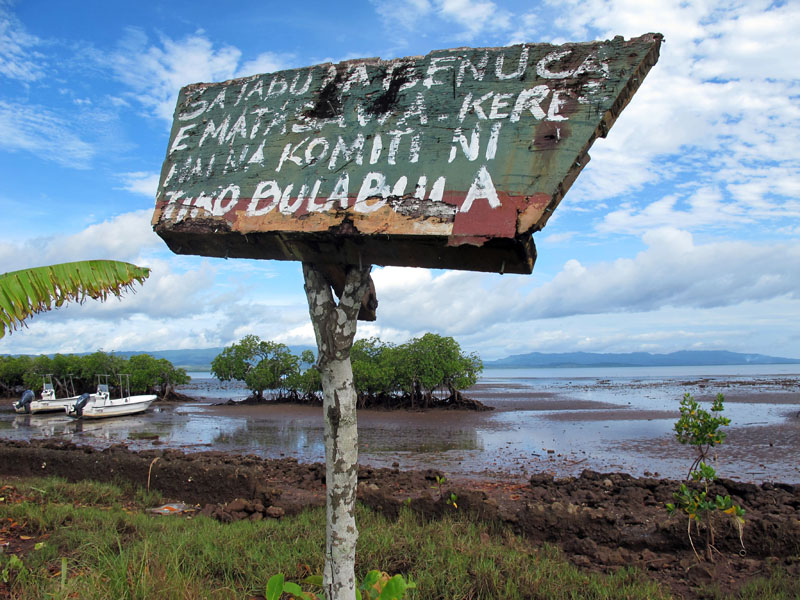
Sign indicating locally managed fishing closure on Vanua Levu, Fiji. (c) Stacy Jupiter

I often get asked, “Does local management really work?”

Yes, it can. Scientific surveys by the Wildlife Conservation Society and others have shown that when management rules are well-enforced, even very small, locally managed fisheries closures can increase the size and abundance of important fish and invertebrate species. On our expedition, we heard from community members in the village of Naroi on Moala Island who established their no-take area two years ago that they have already seen a recovery of fish populations and are extremely happy with the outcome.

For more information about LMMAs in Fiji and the region, visit the Locally Managed Marine Area Network’s website at: http://www.lmmanetwork.org/
Related Posts

Tiny Organisms, Big Impact: Announcing the Winners of the 2026 Science Without Borders® Challenge

The Khaled bin Sultan Living Oceans Foundation is proud to announce the winners of the 2026 Science Without Borders® Challenge, an international student art contest that promotes ocean science and conservation. This year’s theme, Microscopic Marine Life, challenged students to explore the hidden world of ocean microorganisms and illustrate how these tiny organisms sustain marine ecosystems—and life on Earth itself.

Open to primary and secondary school students ages 11–19, the competition received nearly 900 submissions from 65 countries around the world. Through painting, drawing, and mixed media, students transformed invisible ocean life into vivid visual stories, highlighting the critical role microscopic marine organisms play in producing oxygen, supporting marine food webs, recycling nutrients, and regulating Earth’s climate.

The winning entries…

Read More

Navigate with Care: Delivering Global Impact at the Intersection of Maritime Safety and Ocean Protection

Navigate with Care: Protect Our Oceans, a global campaign developed jointly by the International Foundation for Aids to Navigation (IFAN) and the Khaled bin Sultan Living Oceans Foundation (KSLOF), comes to a close after a successful launch phase. 

The campaign established a clear and practical link between maritime safety and environmental stewardship, demonstrating that responsible navigation practices are essential both for protecting lives at sea and for safeguarding vulnerable marine ecosystems…

Read More
Privacy Overview

This website uses cookies so that we can provide you with the best user experience possible. Cookie information is stored in your browser and performs functions such as recognising you when you return to our website and helping our team to understand which sections of the website you find most interesting and useful.  You can view our complete Privacy Policy here.

Strictly Necessary Cookies

Most of our cookies are used to improve website security and reduce spam. These cookies should be enabled at all times. They also enable us to save your preferences for cookie settings.

3rd Party Cookies

This website uses Google Analytics to collect anonymous information such as the number of visitors to the site, and the most popular pages. Keeping this cookie enabled helps us to improve our website.