search-icon
Lagoon Reefs of Fakarava

We have had many interesting dives within the lagoons around the Tuamotu Archipelago, but the Fakarava lagoonal habitats have been the most unique. There are thousands of small patch reefs that extend from the water’s surface to depths as great as 55 m.  Some of these lagoon reefs have an emergent island with vegetation, while others have a small emergent sand patch with some rubble and coral boulders, and others are totally submerged. Each type is unique in structure. In cases where the top of the submerged reef is 2-3 m below the surface, there is a community dominated by unusually large boulder-like Porites, some which can be over 15 m in width.  Porites corals are sometimes described as finger corals or massive corals.
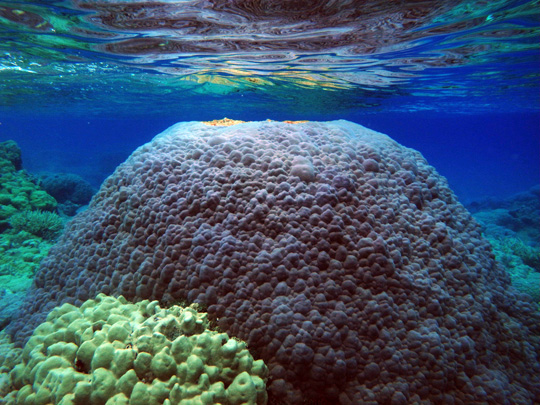
A Porites colony close to the surface with a dead top in lagoon reefs of Fakarava


As the Porites colonies grow up to sea level, the tops of the colonies are exposed during very low tides, and they die, and then become colonized by branching corals (Acropora, commonly called elkhorn, table, or staghorn corals, and Pocillopora, commonly called cauliflower or brush corals).
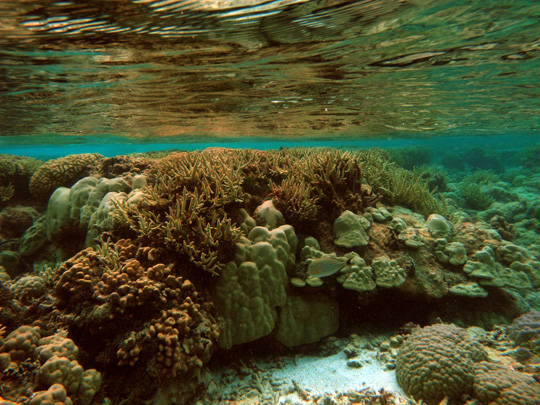
Porites in shallow water that has been colonized by branching corals


Over time, the Porites colonies continue to expand outward, towards deeper water, but the colonies in the center of these lagoon reefs die completely and are replaced by a branching coral community.  Eventually, the center resembles reef flats found on the atoll’s outer rim, with dense stands of small Acropora colonies, fields of large tree-like Acropora and an outer rind of Porites colonies. The surrounding slope is very steep, composed of sand, coral rubble and boulders that break off  from the rim of the reef flat.  The base of these structures is comprised of accumulations of old, dead coral colonies that rolled down the slope, and is covered by woven macroalgae, known as Microdictyon.
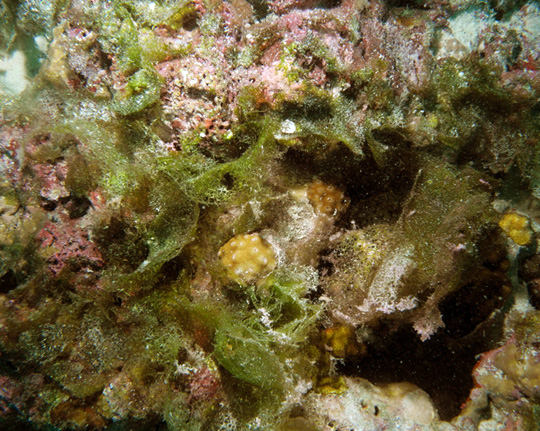
Microdictyon algae, crustose coralline algae and a small coral


The boulders of these lagoon reefs have very little coral growth, presumably because recruitment is inhibited by steep slopes and debris covering the slope. The water is also much more turbid in the lagoon reefs than outer reefs at the same depth due to the high photosynthesis of the benthic communities and the poor flushing of the atoll. There is, however, often a dense aggregation of finely branched, tall and spindly Acropora colonies that can survive in this environment because the wave exposure is so low and the colonies are too tall to be buried by sediments.
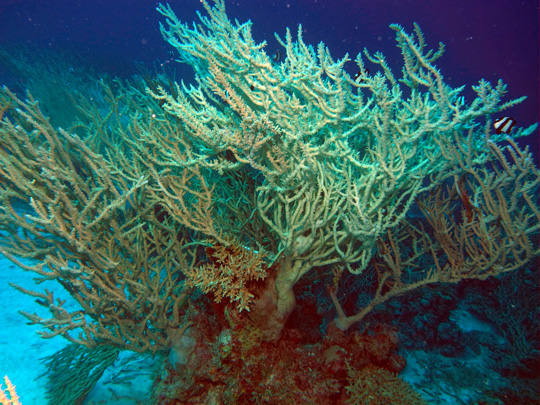
Delicate, upright, branching "spindly" Acropora colonies at the base of a lagoonal patch reef
Delicate, upright, branching “spindly” Acropora colonies at the base of a lagoonal patch reef

(Photos by: Dr. Andy Bruckner)

If you liked this blog, you might also like: Lagoon Life from our Colombia mission.
Related Posts

World Oceans Day: Protecting the Ecosystems That Protect Us

This World Oceans Day, the global community is being challenged to think differently about the ocean.

The 2026 World Oceans Day theme, “Reimagine: Beyond the World We Know, A New Relationship With Our Ocean,” invites us to recognize that the ocean is not something distant or separate from our lives. It regulates our climate, supports our economies, provides food for billions of people, and sustains the natural systems that make life on Earth possible.

Few places illustrate this connection more clearly than the coastal ecosystems that protect our shores and support marine life. While coral reefs, mangrove forests, and seagrass meadows are often…

Read More

After the Storm: Standing with Our J.A.M.I.N. Family in Jamaica

There are moments in this work that feel heartbreakingly familiar.

Two weeks after we completed our Jamaica Awareness of Mangroves in Nature (J.A.M.I.N.) programming, Hurricane Melissa made landfall. A powerful Category 5 hurricane, Melissa is now tied with Hurricane Allen in 1980 for the strongest winds ever recorded in an Atlantic storm. Like Hurricane Dorian, which devastated The Bahamas in 2019, Melissa will be remembered as one of the strongest hurricanes on record in the region.

For 11 years, the University of the West Indies Discovery Bay Marine Laboratory and William Knibb Memorial High School have been more than program partners. They have welcomed us into their classrooms and labs, shared meals and laughter, and committed themselves to educating their students about mangroves and coastal resilience. These colleagues and students are not distant collaborators. They are family.

And they were hit hard…

Read More
Privacy Overview

This website uses cookies so that we can provide you with the best user experience possible. Cookie information is stored in your browser and performs functions such as recognising you when you return to our website and helping our team to understand which sections of the website you find most interesting and useful.  You can view our complete Privacy Policy here.

Strictly Necessary Cookies

Most of our cookies are used to improve website security and reduce spam. These cookies should be enabled at all times. They also enable us to save your preferences for cookie settings.

3rd Party Cookies

This website uses Google Analytics to collect anonymous information such as the number of visitors to the site, and the most popular pages. Keeping this cookie enabled helps us to improve our website.