search-icon
Finding Angels

Spotting new fish species that you’ve never seen before and can’t put a name to is one of the many exciting and fulfilling aspects of being a fish surveyor with The Living Oceans Foundation’s Global Reef Expedition.  This latest expedition to the Gambier Archipelago in French Polynesia offered something particularly special – a sighting of a species of Pygmy Angelfish that according to best and current scientific knowledge has never  been seen before in this island group.  Introducing the Orangehead Pygmy Angelfish, Centropyge hotumatua. 
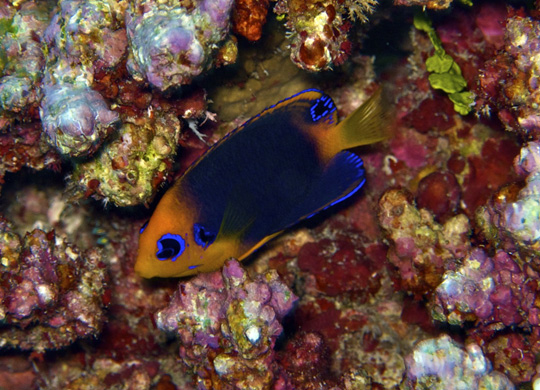
 

Orangehead Pygmy Angelfish


This colorful little critter was previously known to only occur in the far southern reaches of French Polynesia – the Austral Islands and Rapa Island (where GRE heads next!), as well as Pitcairn Island and Easter Island.  This is a rather narrow distribution for a fish species to have, so while spotting this fish in the Gambiers might not sound that exciting at first, when you consider that from the Gambiers its next known locations are ~700km to the southwest (Pitcairn’s) and ~1,000km to the east (Australs) over open ocean, it’s a pretty special find.


Angelfish generally lead a rather elusive and secretive life, and Pygmy Angels are usually under 10cm in length, so it’s not entirely surprising that the Orangehead Pygmy Angelfish has gone unnoticed in the Gambiers for so long.  Further, the remoteness and relative anonymity of this island group as a superb diving location has no doubt helped keep this small fish hidden in the Gambier Islands until now.

Photo by Eva McClure
Related Posts

World Oceans Day: Protecting the Ecosystems That Protect Us

This World Oceans Day, the global community is being challenged to think differently about the ocean.

The 2026 World Oceans Day theme, “Reimagine: Beyond the World We Know, A New Relationship With Our Ocean,” invites us to recognize that the ocean is not something distant or separate from our lives. It regulates our climate, supports our economies, provides food for billions of people, and sustains the natural systems that make life on Earth possible.

Few places illustrate this connection more clearly than the coastal ecosystems that protect our shores and support marine life. While coral reefs, mangrove forests, and seagrass meadows are often…

Read More

After the Storm: Standing with Our J.A.M.I.N. Family in Jamaica

There are moments in this work that feel heartbreakingly familiar.

Two weeks after we completed our Jamaica Awareness of Mangroves in Nature (J.A.M.I.N.) programming, Hurricane Melissa made landfall. A powerful Category 5 hurricane, Melissa is now tied with Hurricane Allen in 1980 for the strongest winds ever recorded in an Atlantic storm. Like Hurricane Dorian, which devastated The Bahamas in 2019, Melissa will be remembered as one of the strongest hurricanes on record in the region.

For 11 years, the University of the West Indies Discovery Bay Marine Laboratory and William Knibb Memorial High School have been more than program partners. They have welcomed us into their classrooms and labs, shared meals and laughter, and committed themselves to educating their students about mangroves and coastal resilience. These colleagues and students are not distant collaborators. They are family.

And they were hit hard…

Read More
Privacy Overview

This website uses cookies so that we can provide you with the best user experience possible. Cookie information is stored in your browser and performs functions such as recognising you when you return to our website and helping our team to understand which sections of the website you find most interesting and useful.  You can view our complete Privacy Policy here.

Strictly Necessary Cookies

Most of our cookies are used to improve website security and reduce spam. These cookies should be enabled at all times. They also enable us to save your preferences for cookie settings.

3rd Party Cookies

This website uses Google Analytics to collect anonymous information such as the number of visitors to the site, and the most popular pages. Keeping this cookie enabled helps us to improve our website.