Archive for June, 2012
Tuesday, June 19th, 2012
June 17, 2012
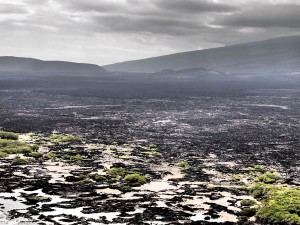
The last day of research brought us to Urvina Bay on the west side of Isabela Island. In passing from Pueto Ayora around the southern end of Isabela, we followed the same route that Darwin took aboard the Beagle in 1835. In his book The Voyage of the Beagle, he wrote how the signs of recent volcanic activity were everywhere in these young western islands:

SEPTEMBER 29, 1835. We doubled the south-west extremity of Albemarle [Isabela] Island, and the next day were nearly becalmed between it and Narborough [Fernandina] Island. Both are covered with immense deluges of black naked lava, which have flowed either over the rims of the great caldrons, like pitch over the rim of a pot in which it has been boiled, or have burst forth from smaller orifices on the flanks; in their descent they have spread over miles of the sea-coast. On both of these islands eruptions are known to have taken place; and in Albemarle we saw a small jet of smoke curling from the summit of one of the great craters.

Lava flow at Urvina Bay, Isabela Island
Read the rest of Goodbye to the Galapagos »
Tags: Charles Darwin, coral, coral reefs, ecuador, Fernandina Island, Galapagos, Global Reef Expedition, isabela island, Khaled bin Sultan Living Oceans Foundation
Posted in Galapagos, Pacific Ocean | 1 Comment »
Monday, June 18th, 2012
June 16, 2012
Peter Glynn, Professor of Marine Biology and Fisheries at the University of Miami, was one of the first scientists to study the coral reefs of the Galapagos. He’s the head of the U. Miami team on board the Golden Shadow, which includes four of his former students: Iliana Baums, Derek Manzello, Tyler Smith and Joshua Feingold.
Peter Glynn (L) and Bernhard Riegl at Concha y Perla lagoon
How did you first get involved in studying the coral reefs in the Galapagos?
In 1974, Jerry Wellington was here with the Peace Corps surveying marine habitats for the Galapagos National Park. I was staff scientist at the Smithsonian Tropical Research Institute in Panama. When I got wind he was finding coral reefs, I hooked up with him and in 1975 we put together an expedition to survey all the coral reef habitats.
Read the rest of An Interview with Peter Glynn »
Tags: coral, coral bleaching, coral reefs, El Nino, Galapagos, Global Reef Expedition, Khaled bin Sultan Living Oceans Foundation, panama
Posted in Galapagos, Pacific Ocean | No Comments »
Monday, June 18th, 2012
June 15, 2012
Iliana Baums, a biologist at Penn State University, explained her research last night after dinner. She’s looking at Porites lobata, a major reef-building coral in the Pacific and Indian Oceans, and its identical-looking relative P. evermanni, and how they fit into the greater reef ecosystems. (These are what’s known as cryptic species, meaning they look the same morphologically but are genetically distinct.) She described the three-way interaction between the Porites corals, the mussels that bore into them, leaving distinctive keyhole-shaped holes, and the triggerfish that bite the coral trying to get at the mussels inside.
Porites lobata colony
Read the rest of Triggerfish, Mussels and Coral »
Tags: coral, Galapagos, Global Reef Expedition, Iliana Baums, Khaled bin Sultan Living Oceans Foundation, mussels, Porites, Porites evermanni, porites lobata, triggerfish
Posted in Galapagos, Pacific Ocean | No Comments »
Monday, June 18th, 2012
June 14, 2012
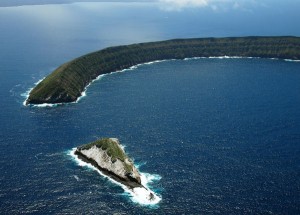
Another day at Isabela Island, with two morning dives at C-shaped island called Tortuga, the remains of yet another partially collapsed volcanic cone (though much bigger than Devil’s Crown). Unfortunately, we found very little coral.
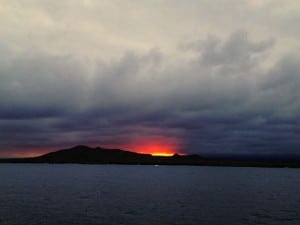
Tortuga island
Read the rest of When Volcanoes Meet »
Tags: Alcedo volcano, Cerro Azul volcano, Darwin volcano, Ecuador volcano, Galapagos, Global Reef Expedition, hotspot, isabela island, Khaled bin Sultan Living Oceans Foundation, nazca plate, Sierra Negra volcano, Tortuga island, Wolf volcano
Posted in Galapagos, Pacific Ocean | No Comments »
Thursday, June 14th, 2012
June 13, 2012
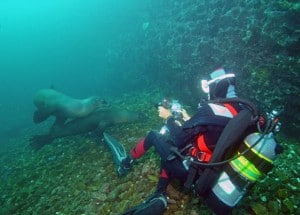
The Golden Shadow arrived at Puerto Villamil, on the southern end of Isabela Island, last night. It the third-largest settlement, and the largest island, in the archipelago. Today we explored shallow lagoons near the town’s docks, in particular one called Concha y Perla (Conch and Pearl), popular with tourists for its fish, curious sea lions and—good guess—its’ corals.
Brian Beck checks for surfacing divers
Today, like most days, Derek Manzello of NOAA hauled a pneumatic drill and an extra tank to power it on his dive, and he brings back bottles full of seawater back to the Golden Shadow. The drill is for taking cores to measure how fast corals are growing, like a tree core tells a tree’s growth rate. The seawater is for measuring carbon dioxide (CO2) levels. This greenhouse gas that we all exhale can also affect the health of coral reefs, and Derek is looking at how the Galapagos can help us predict the fate of corals around the world.
Read the rest of Corals and Carbon Dioxide »
Tags: calcium carbonate, carbon dioxide, CO2, coral, coral reefs, derek manzillo, Galapagos, Global Reef Expedition, Golden Shadow, isabela island, Khaled bin Sultan Living Oceans Foundation, puerto villamil, resilience
Posted in Galapagos, Pacific Ocean | 1 Comment »
Tuesday, June 12th, 2012
June 12, 2012
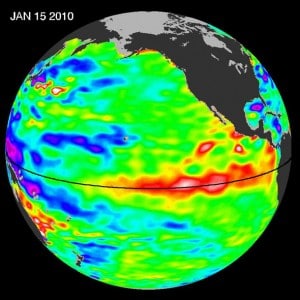
You can’t talk about coral in the Galapagos without talking about the atmospheric phenomenon called El Niño Southern Oscillation (ENSO). Normally, west-blowing trade winds push warm waters into the western Pacific Ocean. Every four or five years on average, though, the trade winds die down, or even reverse, and these warm waters move east as far as the west coast of South America, raising water temperatures as much as 7 to 10 degrees C.
NASA image of 2010 El Nino shows warm water (red areas) approaching South America
ENSO can last anywhere from nine months to two years—usually about a year and a half—but while it does, it affects weather around the world, and especially around the Galapagos. The phenomenon was called El Niño (“The Child” in Spanish) because it usually starts around Christmas. It’s considered to be linked to global warming, since it has been happening more often and with more drastic results as global temperatures have risen, but the root causes are still unclear.
Read the rest of El Niño in the Galapagos »
Tags: climate, climate change, coral, El Nino, Galapagos, Global Reef Expedition, Khaled bin Sultan Living Oceans Foundation, marine iguanas, Panama sergeant major, Weather
Posted in Galapagos, Pacific Ocean | No Comments »
Tuesday, June 12th, 2012
June 11, 2012
After just one dive at San Cristobal Island, the team decided the water was too rough, so the Golden Shadow moved on. We woke Monday to overcast skies at Floreana, the southernmost of the five inhabited islands. Monday brought three dives at the Corona del Diablo, the “Devil’s Crown,” a ring of jagged rocks on the island’s south side formed by a partially submerged basalt volcanic cone. Strong currents sweep around and through the formation, which is only a few meters deep inside and full of life.
Pocillopora coral
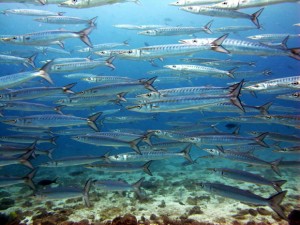
The coral seemed to be recovering here, including large stands of Pavona and Porites, one of which was four meters by two meters. Outside of the crown we found some Pocillopora, a few Cycloseris colonies, which are very rare, and extensive beds of both Psammocora and Diaseris, each stretching for over a hundred meters. This was the first time we had found Diaseris alive, in abundance. Sea turtles, rays, a school of barracuda and multiple parrotfish over two feet long all made appearances.
Read the rest of Corals in the Devil’s Crown »
Tags: barracuda, Charles Darwin, coral reefs, cycloseris, devils crown, Diaseris, floreana island, Galapagos, giant tortoise, Global Reef Expedition, Golden Shadow, Khaled bin Sultan Living Oceans Foundation, Pavona, pocillopora, Porites, Psammocora, san cristobal island
Posted in Galapagos, Pacific Ocean | 1 Comment »
Monday, June 11th, 2012
June 10, 2012
This weekend marked the halfway point of the Galapagos expedition, both in time and in territory. After a week at Marchena, Darwin and Wolf, the latter two far to the north of the main group of islands, the ship will swing through a rough counterclockwise circle through the southern and western islands. We’ll stop at San Cristobal, Floreana and Isabela, and eventually circle back to Baltra over the coming week.
Saturday saw a few arrivals and departures, along with two dives in the Itibaca Canal between Baltra and Santa Cruz and an afternoon wall dive at Daphne Minor, a tiny islet north of Baltra, which was livened up by a few playful, curious sea lions. On Sunday morning, the Golden Shadow pulled up anchor and headed southwest for San Cristobal, the easternmost island in the Galapagos and home to the provincial capital, Puerto Baquerizo Moreno.

Two sea lions pose for a picture at Daphne Minor
Read the rest of Heading South »
Tags: baltra island, caulerpa, cycloseris, daphne minor, Darwin Island, devils crown, espanola island, floreana island, fungiidae, Galapagos, Gardineroseris planulata, Global Reef Expedition, isabela island, itibaca canal, Khaled bin Sultan Living Oceans Foundation, lepteroseris, porites lobata, research, san cristobal island, santa cruz island, survey, Wolf Island
Posted in Galapagos, Pacific Ocean | No Comments »
Friday, June 8th, 2012
June 7, 2012
The story of how these not-incredibly-attractive islands in the middle of the Pacific became world famous starts on December 27, 1831, when the H.M.S. Beagle sailed from Plymouth, England on a five-year round-the-world voyage. On board was an unpaid naturalist named Charles Darwin, age 22.
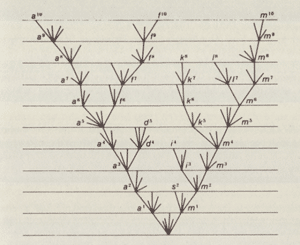
The Beagle followed the coastline of South America and reached the Galapagos in September 1835. Darwin spent 19 days ashore on the islands of San Cristóbal, Floreana, Santiago, and Isabela, collecting samples, observing animals and taking notes. What he discovered provided crucial clues to what some have called “the single best idea anyone has ever had.”

Depiction of the H.M.S. Beagle by Conrad Martens
Darwin had left England a firm believer in the Biblical story of creation, but already he had seen things that challenged the idea: dinosaur bones in Argentina, fossilized seashells high in the Andes. In the Galapagos, he pondered tortoise shells and finch beaks that were similar, but noticeably different from island to island. Could these somehow have come from a single common ancestor, molded by their different environments?
Read the rest of Darwin’s Theory of Evolution »
Tags: Charles Darwin, evolution, Galapagos, Global Reef Expedition, H.M.S. Beagle, Khaled bin Sultan Living Oceans Foundation, origin of species
Posted in Galapagos, Pacific Ocean | No Comments »
Thursday, June 7th, 2012
June 5, 2012
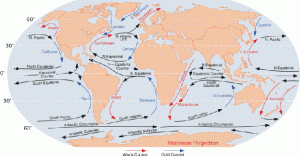
Why are the waters around the Galapagos Islands so rich with marine life? It’s because the islands are in a very special spot. Oceanographically speaking, they at the intersection of five major ocean currents. Along with the equatorial surface weather, these currents help dictate the islands’ climate and their unique ecology, both above and below the water.

Ocean currents
Ever since man has been coming to the Galapagos, we’ve been struck by how mild the climate is for being right on the equator. Charles Darwin wrote how surprisingly un-tropical the weather was, stating, “[It] is far from being excessively hot…excepting during one short season, very little rain falls, and even then it is irregular.” Being a genius, he also pinpointed the main reason, “[T]his seems chiefly caused by the singularly low temperature of the surrounding water, brought here by the great southern Polar current.”
Read the rest of Galapagos Currents »
Tags: Cromwell Current, currents, Galapagos, Global Reef Expedition, Humboldt Current, Khaled bin Sultan Living Oceans Foundation, North Equatorial Countercurrent, Panama Current, photosynthesis, phytoplankton, South Equatorial Current, upwelling
Posted in Galapagos, Pacific Ocean | 3 Comments »